There's little upside if LSU and Lane Kiffin are playing games with Sam Leavitt's inclusion on the pre-Ole Miss injury report
LSU's starting QB was listed as "doubtful" on the Tigers' Wednesday injury report.
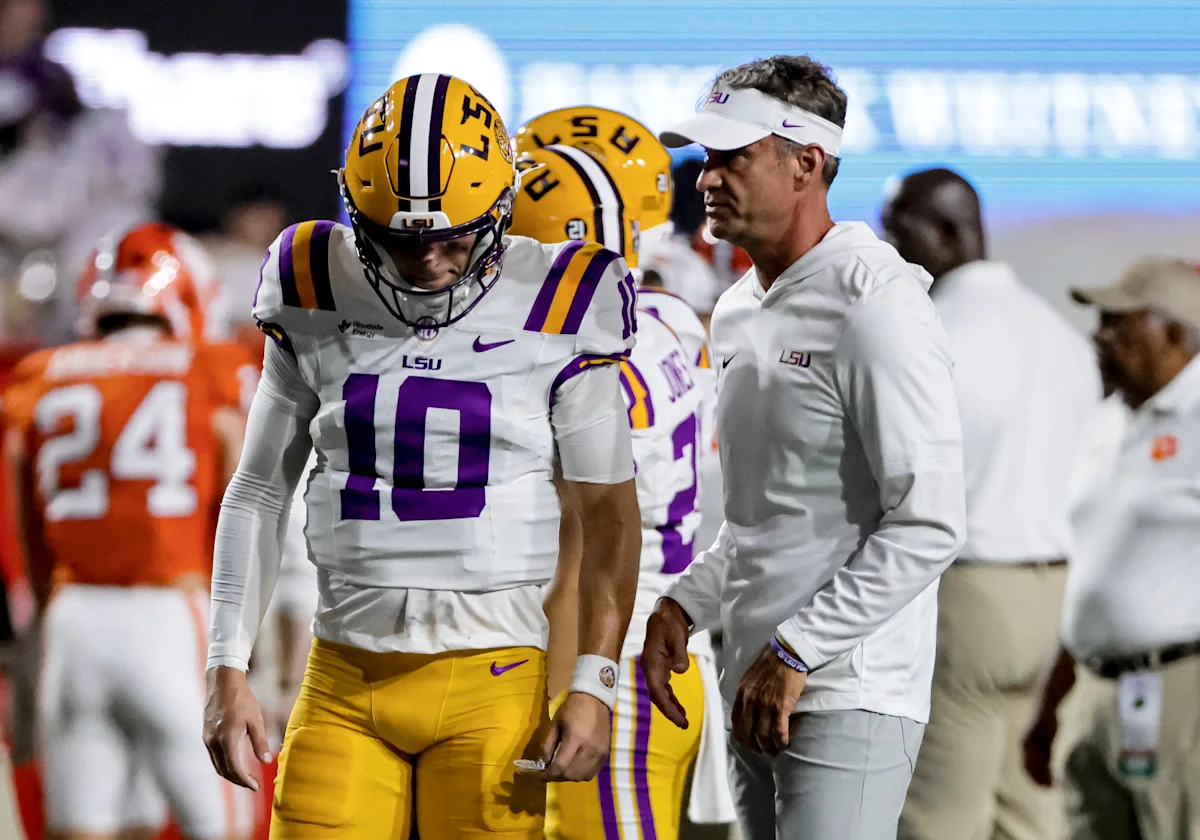
In most instances, there's little reason to doubt a player's inclusion on the injury report. Last week, or even next month, LSU QB Sam Leavitt 's appearance on a pregame injury report would not be met with widespread skepticism.
Alas, this is Ole Miss week. And LSU's coach is Lane Kiffin. You can forgive people for wondering just what the heck is going on.
Leavitt appeared on LSU's first injury report of the week Wednesday night as "doubtful" with a shoulder injury. There had been no indications that Leavitt was dealing with a right shoulder injury before the report's release, though multiple reports later in the evening said that Leavitt had been limited in practice.
Could the senior transfer be legitimately injured? Absolutely. You don't need us to tell you that football is a violent game and players can play through injuries that are discovered to be more serious than initially thought after the adrenaline wears off.
But if you're suspicious of that injury report, you're not alone. ESPN reported Thursday that Ole Miss' coaching staff had their doubts about Leavitt's doubtful status and fully expected him to play on Saturday.
Given Kiffin's status as college football's main antagonist and the way that he left Ole Miss at the end of last season, it's certainly plausible that he's attempting some gamesmanship with this injury report. Few people who don't regularly wear gold and purple will, pardon the pun, give him the benefit of the doubt.
But if he is, the upside is limited. And the downside is very real.
The SEC has clear rules surrounding the injury reports it mandated for all conference games beginning in 2024. If an athlete is listed as doubtful like Leavitt is, he's considered to have just a 25% chance of playing in the upcoming game.
That, of course, leaves the door plenty ajar for him to take the field on Saturday, and we all know that injury statuses can change in the days leading up to the game. But the SEC's rules also contain a subsection called the "Duty to Act in Good Faith."
"Institutional personnel have a duty to act in good faith to comply with this policy. Acts of gamesmanship intended to hide a student-athlete's true participation status for competitive or strategic reasons are prohibited. Any other conduct that reasonably could be construed as misleading or creating unnecessary confusion regarding a student-athlete's participation status is likewise prohibited. An institution must take extra precautions to act in good faith to accurately disclose the status of a high-profile student-athlete (e.g., starting quarterback, leading scorer on the basketball team, or best hitter on the baseball team)."
The league also makes it clear that it can investigate any potential breaches of the injury report protocols by interviewing people and reviewing practice film and that "institutional personnel must cooperate with this process." Additionally, "failure to provide accurate and timely information on the Availability Report will subject the offending institution, and, if appropriate, the offending head coach, to accountability measures, including, but not limited to, private or public reprimands, fines, and other measures as appropriate."
Yes, tensions have cooled between the SEC and LSU over Kiffin's attempt to recruit players who had been on NFL rosters to LSU. After naming Kiffin in its suit against the school, a hearing regarding the suit was continued and the conference's members decided to not discuss kicking LSU out of the league.
The relationship between the conference and school isn't going to be healed overnight, though. Risking the wrath of a recently ticked-off commissioner Greg Sankey isn't worth it in the slightest. An investigation into LSU's injury reporting habits doesn't benefit Kiffin or the league in the slightest, even if the Tigers would end up exonerated.
Topics in this story
Gathered from external sources. Rights to this text belong to whoever originally published it.