Misery Index: Michigan's chaotic and messy season ends in a historic disaster
The last Misery Index of the season ends up right where it started in Week 1. Hail to the Miserables.
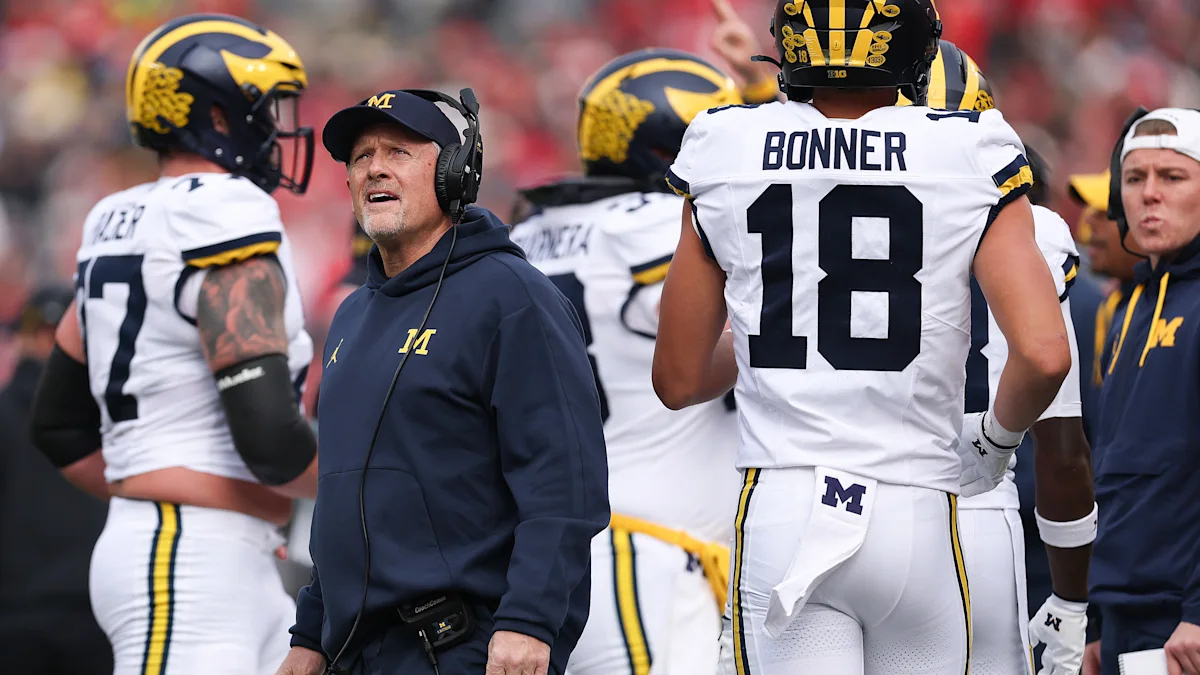
There is enough pain in the college football world that we generally like to spread the disgust and schadenfreude around here at the Misery Index. So many teams across the course of a season underachieve, fall apart and frustrate their fans that there's a never-ending vein of content to mine.
But one program in particular has been consistently in our thoughts from the beginning of the regular season to the end. In fact, things were so bad at Michigan that even in Week 1, we had to highlight the Wolverines even though they won their game, beating Western Michigan after a clock controversy gave them one more second and a chance to win the game on an unlikely Hail Mary .
After something like that happens, you never know which direction these things are going to go. Was it a moment of divine intervention that would put Michigan on the path to a magical season, or was it an omen for the impending doom that would await coach Kyle Whittingham and all Michigan fans throughout the fall?
Slowly and excruciatingly, we got our answer.
Not only is Michigan football the Misery Index champion of 2026, it might represent one of the great achievements in misery that we've ever seen.
Because not only was Michigan a football team that its fans ended up hating, it's a team that managed to win six games but lost to both of its main rivals. It's a team that, with a little luck, could have beaten the likes of Iowa and Indiana in addition to the top-10 win it got over UCLA but never felt like a team capable of being good.
And maybe most of all, in terms of the pain quotient, the dysfunction around the program was so immense that there remains no clear path out.
That remains true in the immediate aftermath of a 45-0 loss to Ohio State , of which the everlasting image will be a catering warmer full of chicken sandwiches for the postgame trip home that caught on fire outside their locker room.
Remember, this game took place the end of a week in which Michigan's incoming, president C. Cybele Raver, pulled the plug on the impending hire of Texas A&M athletic director Trev Alberts , whose own hiring process was rushed through the week before so that Michigan would have someone in place to fire Whittingham and hire his replacement.
Instead, because of concerns that arose from an Alberts' deposition in a lawsuit related to his previous job at Nebraska, Raver decided that Michigan would invalidate the memorandum of understanding the parties had signed. That document will soon be subject to litigation over the $17 million Alberts believes he is owed, which is embarrassing on its own. But of more concern to Michigan fans is whether Whittingham will be replaced, and who will make that call.
Warde Manuel, the outgoing Michigan AD who is now staying on until his replacement is brought in, hired Whittingham and is said to remain a supporter. Maybe he'll be out-ranked. We'll find out soon.
But the bottom line to all of it is, who would Michigan fans actually trust at this point to make a sound decision about the future of their program? Not Manuel, not Raver and certainly not its overly political and meddlesome Board of Regents. The worst possible time to have a football disaster like this is when nobody's in charge.
There have been plenty of Michigan scandals and embarrassments over the last handful of years, but nothing will compare to the feeling of aimlessness surrounding that program and a hire of Whittingham that hasn't worked at all but might get a second year through inertia and bad timing.
Michigan will probably have a worse year than 6-6 in the lifetime of its current fan base. But until they have some clarity on how it gets back to the top, 2026 will be remembered as a year where all of a school's worst qualities — infighting, indecision, incompetence — ended up on the lap of the football program.
The last Misery Index of 2026 ends up right back where it started in Week 1. Hail to the Miserables.
ACC: When SMU reached the College Football Playoff in its first year as an ACC member, it not only set an expectation, it named a price for success. SMU is a private school, so we don't have full transparency into how much Rhett Lashlee gets paid to coach or how much money is being poured into the roster. But rest assured, it's a lot on both ends. Remember, SMU is most famous for engaging in some NIL in the 1980s long before it was legal. Its booster class is rich, garish and desperately wants their small, elite school to compete with the likes of other Texas schools with rich, garish boosters. With that bit of history as a backdrop, it's been awhile since SMU had a season where it started with high hopes and ended in frustration. But going 7-5 with this team an experienced quarterback in Kevin Jennings should count as a massive disappointment. Remember, SMU was picked second behind Miami in the ACC's preseason poll and No. 19 in the AP poll but will end up finishing tied for fifth with a 5-4 record in a pretty weak league. Adding insult to injury, SMU finished up with a 35-34 loss at Stanford in a game the Ponies led by 12 points early in the fourth quarter. But on the way to their desultory end result, SMU got stuffed twice going for it on fourth-and-1 and just couldn't stop the Cardinal when it mattered. Lashlee has turned down other power conference jobs in the past because he's happy at SMU (and well-compensated, of course), but he will need a strong 2027 to maintain his reputation as one of the hottest young coaches in the country.
Big 12: The combination of joining the Big 12 and hiring coach Scott Satterfield has made Cincinnati one of the nation's most irrelevant programs. That might sound harsh, but when's the last time you thought Cincinnati football? When's the last time you remember the Bearcats even playing a game that really matters, much less wining one? That's the reality after four seasons of Satterfield, whose future seems genuinely shaky after a 42-10 loss at BYU. Satterfield's records at Cincinnati are a study in mediocrity — 3-9, 5-7, 7-6, and 6-6 this season with a bowl game pending. Just not good enough. Over the years, Cincinnati has endured a lot of changes between coaches coming and going and moving leagues several times from Conference USA to the Big East to the American to the Big 12. But it has been a remarkably resilient program. Though there have been a few stinker years thrown in there (most of them authored by Alabama Sen. and Governor-elect Tommy Tuberville), Cincinnati hasn't had a four-year stretch without a nine-win season since 2003-06. Obviously, it's much harder to do in the Big 12. But if you're a Cincinnati fan or administrator you've seen Houston make the transition much more successfully, Arizona State win the league since you joined and even Arizona make a big move up the standings despite limited resources. Cincinnati has the juice to matter in the Big 12, but right now, it doesn't.
SEC: It was very simple for Alabama. Beat Auburn at home, finish 10-2 and kick up your feet as a likely first-round host in the CFP. But now? It's hard to see how Alabama gets in this field. Despite being a team that clearly has fans in the committee room based on its No. 6 ranking this week, the full Alabama résumé includes a close loss at home to Georgia, a solid win over Kentucky from early in the season and a good win over LSU. That's probably not enough quality wins in the end for a 9-3 team, and wow, how did we get here? Alabama's 30-23 loss to Auburn had head coach Kalen DeBoer shaking his head on the sideline after the Tigers ran out the clock with a couple long runs, including a scramble by quarterback Byrum Brown to convert a third-and-15 with 2:42 to go. If you can't stop that play with your season on the line, do you really deserve a shot at the playoff in the first place? This is one of those games that can have a lot of implications for a lot of folks. If Alabama doesn't get in, that would mean one playoff appearance in three years under DeBoer. No matter what you think of him as a coach — and Alabama's administration clearly thinks he's great after giving him a huge extension last year — that's a big problem. Alabama has looked like a team capable of winning it all at times this year, but it has been inconsistent and underwhelming offensively when it mattered. Alabama committed three turnovers against Auburn, losing a game in which it had a 400-303 yardage advantage. Alabama fans have actually been more patient and forgiving with DeBoer than the general public might expect, given the ridiculous standard set by Nick Saban. But that might end if a home loss to Auburn costs this team a playoff bid.
Group of Six: Memphis' last trip to the American Conference championship game was in 2019, and since then the Tigers' advantages within the league have only grown with NIL and conference realignment. The expectation at Memphis should be playing for a conference title on a fairly regular basis and winning it from time to time. But the Tigers, remarkably, have now gone seven straight years without making that game, and their fans' frustration with that streak should be at an all-time high after the back-to-back losses they just experienced. With 11 minutes to go last week at Navy, Memphis had a 10-point lead and the ball before completely collapsing in the fourth quarter and losing 38-34. Then they one-upped themselves at home against previously 2-9 Temple, leading the game 31-14 in the fourth quarter before they threw a pick-6, went three-and-out and then coughed up another interception. Before you new it, the Tigers had lost 35-31. The statistical improbability of losing two games from that position is hard to imagine, but the pain is real. That's how you turn 10-2 into 8-4 and blow a chance to play for the conference title. It seems like everything went downhill after Charles Huff, the Tigers' first-year coach, suggested it wasn't a big deal in recruiting if his name came up for power conference jobs because those players would be going with him. Huff lost the plot and will be dealing with a fractious fan base if he comes back for Year 2.
Jeff Lebby: After three seasons at Mississippi State, Lebby is 12-25 overall and 3-22 in the SEC. The only thing propping up his record is that quarterback Kamario Taylor grew up with such strong ties to the Bulldogs he'd likely be playing for them no matter who the coach was. On one hand, you can say that Mississippi State probably would have been a good team this year if Taylor hadn't gotten hurt the first week of October. They were 4-1, after all, and the talk of college football for a hot minute. At the same time, losing Taylor exposed how weak the program around him has been because Mississippi State lost the rest of its games (except for Tennessee Tech) to finish 5-7. Taylor is coming back next year on a deal reportedly worth a breathtaking $7.5 million. But if you're going to invest that much in one player, you have better have a coach who can get the most of him. If they don't have a big year in 2027, you'll have to point the finger at the Mississippi State administration for pairing a generational talent at quarterback with a bust as his coach.
Matt Rhule: Nebraska's 31-7 loss to Iowa was the kind of result that shows an entire program how far it must go to compete at the level to which it aspires. For many years now, practically since Nebraska joined the Big Ten, that's been the Huskers' measuring stick. If Iowa can be good every year in this league, why can't Nebraska? After all, not only are they neighboring states, they're very similar programs. If anything, Nebraska probably has an edge in resources, facilities and history. It does not have an edge in coaching. After four seasons in Lincoln, Rhule is 26-24 overall and eight games below .500 in the Big Ten. He isn't getting fired, largely because of a massive buyout, but 2027 is going to be his Waterloo (and we're not talking Waterloo, Iowa) if this trend continues. Rhule has chewed through coordinators and quarterbacks during his tenure, but the one constant is a lack of toughness when it matters. And even though there were moments this year where things looked a little bit better, here came Iowa on Black Friday to smack the Huskers back into reality and show them that you've got to be physical and precise every day to win in this league.
Kenny Dillingham: Around this time a year ago, a lot of people were wondering whether the 36-year old Dillingham would leave Arizona State for Michigan, where he was rumored to be a candidate. Ultimately, Dillingham signed a new deal with the Sun Devils because he he's from there, his family all lives in the same neighborhood and he's willing to put in the work to make Arizona State the kind of program he thinks it should be. At the same time, Sun Devil fans have been left to wonder whether the 2024 Big 12 title that minted Dillingham as a new star in coaching was a bit of an outlier. Since then, Arizona State is 14-11 overall and 10-8 in Big 12 games, which is more indicative of the kind of program it has always been. In getting blown out by Arizona, 42-21, it was the third time in four seasons Dillingham has lost to his in-state rival. Though nobody is going to put him on the hot seat yet, these are the kinds of things that add up over the course of a tenure. If Arizona State can't regularly beat Arizona in football, Dillingham may end up wishing that he had capitalized on the 2024 afterglow when he had an opportunity.
Eli Drinkwitz: When you get a 20-0 lead over an offensively challenged team like Oklahoma, you're supposed to win — period. That was the situation Missouri had created at home against Oklahoma, but much like the Tigers' entire season, it fizzled quickly. After giving up three straight touchdown drives, one aided by a short field after an interception, Missouri lost that entire lead in the space of about 10 minutes spanning the second and third quarters. Drinkwitz, at this point, appears to have a finishing problem. Last year, Missouri started 5-0 but ended up 8-5. This year, the Tigers got up to No. 13 after a 5-1 start but faded to 7-5. Though the program isn't a disaster by any means, you can't blame Missouri fans for being unimpressed with Drinkwitz's late-season work lately after hitting the double-digit win mark in 2023 and 2024. It's never going to be easy to sustain at Missouri, but this might be a case of a program that kind of beat a lot of its competitors to the punch on NIL early on and is now struggling after everyone in the SEC caught up.
James Franklin: After a full year of hype about how this man was poised to transform Virginia Tech back into a big winner, and quickly, only one team in the league (Georgia Tech) finished with fewer ACC wins than the Hokies' three. That became official after Virginia Tech's 37-13 loss at home to Virginia, which represents a truly embarrassing finish to the year that saw them drop three in a row at the end. No doubt Franklin will use this setback to argue that Virginia Tech's fans need to step up even more financially than they already did when they hired him if they want to do better than 6-6. But you also get the sense in this new era that Franklin's coaching archetype — expensive, high-maintenance and not really representing any discernible advantage on the sideline — is quickly going out of style in college football. The name of the game is efficiency these days, but Franklin has been hard wired to be inefficient, demanding more bells and whistles from every administration he's ever worked with. Virginia Tech will get tired of that quickly if he delivers another year of similar results.
Beamer me up, Dabo: No matter how the Clemson-South Carolina game unfolded, the losing coach was going face an offseason of heartburn. That dishonor goes to Shane Beamer, whose Gamecocks led 17-7 late in the third quarter and then went punt, punt, punt on its three possessions in the fourth. That opened the door for Clemson's Trent Pearman to engineer a 12-play touchdown drive and throw the game-winner to Bryant Wesco, Jr. with just two seconds left. Clemson's 21-17 victory means South Carolina ends the year on a three-game losing streak to finish up 6-6, and a fan base that will demand a coaching change. Whether athletic director Jeremiah Donati obliges that desire is still a bit of a guess. South Carolina would prefer not to spend the money getting rid of a coach who went 9-4 just two years ago and nearly got the Gamecocks into the CFP. But losing in that fashion, against a Clemson team that was forced to play its third-string quarterback, is not a great look.
A Duck hooked: Oregon's only path to the CFP was winning the Big Ten title outright, and when the Ducks scored a touchdown to tie Washington with 1:09 remaining, all they needed was an extra point to potentially stamp their ticket to the conference championship game in Indianapolis. Instead, kicker Gage Hurych picked the worst possible time to miss the first extra point of his career in 58 tries, doinking it off the left upright after the holder failed to get the laces turned out for a clean kick. Still, despite the lack of clean execution on the snap and hold, it's hard to imagine that kick being missed in such an important moment. Washington's 33-27 road upset in the second overtime means 8-4 Oregon will go down as one of the nation's most disappointing teams and put UCLA into the Big Ten title game opposite Indiana.
Louisiana Tech was lousy: The Sun Belt had one of those odd situations this week where everybody knew there was a possibility of Louisiana Tech and Georgia Southern playing two weeks in a row. What few could have predicted was Georgia Southern absolutely dominating, 41-3, meaning Louisiana Tech will have to figure out how to turn that around in six days if it wants to win a conference championship on Friday night. Even more painful for Louisiana Tech is that, had it won the game, it would have hosted the conference championship in Ruston. Instead, it will have to go right back to Statesboro.
Bruins bruised: It seemed like a medical miracle to see quarterback Ty Dieffenbach, who left UCLA's loss to Michigan last week on a stretcher, run out onto the field at the Rose Bowl to start for the Bruins against USC. Give Dieffenbach all the credit in the world for trying to gut it out despite a leg/hip injury, but it was an experiment doomed to failure in a 45-10 loss because he simply couldn't move around out there. Though UCLA will get another shot to save its playoff hopes in the Big Ten championship game, this looks like a team that overachieved under first-year coach Bob Chesney and is now crashing back to earth at the worst time. UCLA has managed to win a lot of games with toughness and turnover margin, but losing to a very mediocre Michigan team and getting Dieffenbach banged up in the process is probably going to cost them a playoff spot and be a longstanding regret.
Topics in this story
Gathered from external sources. Rights to this text belong to whoever originally published it.