Michigan's second-chance Hail Mary win over Western Michigan shows why football needs to overhaul the way it measures time on its game clocks
Football game clocks don't show tenths of a second. As every aspect of the game is dissected by instant replay, clocks need to be more exact too.
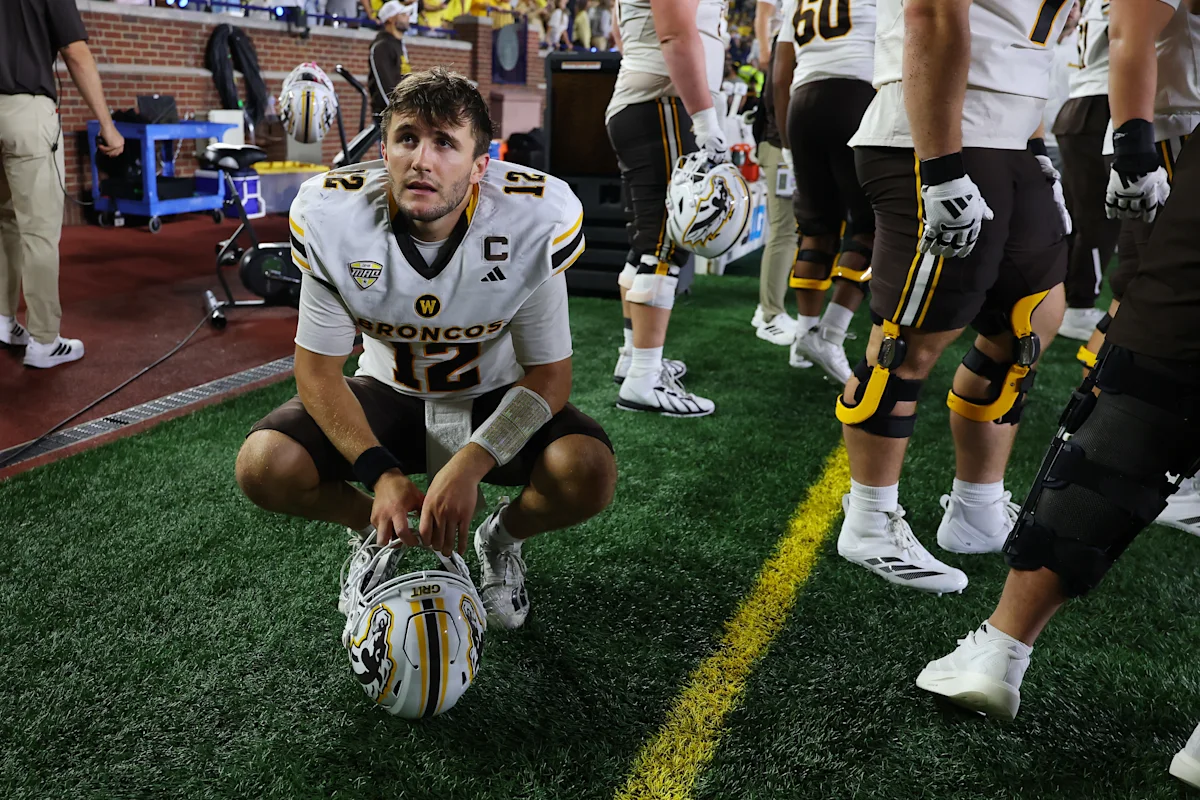
Michigan's win over Western Michigan and the Big Ten's ensuing explanation are further proof that it's long past time for the NFL and college football to use game clocks that show fractions of a second.
The No. 16 Wolverines beat the Broncos 13-12 on Saturday night on Bryce Underwood's Hail Mary to JJ Buchanan as time expired. It was an incredible throw and catch; Underwood fired a rocket as he was getting hit, and Buchanan went up in traffic to make a fantastic contested grab. But it's also a play that isn't getting the appreciation it deserves because of how the end of the game unfolded.
Underwood's throw was his second Hail Mary attempt. His first sailed out of the back of the end zone and didn't touch WMU's Micah Davis until there was no time remaining on the clocks that NBC viewers saw at home. As WMU celebrated, it was clear to anyone watching the game from their house or local sports bar that one of the biggest upsets of the season had just happened.
Officials declared that there was one second remaining on the game clock when Davis, who jumped from out of bounds, touched the football. Hours after the play was over, the Big Ten issued a statement explaining the decision and showing a video of the game clock synced to an angle of the play where you can't conclusively see exactly when Davis touched the football. However, it is clear from that footage that the Big Ten's official clock was still showing 0:01 after the ball made contact with Davis.
But just how many tenths remained in that final second when the ball hit Davis' hands? Were there three tenths? Just a singular tenth? We don't know. And that's a big problem with accepting the Big Ten's explanation at face value. A clock that shows fractions of a second could go a long way to not only disproving conspiracy theories stemming from Saturday night, but also in all other late-game timing rulings going forward.
In this case, the confusion appears to stem from a discrepancy between the clock on NBC and the official game clock. And it's a discrepancy that would be far easier to decipher in tenths of a second.
On the play before Michigan's first Hail Mary attempt, Underwood spiked the ball on first down. The spike came as Michigan got to the line with the clock stopped and 11 seconds remaining. After the spike, the NBC game clock showed eight seconds to go.
Following the play, the referee clearly announces to the crowd and the clock operator that the clock should be reset to nine seconds. That reset is reflected on the NBC ticker, as their clock changes to 0:09.
However, when Underwood takes the snap for the first Hail Mary, the ticker clock is already at 0:08 seconds. Anyone who watches football knows that it doesn't take an entire second for a shotgun snap to get to a quarterback.
As NBC repeatedly showed the replays of the Hail Mary with the clock superimposed on the screen, rules analyst Terry McAuley's only explanation for the addition of the second was if the clocks on the TV network weren't exactly in sync. It was an explanation that made even more sense the day after — and one that could much more easily be deciphered if football clocks showed tenths of a second.
On the current game clock, 0:01 could mean anything from 1.0 seconds to 0.01 seconds. It's a remarkably rudimentary time-measurement process in a game that's dissected frame-by-frame in instant replay. Replay officials can reasonably determine if a player's toe touched a blade of turf that's painted white and out of bounds. But they can't say for certain if a half-second remains on the clock or just two- or three-tenths.
If fractions were shown on the game clock Saturday — and the Big Ten's statement included a video of the entire play synced to the official game clock — it'd be much easier to figure out just how off the clock on TV was for those tasked with explaining the clock differences and those who are trying to understand them.
Adding tenths of a second to game clocks is hardly a new idea, either. In 2023, the Philadelphia Eagles made an NFL competition committee proposal for the game clocks to show tenths of a second within the final 30 seconds of each half. When that idea didn't pass, Philadelphia proposed it again in 2024 and expanded the scope to the final 60 seconds. That idea didn't pass, either.
It's time for the Eagles' idea to be revived, both in the NFL's competition committee ahead of the 2027 season and on the NCAA's FBS rules committee, too. Saturday night's game needs to be the impetus for change. It won't be an easy one, as game clocks in stadiums across the country will have to be replaced and reconfigured. But that's a small price to pay for more clarity.
Topics in this story
Gathered from external sources. Rights to this text belong to whoever originally published it.