Why Florida is at the center of a fight that's holding up the Protect College Sports Act
A small number of schools, including Florida State and Miami, are objecting to the bill's language against conference expansion. Translation: they want the a...
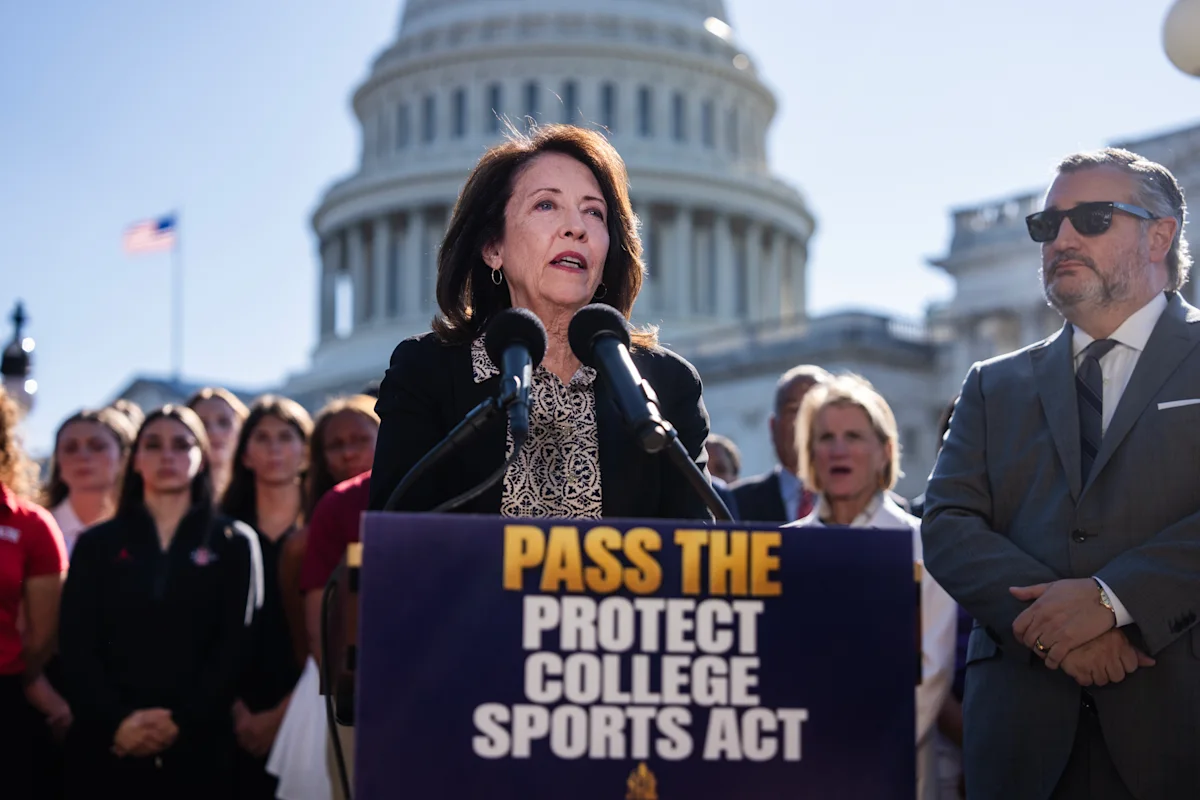
Conference realignment has found its way to Capitol Hill — and the White House too.
A provision in the Protect College Sports Act making it more difficult for programs to move leagues is rankling members and their respective universities, especially in the state of Florida.
What is: The issue has now caught the attention of the most prominent political figures at 1600 Pennsylvania Avenue, according to New York Yankees president Randy Levine, one of the influential developers of the legislation and who President Donald Trump has appointed to lead the executive branch's congressional efforts.
Levine, who has direct communication with commissioners, university presidents and board chairs in the SEC and Big Ten, is strongly encouraging the two Florida senators, Ashley Moody and Rick Scott, to support the legislation as their schools "have nowhere else to go," he said. On Thursday, the senators voted against the second of three procedural motions as two of their most prominent state universities (Florida State and Miami) have raised issues with the legislation. They were two of only three Republicans to vote 'no' in a vote that reached a whopping 77 supporters .
"I understand the Florida State and Miami concerns," Levine told Yahoo Sports on Friday. "I've tried hard to resolve them, but the fact is clear: The Big Ten and SEC have told me they have no plans to expand in the near future. In the foreseeable future, they do not see any addition of Florida State or Miami."
Commissioners Greg Sankey (SEC) and Tony Petitti (Big Ten) have publicly said that they are satisfied with their current membership. However, as conference television contracts come to an end — or, in the SEC's case, as a contractual look-in arrives — realignment is expected to re-emerge over the next four years.
The Big Ten's current television contract ends in 2030. The SEC has a 2030 look-in within its contract. On the heels of lawsuits from Florida State and Miami, the ACC established exit fees that drop below $100 million within the next two years, setting up a potential jockeying of programs lobbying for membership in the SEC and Big Ten — the two richest college conferences in America.
The bill's expansion provision makes it more difficult.
It caps the number of schools in a power conference at 19 and requires power league schools wanting to move to another power conference to operate as an independent for three years. Bill authors reduced the previous five-year probationary period to three ahead of Thursday's vote and added a termination clause (called a "sunset" concept) to the probationary period — it ends within six years of the bill's enactment.
The change did not satisfy many programs in the state of Florida that want to have the flexibility to move to the SEC or Big Ten, or even the ACC. South Florida officials have also expressed concerns with their lawmakers over the membership cap, which could impact their path to a power league. The Bulls, one of the more well-resourced Group of Six programs, are working to elevate themselves.
The conference cap significantly limits any movement from schools in the ACC and Big 12 to the SEC (currently 16 schools) and Big Ten (currently 18). The 19 figure is an odd number for conferences that usually have an even number of members for scheduling purposes. It provides the Big Ten with a single spot for the potential addition of the most valuable school outside of the Big Ten and SEC: Notre Dame. The Irish remain committed, for now, to continue as a football independent.
The membership cap is not affected by the newest revision. The sunset clause only applies to the concept's three-year probationary period.
Also, says one school administrator, the six-year sunset concept ending in 2032 (if the bill is enacted now) extends too long. Many school executives have identified 2029-2031 for movement.
Officials from at least five ACC schools — Clemson, North Carolina and Stanford, too — have expressed concerns to lawmakers over the provision. In fact, last week, university officials proposed a variety of revisions to the clause: eliminate it completely; terminate the probationary period after two or three years; or increase the power league membership cap to 20-24 teams.
The expansion provision could pose a problem in the House of Representatives, where states like Florida, California and North and South Carolina hold more than 100 delegates.
"The schools are already working their House members against it," said one congressional official.
The legislation, intended to regulate the college athletics industry by establishing guardrails, is on the brink of passage in the Senate: a final vote is expected likely mid to late next week. The bill limits player transfer movement, grants the NCAA enforcement powers to regulate athlete compensation and establishes a five-year eligibility standard, among over provisions.
Leaders from all three schools — FSU, Miami and USF — posted social media messages Friday in support of the bill while also lauding their senators over their decision to, for now, vote 'no.'
"If the few provisions in the bill regarding conference membership are adjusted to become satisfactory, universities in our state will continue to thrive in the future," USF athletic director Rob Higgins posted .
"[The senators] have stood up to heavy political pressure to do right by Florida universities," tweeted Rudy Fernandez , Miami's executive vice president for operations and senior advisor to the school's president.
"We are grateful to [the senators] for working to address the bill's provisions related to conference realignment," a statement from Florida State said .
In an interview Thursday after the vote, Sen. Eric Schmitt, one of the authors of the legislation, said he believes the provision provides more stability within a college sports landscape rocked by conference movement over the last several decades.
"All this stuff will settle down and that's kind of the point," he said.
Without the provision, lawmakers fear that the SEC and Big Ten might eventually "join forces to create a super league," Sen. Ted Cruz said.
In an interview with Yahoo Sports on Tuesday, another co-author, Sen. Maria Cantwell, expressed openness about relaxing the provision — to a point.
"People want to know that conferences are going to be strong and not undermined and that you're not going to have a ton of ways in which people are going to run off and create a super league or move around too much," she said. "But you do want to honor some flexibility."
Levine's comments signal frustration from the president, who in a social media post on Thursday celebrated the latest bill vote while critical of the nay votes from Scott and Moody. Trump has said that Levine speaks for him on this matter.
"I talk directly to the commissioners and the school presidents," Levine said. "There is nowhere for Florida State and Miami to go right now."
For a couple of years now, expansion conversations among executives in the SEC — off line and not at all formal — have centered around other schools than those in Florida, sources with knowledge tell Yahoo Sports. North Carolina and Virginia provide the league with a presence in two new states, high achieving academic brands and strong basketball programs.
Within the league, Florida and South Carolina stand as threats to any addition of other in-state programs such as FSU, Miami and Clemson. A similar situation unfolded years ago with Texas A&M. The Aggies privately objected to the SEC's pursuit of Texas.
Topics in this story
Gathered from external sources. Rights to this text belong to whoever originally published it.