Premier League: How top-flight officials adapt to pace of games
Pre-season camps in Spain and full-time training throughout the season - the rigorous regimes top-flight officials undergo to keep up with the pace of play in the Premier League
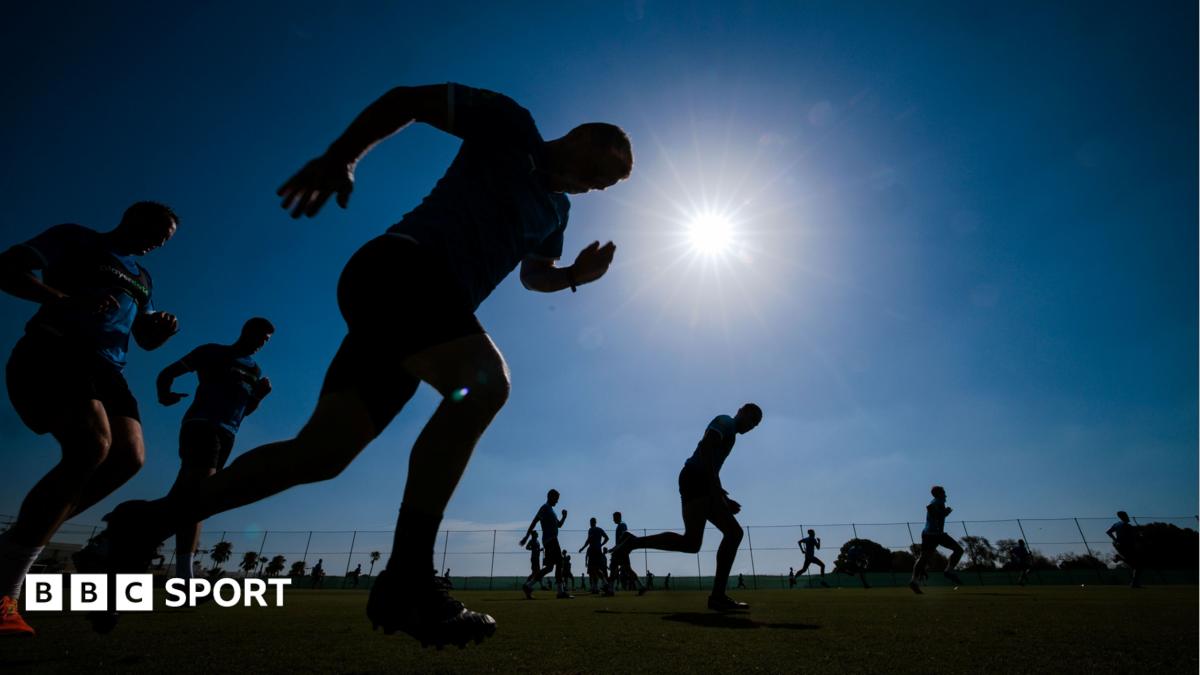
Referees know every decision will be scrutinised.
Fans, pundits and players will pore over their calls, creating never-ending debates.
Many of the Professional Referee Group, the top officials in the country, have met in Loughborough this week.
They meet every few weeks to work and train together, with the officials spread across the country.
Lunch is a choice of chicken, teriyaki beef or tofu with vegetables and salad, with protein bars and rice cakes alongside the fruit, granola and Greek yogurts.
It is a reminder of the environment. Since becoming professional in 2001 top flight officials have had to adapt.
"I never thought referees did as much as what we do now," says Sam Allison, who played for Chippenham Town and Frome Town during his playing career, which started at Swindon.
"We are training full-time, sometimes two, three sessions a day, making sure that we are ready on a Saturday afternoon.
"Some of it (not understanding referees' workload) is probably ignorance, lack of awareness, lack of communication being disseminated to people out there.
"I think of my ignorance of just thinking referees just turned up, refereed the game and then went home.
"We have all the preparation, all the training, all the sacrifices, all the commitment, all the desire, all the support networks, people investing in you to make sure that you are ready in the best position to deliver a game."
Allison, a former firefighter, is the fourth official for Manchester City 's trip to Crystal Palace on Friday while colleague Sam Barrott has been given Saturday's early match between Liverpool and Nottingham Forest .
Barrott took charge of Arsenal's Community Shield win over Manchester City this month and was in the Faroe Islands on 20 August to referee Ki Klaksvik's 0-0 draw with Riga in the Europa Conference League.
Different teams and different tactics means a different approach to each game, with officials prepping with Pro Ref's analysis team who provide key information to understand the way a team is going to play, to support the flow of the game.
It comes after a summer of work to ensure the officials can match - and better - the demands of the Premier League.
"At the moment we've got five substitutions and we see all the time fresh legs for teams can change the momentum in a game," said Barrott.
"If three new attacking players are on that are all very pacey after 70 minutes you know they're going to change the way they play, they're going to try and push.
"That normally means an increase in output for us and when that happens, there's not a point in us where we go, we can't handle this'.
"We've been trying to push the demands of where we are, everybody's trying to get better. Football has the 1% gains, every game or every training session we're very similar in the mindset, we want to be better."
Francis Bunce has been with Pro Ref - rebranded from the Professional Game Match Officials Limited - for 10 years and is now the physical performance manager.
He was with the group in Spain last month for their pre-season training camp, putting them through what is viewed as the infamous Maximal Aerobic Speed (MAS) test - an all out six-minute run.
"When you look at refereeing in the Premier League and Championship people very rarely talk about their physical qualities or physical capabilities," he tells BBC Sport.
"They've all done so well to keep developing and they look like athletes on the pitch - they are athletes.
"We're in a very different space with match officials, they are naturally some years older than the players and you can't get away from that because having a 21-year-old referee would be very difficult in the Premier League with everything you need to learn and experience.
"They should be definitely considered as athletes and if you then compare them to Joe Public who might want to shout some views from the sidelines, they wouldn't be able to keep up for a minute with what some of our guys can do."
With officials training remotely for part of the week, they need to be monitored with heart rate and GPS technology.
All the officials are on tailored plans and work in a group of around five once or twice a week at local hubs where strength and conditioning sessions are delivered.
Those at the World Cup - referees Michael Oliver and Anthony Taylor, along with assistants Gary Beswick, Adam Nunn, Stuart Burt and James Mainwaring - also had special training this summer, running and cycling in chambers of around 40 degrees to prepare them for the intense heat at the tournament.
Last season referees ran a total of 3.6m metres, with their overall sprint distance 12,136m.
At the weekend, Stuart Attwell covered the fourth highest distance of anyone on the pitch while taking charge of Newcastle 's 2-2 draw with Liverpool , awarding the Reds a stoppage time penalty.
He was also fifth for highest high-speed running, therefore beating all but four players.
"A lot of people could go and run around the pitch but they wouldn't be able to pick up those key positions to make those defining decisions," says Bunce.
"That's something that's really important we build into our training, in terms of how we improve speed, how we improve being able to physically exert that kind of acceleration or high-speed running into a game.
"Then make a decision and to do it in a cool, calm manner and potentially have to make a VAR announcement and sound completely like they haven't been running around for 90 minutes."
The work pays off with Barrott recalling an incident in a match between Brighton and Fulham which underlined why it is worth it.
It came in March 2025 when he awarded a late penalty after Harrison Reed fouled Joao Pedro and the striker scored the injury-time penalty to earn the Seagulls a 2-1 win.
"I'm stood at the edge of the box, everyone turns and you're pointing at the penalty spot. There wasn't anything in me that thought 'you've got that wrong'," says Barrott.
"It was complete confidence, all because I'm stood in the right spot and to do that. It involves a little bit of football knowledge, anticipating what could happen and what we would call a danger area.
"But then also knowing what you've done for weeks and weeks - and potentially years and years - has allowed you to move into that position without having to think.
"It's just subconscious, it just happens and you're not stood there thinking: 'I'm tired, do I need to make that run?'
"That never comes into the thought process anymore, and the fatigue aspect of it never crosses your mind because we are where we need to be."
Topics in this story
Gathered from external sources. Rights to this text belong to whoever originally published it.