College football's obsession with young coaches might be causing it to overlook some of the sport's best minds
Given the way college football has changed, age shouldn't be viewed as a barrier to doing the job well. This season proves it. At some point, maybe the coach...
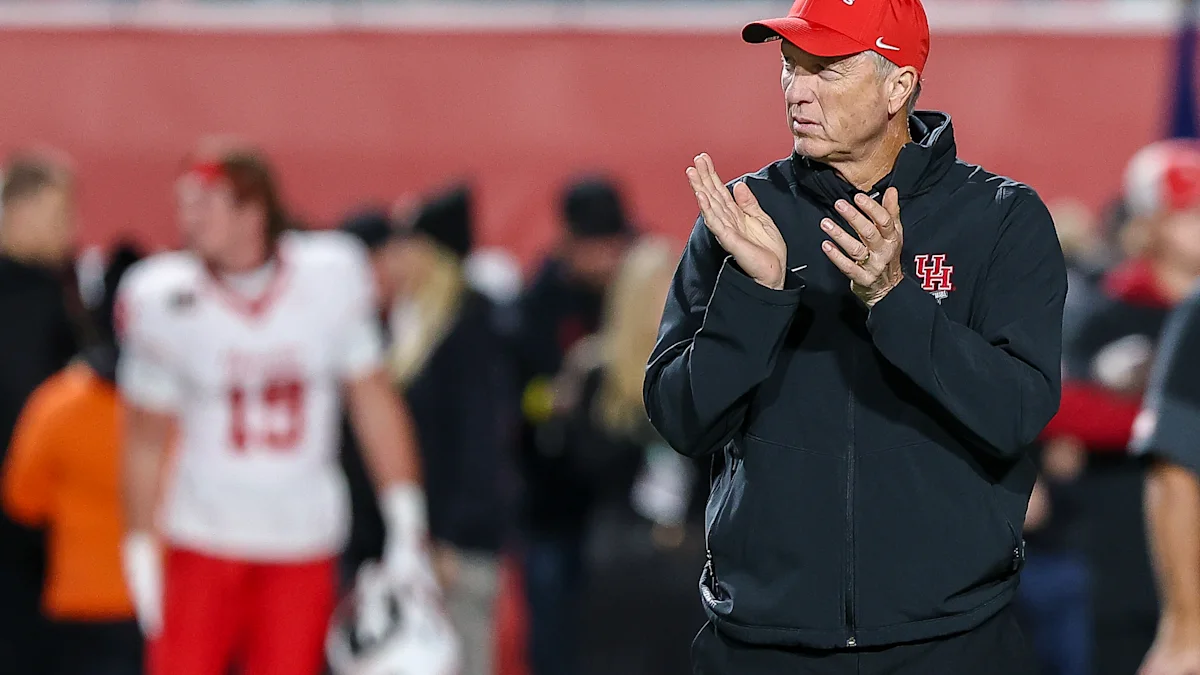
Before returning earlier this season to Georgia Southern, where he coached for two years and won a Sun Belt title, Houston coach Willie Fritz made an eyebrow-raising comment.
"It's a work trip," Fritz told reporters before the game, which Houston won 42-28. "In 10-15 years, I'll retire and go back and watch a homecoming game. This is a business trip."
Wait a second . Fritz was born seven months before John F. Kennedy was elected president, which makes him 66 years old. Another 10-15 years in coaching, potentially taking him into his 80s, is hard to fathom.
But it's a quip worth thinking about as the coaching carousel gets underway in earnest following Mike Norvell's firing at Florida State , which put one of the sport's big brand names on the board.
If we're ranking the most inspired college football hires of the playoff era, there's no doubt that Indiana identifying the potential of Curt Cignetti is No. 1 by a mile. When you go to Indiana and instantly transform a no-hope program into a national title contender, you have accomplished something nobody else in the business can touch. But you could argue Fritz belongs right behind Cignetti on that list not just once but twice for rescuing Tulane from years of ineptitude and leading them by 2022 to a Cotton Bowl win over Southern Cal and a top-10 finish.
Cignetti and Fritz have something in common: They're both eligible for Medicare (Fritz is 14 months older), and it doesn't seem like they're heading off into the sunset anytime soon.
This isn't to suggest either one of these men will be part of the carousel; certainly not Cignetti, who recently signed a $13 million-per-year contract that runs until he's 72 years old. But it should make you think a little deeper about how age is viewed within the coaching profession in 2026. Is the industry's obsession with youth causing programs to miss out on a genius hiding in plain sight?
"If you hire a 65-year-old, that's the first question at the press conference: How long are you going to coach?" one power conference athletic director told Yahoo Sports. "Is it fair? No, but your fans want to believe you just got the guy who's going to be there a long time, so what do you say? 'We think he's a great coach, and he's got five or six good years left'? That's not going to play well."
When Nick Saban retired despite being a healthy and young-looking 72, it was interpreted — perhaps correctly — as something of a rebellion against the changes in college sports. Other coaches in or adjacent to the Saban generation made similar calculations because they didn't like that a major component of their job changed from recruiting to money allocation. Others, such as Michigan State basketball coach Tom Izzo, soldiered on through gritted teeth.
That certainly plays into why older coaches aren't getting hired very often. The conventional wisdom across the industry is that the amount of energy and mindset adjustment required to deal with all the transfer portal madness, players and agents constantly trying to negotiate new contracts and working with boosters to raise NIL money is young man's work.
We saw that in the coaching carousel last year, when the average age of hire for the 14 open power conference jobs was 45.6 years old. To put that in perspective, Lane Kiffin — yes, Lane Kiffin — was the fourth-oldest member of that group.
The one outlier — and the guy who raised the average age by more than a year — was Kyle Whittingham going to Michigan in what was clearly framed as a caretaker situation following the personal and professional implosion of Sherrone Moore. There's certainly a debate taking place in Michigan over whether that was the right move, but the issue seems to be related more to Whittingham's fit and his offensive coordinator than his age.
But in an era when athletic directors and school presidents are enamored with the idea of a young and energetic coach — before this year's struggles, Oregon's Dan Lanning (40) and Arizona State's Kenny Dillingham (36) were sort of the prototype of what everyone's looking for — maybe it's time for the pendulum to swing back the other way a bit.
Cignetti is once again doing a ridiculously good coaching job at Indiana. Houston was completely aimless as a Big 12 program until it hired Fritz, who is 6-2 and will be favored to win his remaining four games despite some NIL limitations. Kirk Ferentz is 71 and arguably as good as he has ever been with Iowa, which is still very much in playoff contention. Even 74-year-old Bill Belichick has gotten North Carolina to play a much better brand of football this year because he's just flat-out good at the coaching thing.
You can certainly win in college football by hitting on the right young guy. As the coaching carousel starts to heat up, the phrase "finding our own Will Stein" will undoubtedly be uttered in strategy meetings across the country, now that the 37-year-old has Kentucky up to No. 6 in the CFP committee rankings.
Most programs firing coaches, though, look more like Houston prior to Fritz: disorganized, struggling to compete on resources and badly in need of some no-frills, low-key competence, rather than a recruiting reputation and a social media marketing machine. Florida State, just to name one program that will be hiring a coach over the next month, could do a lot worse.
"It's a CEO position," one coaching industry executive said. "Most people aren't ready to be CEOs at 35."
In the early stages of the NIL era, the conventional wisdom was clear: This is now a young man's game. It probably still is. But the job is both more complicated than ever and more supported than ever, with personnel departments and general managers doing so much of the grueling work that used to fall on the head coach.
That will surely be the model FSU has in mind if it brings back 61-year-old Jimbo Fisher for one last run, nearly 20 years after he was named the program's head-coach-in-waiting under Bobby Bowden.
The world looked a lot different back then, and of course, that was an example of how time comes for everyone. Things got ugly as Bowden got into his 70s, to the point that he had to be forced into retirement. In many ways, the coaching youth movement of the past couple of decades has been a reaction to the likes of Bowden and Joe Paterno hanging on too long.
But given the way modern college football has changed, and the way fans have changed with it, age shouldn't be viewed as a barrier to doing the job well. This season proves it. At some point, maybe the coaching carousel will catch on, too.
Topics in this story
Gathered from external sources. Rights to this text belong to whoever originally published it.