B/R's 2026 College Football Playoff Bracket Projections and Predictions after Week 12
Conference championship games are looming, but the final weekend of the regular season will provide some clarity for the 2026 College Football Playoff.
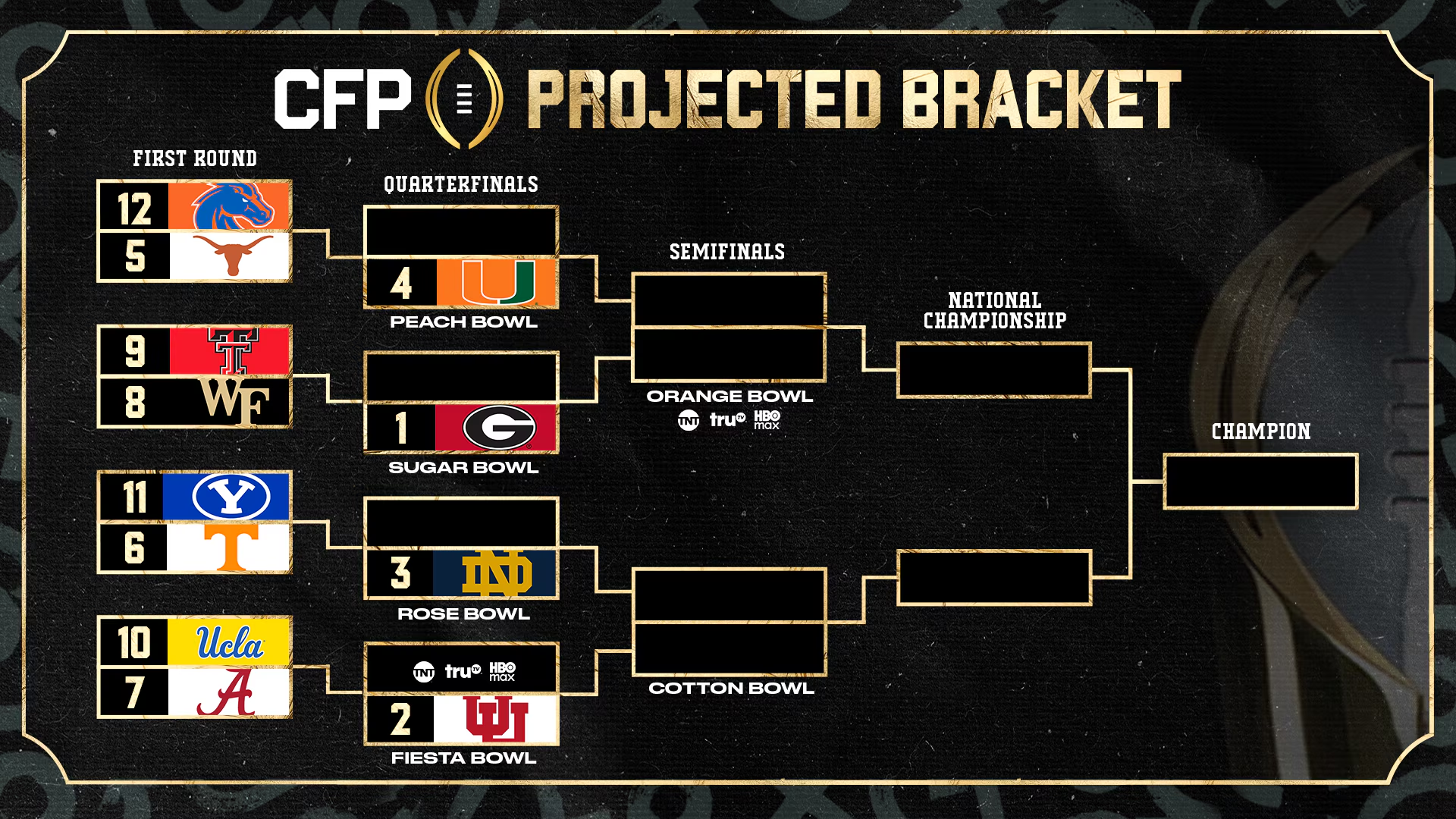
Conference championship games are looming, but the final weekend of the regular season will provide some clarity for the 2026 College Football Playoff.
If there are a few significant upsets, that clarity could be delayed. But if most of the nation's top-ranked teams navigate this rivalry-filled week, several of those programs will essentially lock in their CFP invitation.
First-round byes remain at stake, however.
Even if a team has a notable margin for error—Georgia or Utah, as examples—locking in the best possible seeding in the Playoff is essential.
The projected bracket is a reflection of B/R's Top 25 dropped into the organization of the official CFP format.
What a wild Saturday in the Big Ten. Nebraska ended a 31-game losing streak against Top 25 competition, also eliminating Ohio State from the conference and CFP races in the process. Upsets by Michigan and Washington cracked the Big Ten standings wide open—especially for Oregon. More on that later.
Because of these two results, the ACC Championship Game is locked in. Wake Forest continued its hot streak in Week 12, at one point building a 36-point lead at Georgia Tech. Miami recovered from an early 14-0 deficit and outlasted rival Virginia Tech. The main question between now and this showdown is whether Miami wideout Malachi Toney will be able to return from an ankle injury in time.
Georgia and Utah clinched berths in their respective conference championship games and probably secured spots in the CFP as well. At the very least, both are guaranteed a shot at an automatic bid.
1. Georgia 2. Utah 3. Notre Dame 4. Miami 5. Texas 6. Tennessee 7. Alabama 8. Wake Forest 9. Texas Tech 10. UCLA 11. BYU 12. Iowa 13. Indiana 14. Oregon 15. USC 16. Arizona 17. Houston 18. Louisville 19. Liberty 20. Florida 21. Boise State 22. Oklahoma 23. New Mexico 24. Auburn 25. Air Force
Seeding is a reflection of how B/R's Top 25 would shape the bracket.
Power 4 Champions and Top Group of 6 Team
I already wrote the obituary. You probably did, too.
Several weeks ago, Oregon dropped its third game of the season. That, historically, has been a cutoff to make the College Football Playoff—and the Ducks already were without quarterback Dante Moore due to a concussion.
Additionally, they still had Ohio State left on the schedule. Surely the Buckeyes wouldn't fall to a Moore-less Ducks team? Well, fast-forward a bit, and OSU lost its own quarterback to injury. Oregon ended up recording Top 25 wins against Northwestern and Ohio State in consecutive weeks, and Friday's rout of Michigan State pushed the Ducks to four victories in a row.
Crack open the coffin, my friends, because Oregon has arisen.
Yes, the Ducks absolutely must defeat Washington next weekend. There's only one unlikely path to the Big Ten Championship Game if UO loses.
As long as Oregon wins, though—and either UCLA or Indiana wins—it'll secure an improbable trip to Indianapolis with an automatic CFP berth at stake.
On Thanksgiving and Black Friday, the Lone Star State will host a critical showdown each day. Texas Tech needs a win to clinch a berth in the Big 12 Championship Game, while Texas needs a win and help from other results and tiebreakers to reach the SEC Championship Game.
The short version: UCLA can clinch a berth in the Big Ten Championship Game by beating rival USC. The remaining berth would come down to tiebreakers, depending on which of Iowa, Indiana and Oregon—all with two conference losses—win in Week 13. A UCLA loss would open up a much wider range of scenarios.
The Iron Bowl rounds out the weekend, with Alabama looking to remove any doubt about its playoff prospects. The Crimson Tide could still make the CFP with a loss, but a win would spare them some selection-day suspense and keep them in contention for an SEC Championship Game berth.
Topics in this story
Gathered from external sources. Rights to this text belong to whoever originally published it.