Why Spurs are struggling to score goals and what next?
Roberto De Zerbi's Tottenham are yet to score a Premier League goal this season, how do they fix that?
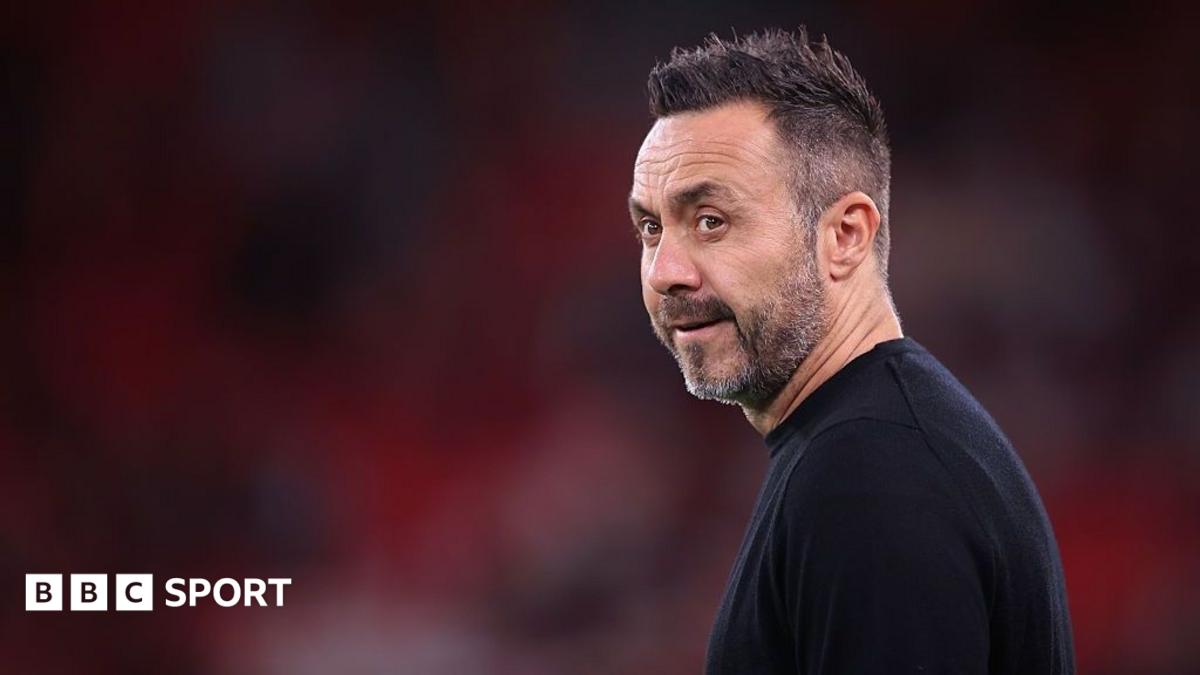
Four games into the season, Tottenham Hotspur and Coventry City are the only sides yet to score in the Premier League.
Spurs have brought in £320m worth of talent – a bulk of that in attacking reinforcements – so why are they struggling to score?
We analysed the tactics Roberto de Zerbi is trying to implement and what potential fixes may look like.
While the Premier League looks different to when De Zerbi left Brighton in 2024, the Italian has shown clear signs of adapting while retaining his tactical principles.
De Zerbi's sides entice opponents to apply pressure – often through slowing down play and passing the ball backwards.
They then react to the opponents' movements by speeding up play, looking to take advantage of the spaces behind the pressing players through direct passing or powerful carrying.
In a 2020 coaching seminar, De Zerbi explained: "The stronger the pressure of the opponent, the more vertical [our] action becomes. [The fewer opponents behind], the easier it becomes to go and score."
We have seen De Zerbi's forwards in bigger spaces facing fewer defenders on numerous occasions this season already.
Turning build-up play to goals, however, requires many parts to come together.
Spurs' shape in possession can be hard to read but it often looks like a 2-3-2-3.
The holding midfielder, usually Rodrigo Bentancur, anchors the midfield in front of Spurs' two central defenders with this trio remaining fairly fixed.
The 2-3-2-3 shape generally stays the same but there is rotation between the wingers, full-backs and central midfielders.
In rotating, players are encouraged to maintain the side's shape by swapping zones with their team-mates – filling gaps as they arise.
On top of these positional rules, De Zerbi gives his sides principles to implement.
A lot of what he is doing worked well during his time at Marseille - from 2024 to 2026 - where they averaged 2.3 goals per game.
It might not be happening for De Zerbi yet this season at Tottenham . But they might not be that far off.
Glimpses of Spurs' central play but work required
De Zerbi encourages his players to play centrally.
When Spurs' centre-backs are on the ball, opposing midfielders and forwards begin to push up, creating space for Spurs' attacking midfielders between the lines.
The other effect this central play has is that it can draw the defending team in-field, which opens up space in the wide areas for Spurs' direct wingers to attack.
When playing these passes into the middle, a few things have to align.
Players receiving the pass have to be comfortable doing so under pressure and naturally, some are more suited to these constraints.
Recognising that Sandro Tonali is better in big space facing forwards, we have seen him rotate positions with Archie Gray, who starts at right-back - a sensible tweak.
Although not his natural position, the 20-year-old has managed in these tight spaces and appears to understand the tactical demands of his manager.
The return of James Maddison, who came back from a shoulder injury for last Tuesday's Carabao Cup tie at Liverpool , will provide De Zerbi with a player better suited to these spaces and in turn help get Spurs into attacking zones more often.
Individual player quality aside, much of the success of this approach will come down to players internalising their manager's instructions.
And it will take time for some of the squad to unlearn the habits they developed under previous coaches.
At the start of last season under Thomas Frank, Spurs built up primarily down the flanks, almost skipping the centre of the pitch entirely. The logic then was to avoid the risk associated with turnovers in the middle of the pitch.
De Zerbi is actively coaching an unorthodox style that goes against these instructions - but getting players to be brave enough to play in congested areas may take some time.
Spurs' build-up has regularly got them in positions behind the opposition midfield by attacking quickly after they are pressed.
Turning these great attacking situations into goals has been one of Spurs' biggest issues.
There are three parts to this. The first is the ability to recognise the best pass available. This depends the second element - the movement of players ahead of them. Thirdly, players need to have the ability to execute the pass.
Spurs' biggest bottleneck so far has been in players either failing to recognise or opting not to play through balls in behind.
The attacking runs, particularly from Omar Marmoush, have generally been good but passes haven't always followed.
Gray has attempted to feed passes down the line but Spurs have not done this regularly more centrally.
Pedro Porro, known for his ability to create chances, took up a more central role in possession for Spain this summer as they won the World Cup.
As he returns, his natural tendencies, which suit these tactics, may help Spurs create more goalscoring chances.
They might then get some of the joy that De Zerbi's forwards had at Marseille.
But while Porro gets up to speed, others in the Tottenham team are still getting to grips with the runs expected of them.
During De Zerbi's time at Marseille, diagonal runs from wide attackers on the last line, found by willing vertical passers, worked as a way of finding goals.
Igor Paixao's goal in Marseille's 2-2 draw with Toulouse last season is a strong example of these ideas working well, with De Zerbi's former club displaying a good understanding of direct passing and well-timed off-ball movement.
Similarly, against Liverpool on Tuesday, we saw Destiny Udogie get into good positions on the left flank.
Although Andy Robertson has played well for Tottenham this season, Udogie's physicality and timing helped him exploit space when the game became stretched.
This allowed Spurs to get into crossing positions against a disorganised Liverpool shape.
When an attacking side accelerate play, it is common for the defending team to drop back in an urgent manner, looking to protect their goal.
When this happens, space opens up in front of the defence, for late-arriving midfielders or clever strikers that drop back.
Again, Marmoush has tried to do this on a number of occasions but has not always been found.
This may be a matter of players requiring time to gel. For Savio, it may also be a wide player struggling to pull the ball back on their weak foot.
Left-footed right-winger Savio is better at getting to the byeline but the left-footed Udogie and Robertson have created clearer chances via crosses.
At Marseille, both right winger and right full-back were comfortable cutting the ball back on their right foot.
These crosses were maximised by the excellent box-movement of 37-year-old Pierre-Emerick Aubameyang.
Looking at how De Zerbi is trying to work, it is easier to see how many of Tottenham 's attacking moves are almost there in terms of creating clearer chances.
This is not to say things will be perfect immediately. Successful tactics depend on a team's quality - and Marseille's forwards were excellent finishers who thrived in space.
But if the small details across the pitch are refined, Spurs should create enough chances to score, even if they miss a few.
Topics in this story
Gathered from external sources. Rights to this text belong to whoever originally published it.