Georgia keeps winning, but Kirby Smart keeps worrying. There's a reason for that ...
While the college football world is full of chaos, the one constant is Kirby Smart and the Bulldogs.
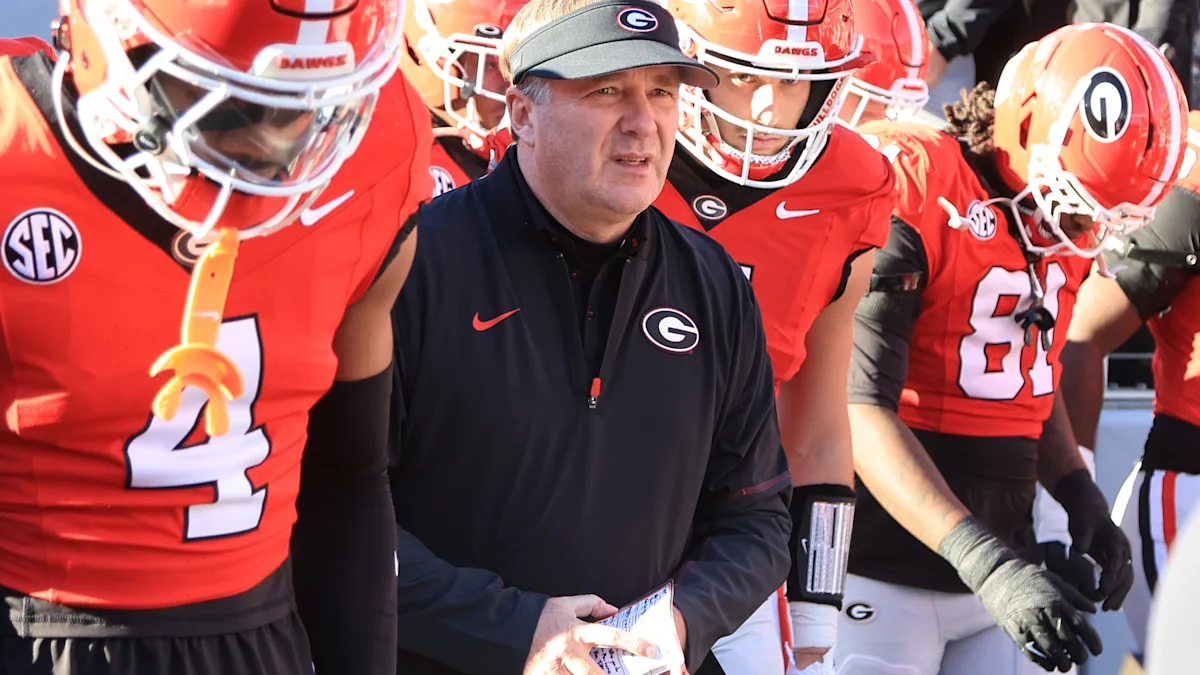
Preseason college football predictions in the best of times are coin-flips; preseason predictions in a catastrophe-ridden year like this one are unintentionally hilarious. Ohio State's going to win another natty! LSU is headed to the playoff! This is Oregon's year! Pretty much every preseason favorite has sputtered, stalled or spun into the ground at one time or another this season.
The Georgia Bulldogs just keep on winning — with one inexplicable exception, but we'll get to that — and winning in a way that leaves no doubt about their dominance. Check the numbers: except for the narrow 20-17 win over CFP No. 3 Alabama, Georgia has won its other eight games by at least 19 points.
And after that three-point loss to Auburn in October, a game in Georgia's hands until the final seconds, the Dawgs dropped a combined 117 points on their next three opponents, all ranked, allowing Florida, Ole Miss and Missouri to score only a combined 36.
All of this is a testament to the remarkable consistency that Kirby Smart has imposed on this program. It's tough to remember now, but before Smart, Georgia was a generational underachiever, capable of winning double-digit games in a season but never the ones that mattered most. A long, dark four decades passed between the Dawgs' last championship in 1980 and the back-to-back ones under Smart in 2021 and 2022.
Now, Smart has the red-and-black battle station fully operational. Georgia has been in the national championship conversation every season for a decade. This year, Georgia is one win from a guaranteed berth in the SEC championship, which would be the Bulldogs' ninth appearance in the past 10 conference title games.
Only a ranked-but-wobbly South Carolina and a deeply overmatched Georgia Tech remain on Georgia's slate. After that, the Dawgs could well get a first-round bye regardless of how the final conference title game plays out. And from there, well … who knows, but Georgia's consistency fits the playoff a whole lot better than the chaotic energy of virtually every other school in the bracket.
At this point, the real challenge to Georgia isn't from Alabama or Utah or Notre Dame. The most serious threat to the Bulldogs might be already inside their stadium. It might be on their roster. It might be looking back at them from the mirror. The Bulldogs' greatest threat might just be themselves, is what I'm getting at here.
Smart spent eight seasons at Alabama under Nick Saban before taking over Georgia in 2016, and you can see Saban's crushing-defense, no-BS influence in Smart's style. Like Saban before him, Smart has managed to keep meddling and cranky boosters in line.
You watch Georgia, and you see a fearsome juggernaut. But listen to what Smart says about his team, and you'll start to hear some fascinating comments. This isn't the usual talking-up-the-cupcake-opponent speech; Smart spends his time at the podium airing real frustrations and giving us a look at his psyche in a rapidly evolving college sports landscape.
After the Missouri win, a thundering victory in which he was nonetheless bellowing at his players even while up big , Smart noted that he would like to see the players holding one another more accountable than he believes Georgia — or anyone — is now.
"The best teams I've been on, they had guys ready to kick somebody's ass on the sideline because of the same things I saw [during the game]," he said on Saturday . "So the player-led version I'm seeing now is like a millennial player-led, because 10 years ago, it would have been player-led." (Smart means Gen Z, not millennial; any team still fielding millennial players in their 30s and 40s would not be making the College Football Playoff.)
"I don't think in this day and age, more kids want to confront and demand each other," Smart continued. "So if they're not willing to, then I'll volunteer." It's the latest of many comments Smart has made over the years about players getting too comfortable and not demanding enough of themselves or each other.
And this is where the dark clouds gather for Georgia fans. Saban retired in January 2024, and one of his stated reasons — in addition to his age — was the changing power dynamic between players and coaches.
"I thought we could have a hell of a team [in 2024] and then maybe 70 or 80 percent of the players you talk to, all they want to know is two things: 'What assurances do I have that I'm going to play,' because they're thinking about transferring, and 'How much are you going to pay me?'" Saban said in 2024 shortly after he retired . "So I'm saying to myself, 'Maybe this doesn't work anymore, that the goals and aspirations are just different and that it's all about how much money can I make as a college player?' I'm not saying that's bad. I'm not saying it's wrong, I'm just saying that's never been what we were all about, and it's not why we had success through the years."
It's worth pointing out that Smart has, in fact, had considerable success in the NIL era, and has managed to navigate it — often at Saban's expense — in a way few others have managed. Smart has said he's not against players being paid, and has joked he wished he had that opportunity when he was playing, but noted earlier this season that paying players can have downstream effects that don't benefit the team as much as the player's bank account.
"I think about the teams we had in '21 and '22, and how physical they were and how they practiced. We can't even get close to that now," Smart said after Georgia's Halloween decimation of Florida. "If it's a different culture that guys don't want to as much, I don't know. They were definitely hungrier, because there was a motivation to make it. A lot of these guys, honestly, they make more than I did until I was 40. It's just a different day and age."
Whether you agree with Saban and Smart that college players are too NIL-focused, or believe players are receiving appropriate compensation for their labor, isn't really the central issue here; the question is how much more of this Smart is willing to put up with before he decides to hang up the visor. That could be several decades in the future — Smart is 50, Saban was 72 when he retired — or it could come a lot sooner than that.
Before then, though, Georgia has a few important games to play, perhaps even late into January. The Bulldogs will be favored in most, if not all, of them … because no matter how the bracket shakes out, Georgia won't have to face Georgia. Yet.
Topics in this story
Gathered from external sources. Rights to this text belong to whoever originally published it.