Michigan's ruling explained: Analyst Terry McAulay presents only theory in which bizarre ending makes sense
Usually, a game is over when the clock hits zero.
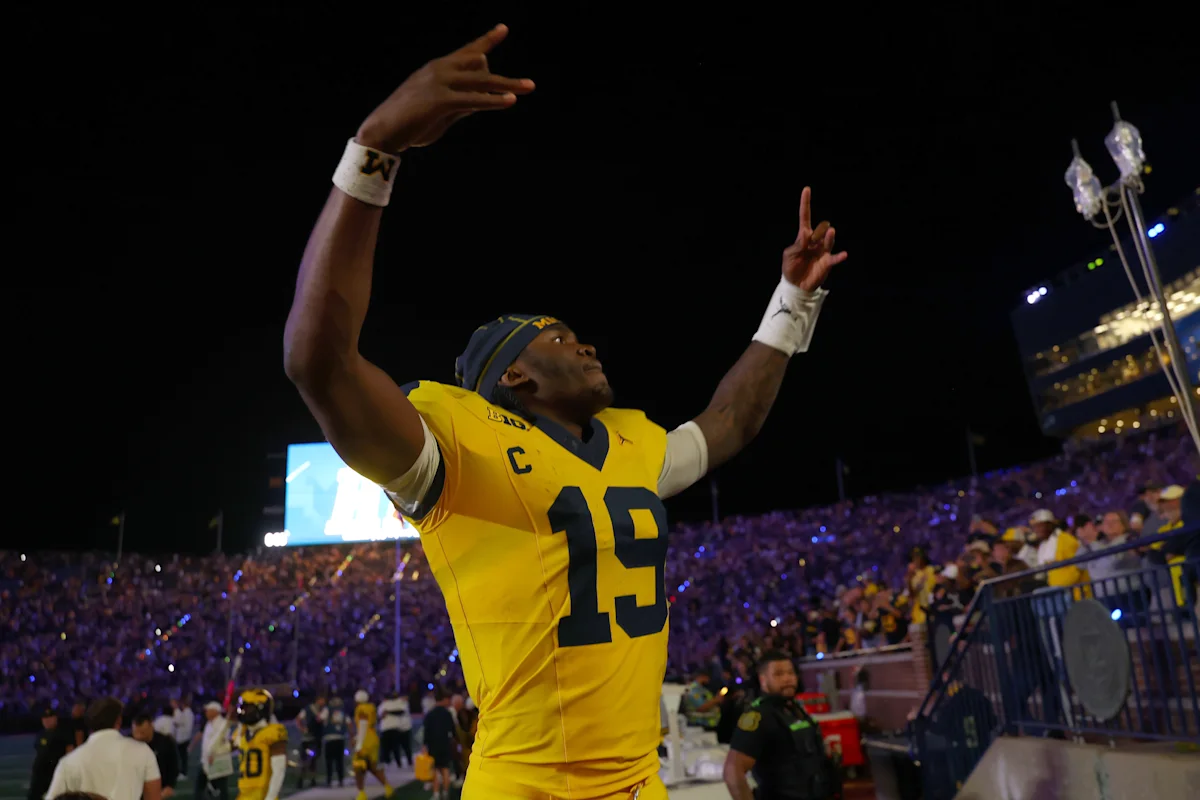
The easy word for what happened at the end of No. 16 Michigan's win over Western Michigan is "controversial." That might not work, though, as everyone seems pretty unanimous on what happened.
With only a few seconds on the clock, Michigan attempted a 47-yard Hail Mary that fell incomplete as time seemingly expired. A replay review predictably ensued, with the Big Ten's replay center eventually deciding to put one second back on the clock.
Michigan's second Hail Mary attempt had a better outcome, with the Wolverines pulling off a wild 13-12 win .
However, anyone with the ability to pause and slo-mo the replay shown on television can tell you the clock clearly struck zero while the ball was in the air on the first attempt. The clock should have stopped as soon as Western Michigan safety Micah Davis touched the ball because he had stepped out of bounds. But, again, time expired while the ball was in the air.
There should not have been a final play, as far as any outside observer can tell. It is rare that a blown call feels this obvious, this blatantly irreconcilable with the plain fact of a clock on a screen.
It's not just a bad call, it's a call so bad it leaves us wondering how it's even possible.
There is, however, an explanation of what happened courtesy of NBC officiating analyst Terry McAulay. In the aftermath of the ruling, McAuley went through the replay with the broadcast booth and explained that while the NBC broadcast supposedly had the stadium clock synced up on its replay, the Big Ten's replay center might have had a different sync with its Hawk-Eye camera.
"The ball isn't even close to touching the player when it goes to zero. Now their Hawk-Eye system apparently either was — had a different sync or whatever and they came up with one second when it touched the players. I don't see how that happened, assuming our clock is correct. It is clearly not touching the player. The ball is clearly still in the air when the clock goes to zero on our screen. So the Big Ten's going to have to tell a lot of us how did they get to one second on this play."
That is all speculation, but it at least adds some sort of logic to an irrational sequence of events. It would still make the outcome an outrage, as a clock at the Big Ten replay center in Rosemont, Illinois, would be overruling the clock in Ann Arbor.
We do know one area where McAulay is 100% correct, though: The Big Ten has some explaining to do.
Topics in this story
Gathered from external sources. Rights to this text belong to whoever originally published it.