The heart transplant footballer who won a World Cup for England
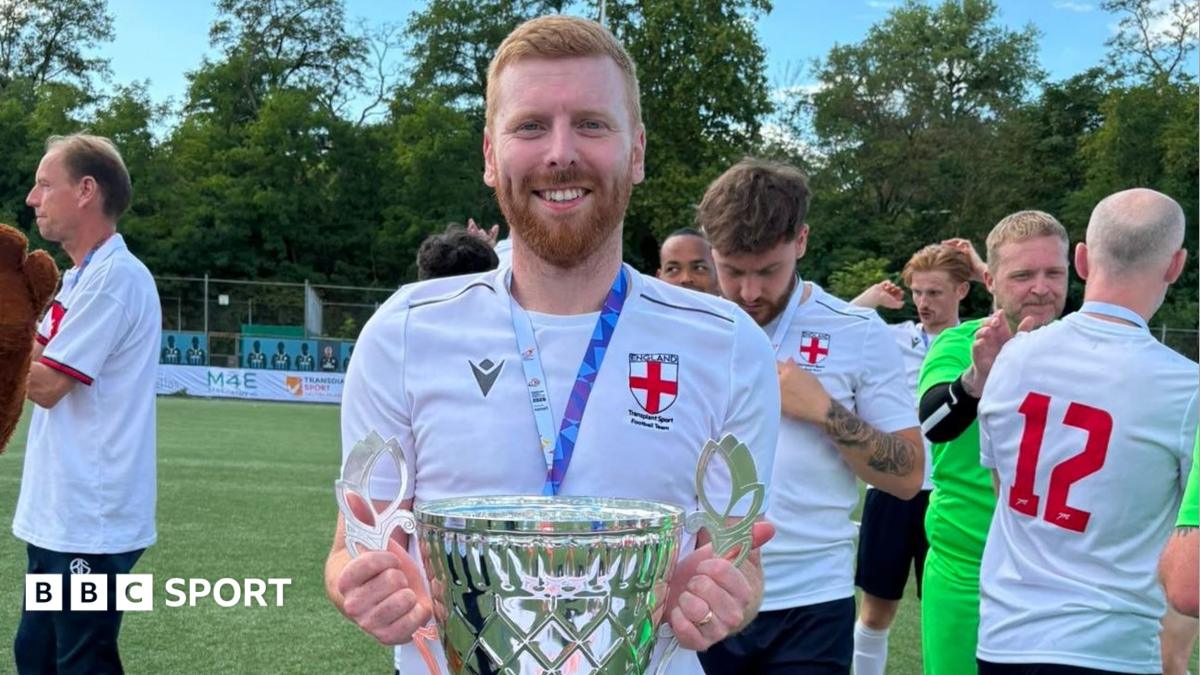
Martyn Jackson never thought he'd play football again when he had a heart transplant in 2024. Less than two years later, he was a World Cup winner with England.
When Martyn Jackson walked off the pitch after Ramsbottom United's 2-1 win over Cheadle Town in October 2024, it never crossed his mind that one day he could be a World Cup winner.
In fact, in the days after that match, his goal was just staying alive.
Just a couple of days after the final whistle, Jackson started to feel unwell during the night.
He went into hospital and was diagnosed with myocarditis, an inflammation of the heart usually caused by an infection. Within weeks, he was placed on the super urgent waiting list for a transplant.
His life was saved when a donor heart became available, and on 28 November 2024, he had successful surgery at Wythenshawe Hospital in Greater Manchester.
Fast forward to September 2026, and Jackson scored for England in their 5-1 win over Spain in the final of the Transplant Football World Cup.
His team-mates and opponents were, like him, all recipients of a donor organ.
"Obviously, when you've had a transplant, you don't think you're ever going to play again. That's what I thought anyway," Jackson tells BBC Sport.
"I'll be forever grateful to my donor and the family for what they've given me. They've given me the gift of life and the opportunity to live my life to the fullest."
Football at the Transplant World Cup is not quite the same as the game played at the Fifa World Cup.
Instead, it reflects how delicate each player's body is having been through life-altering surgery.
Matches are seven-a-side and played over 20-minute halves. Contact is "not as aggressive as I was used to", Jackson says.
Having played 11-a-side football in the ninth tier of English football before his surgery, he became a game-changing new addition to the national transplant team when he joined up with the squad in January 2026.
Jackson spent his youth career in the academy at Manchester United, before spells at Blackburn Rovers, Preston North End and Burnley. He eventually stopped pursuing a career as a professional and spent 13 years with clubs across the non-league pyramid.
During his recovery, wife Lucy heard about the opportunity to join an England Transplant FC team on social media.
Daley Cross, manager of the England team, said of Lucy's role: "She was just trying to do her best for him and trying to find a way to motivate him.
"His wife did drop in the conversation that he used to play at Manchester United as a schoolboy. So that got our ears twitched instantly.
"You could tell from him being on the pitch, even though he was so fresh into his journey, that he knew the football game and he would be such an incredible asset to us.
"You can be in a dark place, at the time of diagnosis, through your treatment or even post-transplant. So to have us exist to help and inspire people means that we are getting some incredible footballers.
"And that really is the power of it: to that transplant community or to the world, showing people that when you've had organ failure, your life isn't over. There is a chance for you, and you can go and resume and live your life."
As the recipient of a donor heart, Jackson has to manage his exercise workload more carefully than his team-mates, many of whom have had kidney transplants, the most common transplant in the UK.
His role in the side tends to involve 10-minute bursts, rather than playing for the duration of matches.
Bayern Munich's Alphonso Davies was diagnosed with a mild form of myocarditis in 2022. He was sidelined for nearly five months, undergoing specialist cardiac monitoring, before returning to play.
Jackson started to feel ill two days after Ramsbottom side's win over Cheadle, and his case became so severe that doctors had to fit his heart with a mechanical pump to keep him alive.
"Of course it was extremely scary," he says, "but at that stage, when you are critically ill, there's not really much you can do about it. You have to accept it."
The super urgent waiting list he was placed on is the highest priority of the three tiers of patients waiting for a new heart. Typically, only about four or five people are on the list at any one time in the UK.
Dr Paul Callan, a consultant cardiologist at Wythenshawe Hospital's Heart and Lung Centre, worked with Jackson during his diagnosis and recovery.
"Initially, we used to quote an average wait of seven days on the urgent transplant list," he says. "Now it's up to 14 days. Maybe 10% of patients who are put on the list get too poorly and have to be taken off the list."
That increased waiting time is the result of a reduction in the numbers of organ donors in the UK, with a 9% drop recorded in 2026 compared to the same period last year. There are 8,700 people currently waiting for a donor organ, a figure that NHS Blood and Transplant say is an all-time high.
This Organ Donation Week, , external which runs from 21-28 September, the NHS has launched an urgent response plan to address the decline.
Jackson has yet to meet the family of the donor from which he received his new heart. He says he is considering reaching out to them around the two-year anniversary of his surgery.
For him to make a recovery within that time frame, culminating in playing football in a Transplant World Cup, is "remarkable", according to Dr Callan.
England beat six teams on their way to winning last Friday's final in Frankfurt, scoring 36 goals, but for every player at the tournament there is gratitude that they even have the opportunity to play a football match again.
"It is so important to spread that message, have that conversation about organ donation," says England manager Cross, "because our team only exists for that reason.
"I wouldn't have 16 players to manage if we didn't have organ donation. And England wouldn't have just gone and won a World Cup."
Topics in this story
Gathered from external sources. Rights to this text belong to whoever originally published it.