Yamal, Mbappe in El Clasico spotlight as 40 cameras dedicated to coverage
The coverage includes ultra-high-definition filming, slow-motion replays, and individual player tracking techniques.
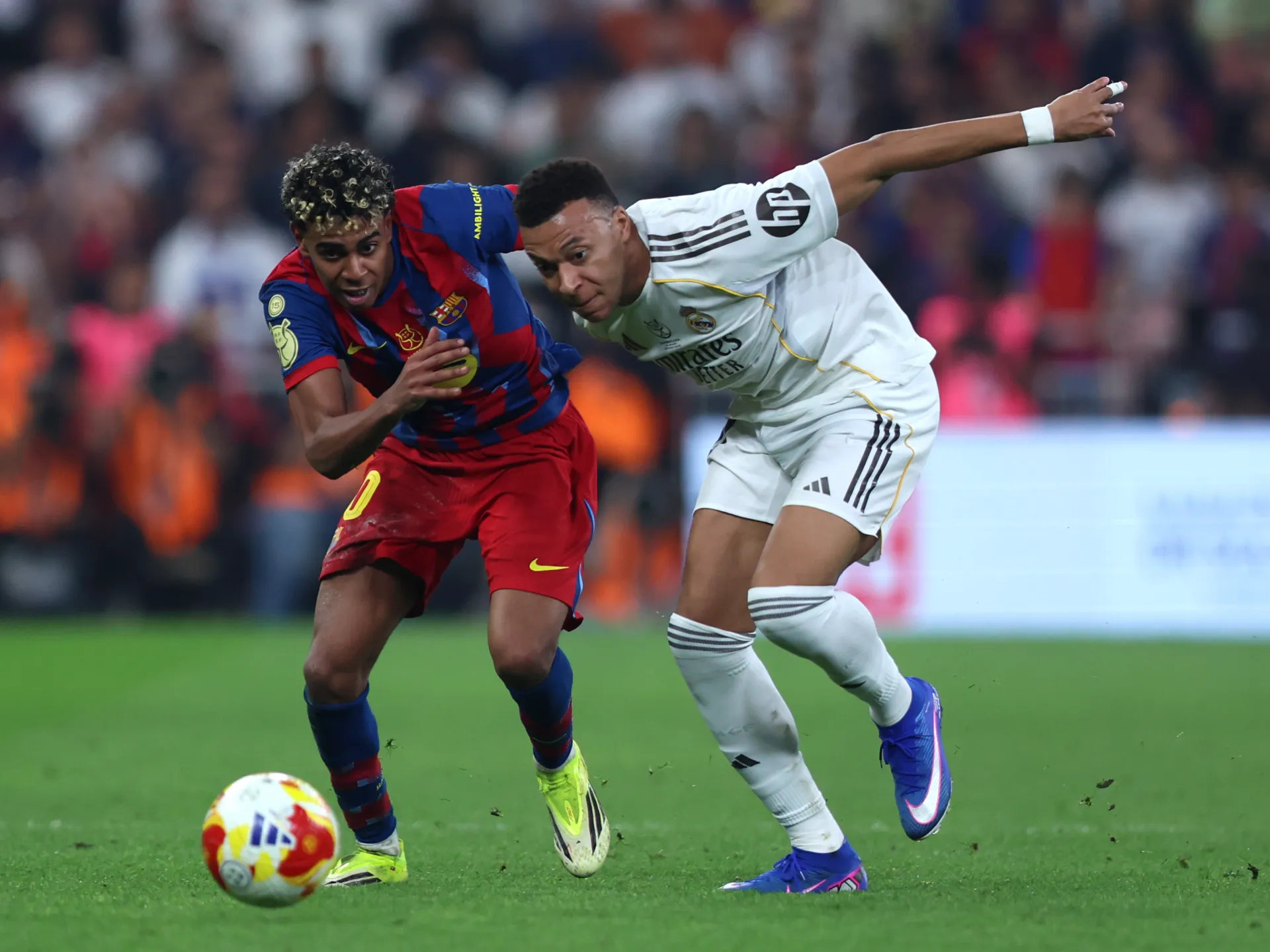
Sunday’s highly anticipated El Clasico will see up to 40 cameras cover the match between Barcelona and Real Madrid, including dedicated coverage of stars Lamine Yamal and Kylian Mbappe a day before Ballon d’Or winners are announced.
The cameras will be placed across Camp Nou Stadium as part of a television production plan that includes ultra-high-definition filming, slow-motion replays, and individual player tracking techniques, Spanish newspaper Mundo Deportivo reported on Tuesday.
Spain’s top-flight La Liga classifies matches involving Barcelona or Real Madrid as “Category A”, requiring at least 22 cameras for coverage.
Major matches like El Clasico or the Madrid Derby have a higher rating of “A+” and require 35 to 40 cameras distributed according to a pre-defined shooting plan, which includes their locations and coverage angles.
The details are made available to the referees’ technical committee and the Video Assistant Referee (VAR) technology team, advising them of the available image sources for reviewing refereeing decisions.
The announcement of expanded coverage follows controversy in the Real Madrid vs Sevilla match on Sunday, which saw an off-the-ball clash with Real Madrid midfielder Adra Guler and Sevilla’s Peque Fernandez in the 24th minute.
Despite 26 cameras being used during the match, none of the available angles provided a clear enough picture to determine the nature of the contact between the players, thereby reviving the debate on whether television coverage can provide the angles required to decide in controversial cases.
However, using more cameras does not guarantee that all events will be clearly filmed; it depends on the location of the equipment, direction of the lenses, and how close the event is to the angle being filmed by the camera.
Anticipated coverage includes cameras with long-range and cinematic lenses, with the production of images in “4K” resolution compared to “full HD”.
This allows the television director to choose between multiple angles during the game, and replay important shots in clearer detail, especially goals, dangerous opportunities, and collisions inside the penalty areas.
Additionally, cameras will be installed behind the two goals, as well as equipment capable of capturing fast shots and replaying them in slow motion.
Is this the first time camera innovation has been enabled?
During a 2017 El Clasico, the Spanish League used 40 cameras mounted on cranes and carried by helicopters, as well as slow-motion cameras dedicated to tracking Lionel Messi and Cristiano Ronaldo. More than 400 specialists in photography, directing and television production were involved.
In 2016, El Clasico experimented with 360-degree replays using a system based on cameras distributed around the stadium to produce three-dimensional images, allowing the director to show some scenes from virtual angles that are difficult to obtain using a traditional camera.
The league later developed this technology through a system that uses images captured by 38 high-resolution cameras to produce stereoscopic scenes, allowing the viewer to see the shooting angle from a virtual location close to the player.
In newer versions, coverage has reached 32, 34 and 38 cameras depending on the stadium and match conditions, with the introduction of cinematography, aerial cameras, drones, visual effects and live data.
Topics in this story
Gathered from external sources. Rights to this text belong to whoever originally published it.