'I know who I am' - How fatherhood and a fresh start at Leeds helped England striker Dominic Calvert-Lewin find his joy again
In an exclusive interview with GOAL, Dominic Calvert-Lewin opens up on his Leeds revival, the injuries that tested him and how fatherhood changed his outlook...
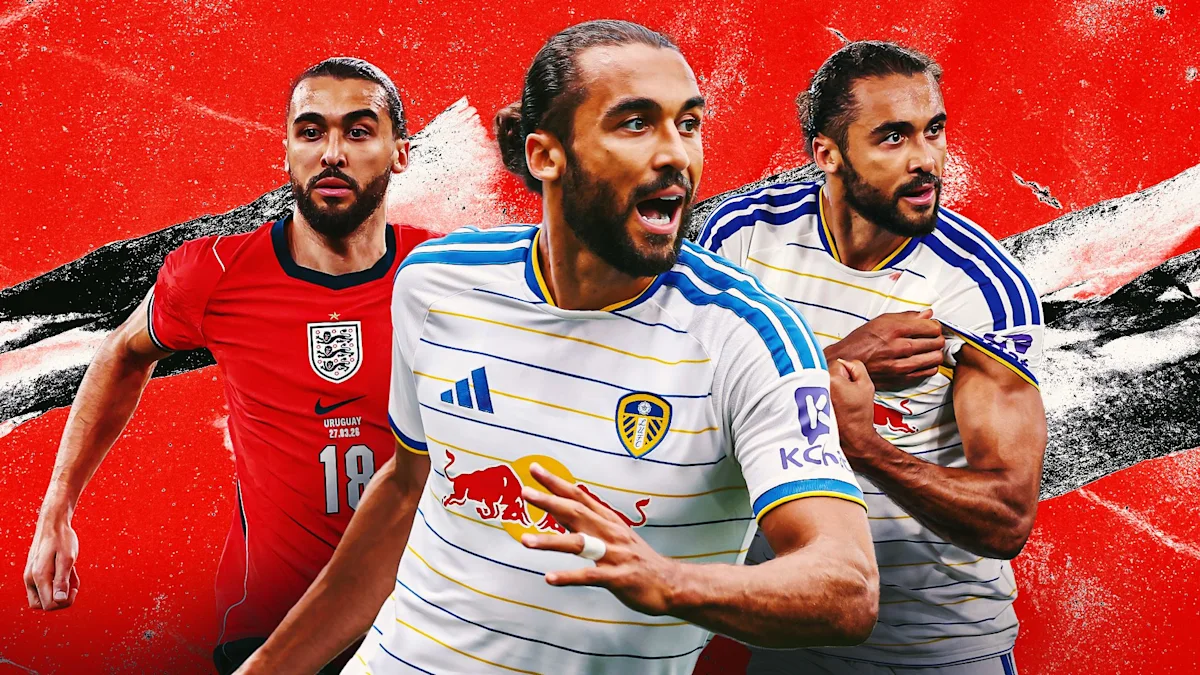
In an exclusive interview with GOAL, Dominic Calvert-Lewin opens up on his Leeds revival, the injuries that tested him and how fatherhood changed his outlook on life.
Dominic Calvert-Lewin grew up with a Muhammad Ali poster on his wall. The quote on it wasn't one of the boxer's more braggadocious sayings. It wasn't even particularly relevant to a kid. Yet Calvert-Lewin read it so often that, all these years later, he still knows it by heart.
Now, perhaps more than ever, he's been thinking about that memory.
"A man who views the world the same at 50 as he did at 20," that poster read, "has wasted 30 years of his life."
Calvert-Lewin isn't 20 anymore. He isn't 50 yet either, to be fair, but that 30th birthday is rapidly approaching. It's been 21 years since he joined the academy at Sheffield United, effectively beginning his journey as a footballer. It's been 10 years since the move to Everton and six since his first England cap. Three years ago, he became a father. Even his move to Leeds, which happened less than a year-and-a-half ago, seems so far away. Life changes, and it changes quickly. Particularly for Calvert-Lewin.
Yet through all the change, the highs and the lessons learned from the lows, Calvert-Lewin has kept scoring. This season, he's playing his best football since his Everton breakout from 2019-21. With 18 goals, he's the Premier League's most prolific Englishman since arriving at Elland Road last fall.
So what's the big secret? Why are the goals coming now more than they did a few years ago? What's changed?
Well, Calvert-Lewin has, and he's changed for the better.
"I think there's definitely strength in that," he tells GOAL , "and there's power that it's given me to know that now I know what I'm about. I know what I can do. I know who I am, and I know what I bring to the table. I think that gives me a lot of confidence when I step on the pitch…I'm a little bit more relaxed in times of hardship or difficulty. That comes from the foundation that I've got at home. I believe that's my main springboard, and I didn't have that when I was 21.
"I've got that now, and that gives me the confidence to go out and attack the world."
That part of him hasn't changed, of course. Calvert-Lewin has been attacking the world since his debut for Sheffield United 11 years ago. He's been attacking the Premier League for most of his career. Life, of course, has attacked him back: injuries, setbacks, narratives, droughts. They seem far away now, but Calvert-Lewin knows they aren't. If there's one thing he's learned in this life, it's that you can't get too comfortable in good or bad.
"Life goes in seasons," he says, "and it can sometimes be good, and sometimes there are difficult moments.
"But at the moment," he adds with a smile, "life's good."
This is a look inside the life of Calvert-Lewin, how it's changing and, more importantly, how it's changed him.
In football, it's easy to forget that the process is never really linear. Things don't always get better, and players don't either. So often, footballers peak early and spend the rest of their lives chasing that peak. The longer the chase goes, the harder it is to catch it.
For a little while, it was easy to wonder if Calvert-Lewin would return to his peak.
Between 2019 and 2021, he scored 36 goals for Everton, including 29 in the Premier League. He was just 22 when that run started. England came calling; he played at the Euros, and everything was going well. It was the start of something beautiful.
Until it wasn't. Injuries took hold, the goals dried up, and the narratives began, too. "Injury-prone" is the one that hurt most of all. His hamstring gave him nightmares in 2022-23. It made him miss 100 days during the 24-25 season, too. A broken toe, broken cheekbone, various knee and ankle issues - so much lost time. So many quiet moments that allowed the "injury-prone" label to become more than a narrative and something closer to reality.
For a while, Calvert-Lewin admits he was desperate to respond to it all. Now that he has, oddly enough, he no longer feels it's worth responding to at all.
"I think the obvious one is, when you get a couple of injuries, you get tarred with a brush, and it's very hard to shake that brush off. It's hard to shake that off yourself. There's no amount of words that can change that. The only thing that will change that is playing week in, week out, training every single day, and having consistency and robustness. Eventually, that narrative will filter away, but that's a hard one to shake off, as I found. I think people know what I'm about now.
"I think there probably were some narratives around me prior to me joining Leeds," he adds, "and I think that I've smashed them. It was my intention to break those narratives by performing well and doing my job well on the football pitch, and I believe that I've done that to a certain extent."
There's no big secret to shedding labels, but there is an easy way to do it: consistency. That's what the 29-year-old striker has found at Leeds. It was his arrival at Leeds, in many ways, that was the springboard. Leaving Everton in 2025 was a big decision, particularly given his connection to the club. It came during a period of change off the field, too, as he adjusted to fatherhood and married life. It was time, he said, to start a new journey.
Leeds and Daniel Farke will be glad he did. Since the forward's arrival, only four Premier League players have a better goal-per-game ratio than Calvert-Lewin. Over the last 15 months, he's scored 20 goals. Across his final four seasons at Everton, the ones that came after his career-best 21-goal season, he netted just 18.
"I never stopped believing that this is where I would eventually return to: playing at this level week in week out and finding this consistency," he says. "That's one thing that I always believed: through ups and downs over the last few years, I was capable of returning to being a goal-scoring center forward again.
"It sounds cliché, but, each day, it's just believing that you can return."
Through it all, the belief was simple: he was, is, and will be a goalscorer. He's proven that right a lot recently, which has gotten him thinking about the nature of goals and what they mean.
The most important goal Calvert-Lewin ever scored remains undeniable. Level with Crystal Palace late, Everton needed a hero. They were fighting against relegation and knew a win would seal their safety. Then Demarai Gray fired a free kick into the box, and Calvert-Lewin leapt through the air like Superman, heading home a goal that saved a club.
It was one of the more exciting goals in recent memory. Fans went wild. So, too, did Calvert-Lewin's teammates. But, in that moment, the striker didn't feel excitement.
"It was just relief," he says. "It wasn't even joy; it was just pure, pure relief."
At that point in his life, that was the most common emotion: relief. Goals didn't feel like a celebration; they felt like an exhale. The pressure on him was immense. Most of it came from within as he fought so desperately to return to his best level.
"There were periods, probably more so at Everton, where it was difficult," he says, "and scoring goals felt more like a relief than something that I was really enjoying. The difference in scoring goals at Leeds now is that I enjoy every moment, and I think because I've been through different periods in my career, I've learned to appreciate it more."
For Calvert-Lewin, each comeback from injury brought pressure to prove himself again, making it harder to simply enjoy the game. At Leeds, though, he says he's rediscovered that joy, and he believes it shows in the way he plays.
Take the recent goal against Manchester United, for example. It was a poacher's goal and, as it hit the back of the net, Calvert-Lewin played it cool. He walked towards the corner, did a forward roll and then let it all out. He screamed with joy as his teammates surrounded him.
"I always think to myself that I hope that never changes," Calvert-Lewin says. "I hope I still have that same feeling, that same desire, that same hunger, for as long as I can possibly play."
There is a new level of desire and hunger now, though. There are new feelings in play, too. That's the impact of fatherhood, which is something Calvert-Lewin feels every day.
Calvert-Lewin's daughter is three now, which means she's just starting to get it.
"I'd say, in the last like six months, she started to realize that daddy goes to football every day and plays there," he says with a smile from ear to ear. "She calls it 'Football Leeds', so, every day, I go to Football Leeds."
"She's been watching at the stadium," he says. "I've walked out with her, and that was a dream of mine: to walk out with my child in my arms in the Premier League. That was a special moment, and she's starting to understand it. She still doesn't understand to what level I play football, but she knows I play football all the time."
Well, not all the time. When he's not Leeds' No. 9, Calvert-Lewin has another crucial title: dad. The games and results aren't particularly significant to her. That fact has been one of the key influences on Calvert-Lewin. It's one of the things that's changed him the most.
Football demands a certain selfishness, Calvert-Lewin says. Fatherhood has helped him grow up and look beyond himself.
"I think, when you become a father, it gives you a completely new perspective that something is more important than you now. Something's more important than everything that you've been chasing. I think that gives me a lot of harmony in my life."
That harmony has made him a better man on the field. It's also, weirdly enough, made him a more complete player on it, too, because it's helped him rediscover his flow state.
'Got a little bit more quality than people think'
Given his height and style of play, Calvert-Lewin was naturally pigeonholed as one type of striker: he was a big guy up top. The truth is that he didn't really appreciate that fact - until now.
"I used to not like 'Target Man' so much when I was younger," he says, "but as I've got older, I've grown to appreciate the 'Target Man' label that I've been given. I see it as something that I am exceptionally good at. When it comes to being a Target Man, what does that require? My attributes suit that pretty well.
"I also believe that I can do a little bit more. I've got a little bit more quality than people think. I do have more."
The numbers show that. Compared to other strikers in the Premier League, Calvert-Lewin is in the 95th percentile in distance covered. He's in the 74th percentile in top speed. Yes, he leads the league in aerial duels, but he's also significantly more mobile than people give him credit for.
Still, Calvert-Lewin knows how this all works. He's a striker, which means he's measured on goals. The more he scores, the more those numbers pop and the more they justify that he is, in fact, a better player.
"There's flow state, and I can certainly relate to that," he says when asked about his current form. "It's when you come out of your head and more into your body, and just trust that your body knows what to do. I think it's a feeling that you get when you are performing well and you're not overthinking things. Things just come naturally.
"That's the grand old question: how do you tap into flow state more often so that, whether or not it's result-based, you're always there? I think I can definitely say I'm there at the moment, and I have been there since I joined Leeds and since I started scoring."
The goals have Leeds fans wondering how far things can go. Calvert-Lewin is wondering, too.
After five years away, Calvert-Lewin returned to England duty in March, coming off the bench against Uruguay. He missed out on the World Cup squad, but September brought another call-up and a chance to build on that return. After so long away, he was back representing his country. It's hard to articulate how much that meant.
"It's something I've loved and thought about so much since I was able to do it when I was 23," he says. "Then as time goes on, you realize more. I became grateful, but then I also appreciate it more. I appreciate it more this time around, representing England."
Returning to the national team remains a goal, but the truth is that Calvert-Lewin thinks less about those things than he used to. There was a time in his life when he laid everything out. Now, it's about the daily routine. The goals stay in the background, but he knows now that the way to get there isn't by doing big things, but a series of little ones.
You can count that among the lessons learned by the older, wiser Dominic Calvert-Lewin. There are plenty of them, in truth.
"There's a difference between me as a 21-year-old and a 29-year-old now," he says. "At 21, you think you've got it all figured out, and you think you know all the answers. Then you get to 29 and realize you'll never have all the answers. There's no point trying to understand too much. With experiences and things that you go through, I always try and see, particularly the tougher moments, as lessons now. What is this trying to teach me, as a man, in my career or as a father or as a husband? What can I learn from this?
"I think that's a different mindset I've got now compared to what I had when I was a little bit younger. You think maybe 'Why me? Why is this happening to me and what can I do about this?' Now, I'm a little bit more relaxed."
As Calvert-Lewin finishes his thought, the door opens. Mid-answer, he looks over and smiles.
"My daughter's just coming through the door now," he says. "She's throwing me off."
He collects himself and finishes before returning to his favorite role: dad.
"I think I'm very much, nowadays, what you see is what you get," he says. "Everything we've spoken about? That's generally me. That's how I live my life."
Topics in this story
Gathered from external sources. Rights to this text belong to whoever originally published it.