Dominick Goodman playing long game as he builds Walnut Hills football
Cincinnati football legend Dominick Goodman is preaching patience in building Walnut Hills from the ground up.
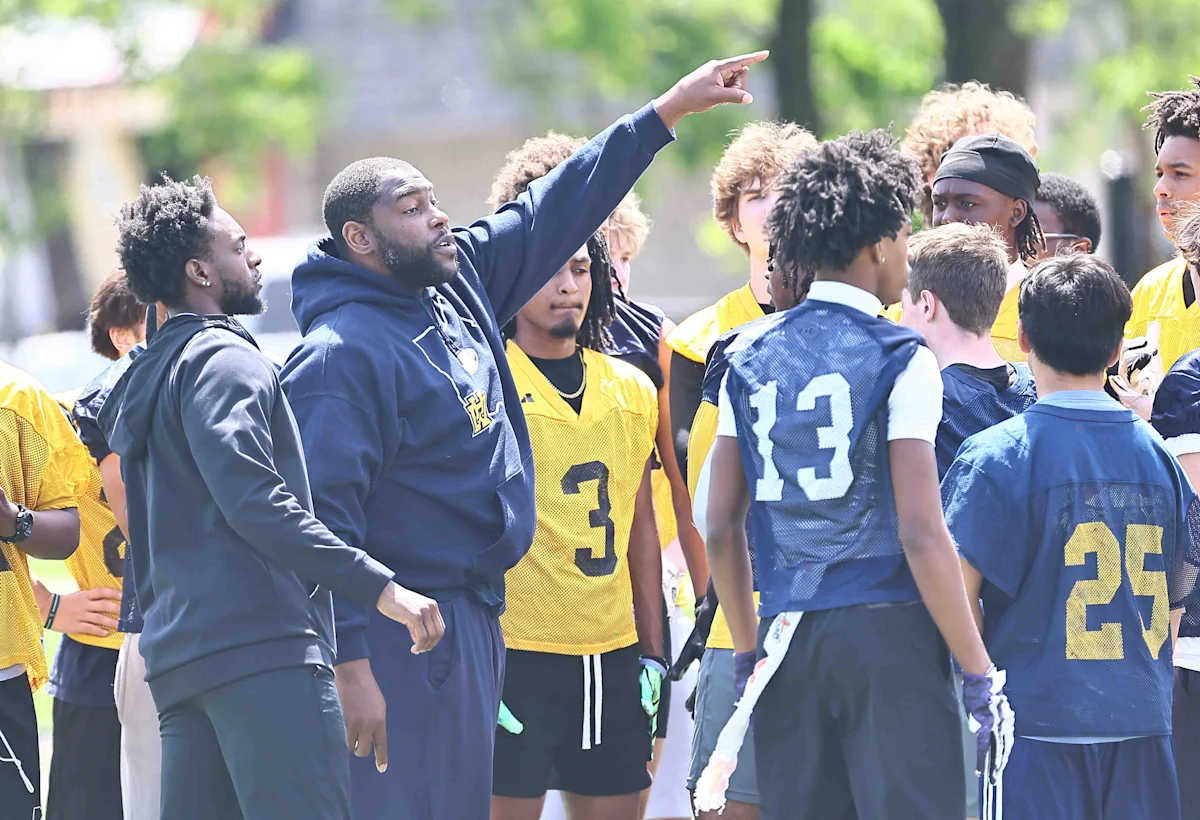
For most of his football life, Dominick Goodman knew what winning looked like.
At Colerain, Goodman was the quarterback of a 15-0 state championship team in 2004 , earning All-American honors as the anchor of one of the most dominant seasons in Ohio high school football history.
With the University of Cincinnati Bearcats , Goodman became one of the most productive wide receivers in program history. He still ranks in UC football's top four in receptions, receiving yards and touchdown catches. Goodman's UC squads (2005-2008) went a combined 33-18, finished No. 17 in the final AP poll twice, won a pair of bowl games and reached the program's first-ever New Year's Six bowl in 2008.
Dominick Goodman | Photos of Walnut Hills coach in his playing days
After years of football where winning was the expectation, Goodman is now learning what it means to build as the head coach at Walnut Hills High School.
Through four games, Goodman's Eagles are 0-4. Those losses have come by 37, 40, 24 and 35 points. But when Goodman talks about his first season, the scoreboard is not a hot topic.
"I'm not worried about wins and losses," Goodman told The Enquirer. "I'm more worried about are we getting better each week?"
For someone as competitive as Goodman, that might sound strange. But Walnut Hills has been searching for stability for years. The Eagles haven't had a winning season since 2011, their final year in the Fort Ancient Valley Conference. Since joining the Eastern Cincinnati Conference in 2012, Walnut Hills has averaged 2.5 wins per season.
The Eagles went a combined 3-28 in three seasons before Goodman's arrival. They haven't won more than two games since 2019. Goodman is well-versed in the program's recent struggles. He also knows what it takes to change it.
He came to Walnut Hills this spring, leaving his offensive coordinator position at Talawanda after helping lead the program to a high-scoring offense that featured one of the nation's top rushers. In 2025, the Braves won a playoff game for the first time in a full season since 1991. Before that, he helped develop players at New Miami.
"It was a perfect situation to help me grow as a coach," Goodman said of the Walnut Hills job. "I've been in programs where we've had to develop and start from the bottom and work our way up to where we transition into a football school. I saw the opportunity here to do the same thing."
The first step is changing the culture in the program.
"Coming into a situation where they had losing seasons, it was a bad culture, leadership wasn't there," Goodman said. "The main focus for this year is building that culture, building that foundation and getting the kids to love and enjoy football."
That process has helped Goodman redefine what success looks like this season. Walnut Hills is a young team with a dozen underclassmen playing. There are only four seniors and juniors in the starting lineup. Some upperclassmen have only played football a few years.
"You're teaching them from the ground up," Goodman said. "That's what I love about it because I love coaching and developing kids and seeing them get better."
For Goodman, improvement won't necessarily show up on the scoreboard this fall. He sees players getting bigger, faster and stronger. Players who were overwhelmed by the speed of the game in the season-opener are beginning to slow it down mentally and make plays.
"I tell the kids every day, there's no point if we're not getting better," Goodman said. "You can see strides.
"I'm a competitor at the end of the day. I want to see results now, but you have to be patient."
Goodman's own playing career taught him the value of hard work. He said he was never the fastest or the strongest, describing himself as "always average." What made him stand out was his willingness to work.
"I worked hard, trained all the time, pushed myself so I could outwork everybody to put myself in a position to succeed," he said. "That's what all of these kids have to learn."
He's trying to teach that lesson to players in a program that has grown accustomed to losing. He's also teaching some basic fundamentals of the game.
Goodman said a misconception former players have about coaching is assuming every player has a firm grasp of the game's basics. That's not the case.
"We assume a kid, especially high school kids, know what a three-point stance is or a slant," he said. "We assume a lot of things, but when it comes down to it, we're teachers."
Goodman's first got a taste of coaching from former Colerain coach Tom Bolden, who gave him an opportunity to work alongside him while Goodman was still playing Arena Football. He retired from football and worked as a behavioral specialist at Cincinnati Children's Hospital and was the YMCA's director of sports and fitness before arriving at Talawanda, where he realized coaching was his career path.
His players are aware of his history. Their parents, many around Goodman's age, know the stories. But Goodman wants them to understand that highlights aren't the important part.
"It's all about work. Put in work; get results," he said.
Those results don't happen overnight. That's why Goodman is thinking down the road while he lays the groundwork in year 1.
"By Week 10, if we don't get a win or we get one win, it doesn't matter as long these kids get better," Goodman said. "I know what's happening in the future. I'm always thinking two, three years ahead."
Goodman also knows that's not the easiest message to sell in a program desperate for wins, but it's an essential one as Walnut Hills needs to learn how to walk before it can climb out of its perennial place in the ECC cellar.
"I don't care if you're Nick Saban; you can't turn it around just like that," Goodman said. "You gotta build, grow and develop kids."
Topics in this story
Gathered from external sources. Rights to this text belong to whoever originally published it.