Protect College Sports Act crosses another major hurdle, but House fight remains
The third and final procedural vote is expected as early as Tuesday with a final vote to adopt the legislation as soon as Thursday, according to multiple law...
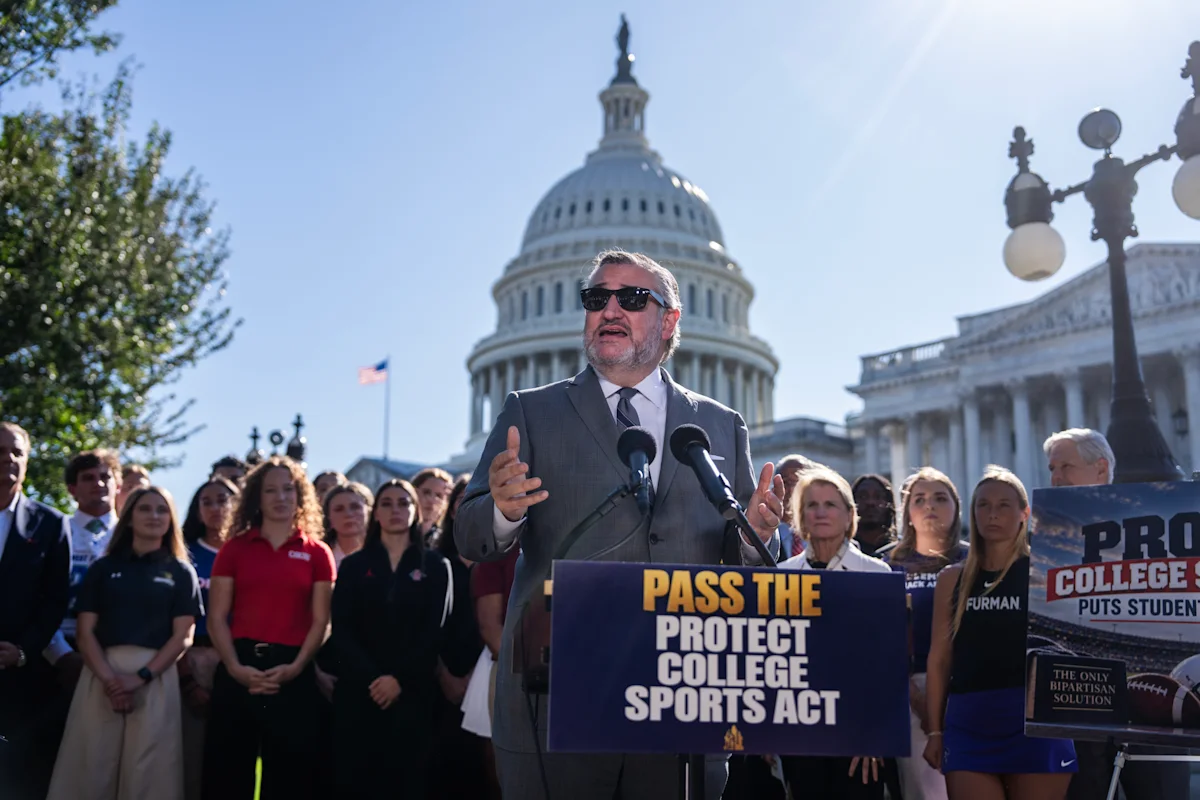
The Protect College Sports Act has thundered through another step in the congressional approval process.
The 150-plus page legislation, intended to regulate the industry, passed the second of three procedural motions by a sweeping margin Thursday in the U.S. Senate, paving the way for its ratification as soon as next week.
Needing just a simple majority of the 100-member Senate, the bill garnered 77 votes — an overwhelming figure that exceeded the 74 during the first procedural vote Tuesday.
"That's a big number. You can't get 80 votes in the Senate to congratulate Santa Clause," said Sen. Eric Schmitt (R-Mo.), one of the co-authors of the bill.
The third and final procedural vote is expected as early as Tuesday with a final vote to adopt the legislation as soon as Thursday, according to multiple lawmakers and their staff. After Senate approval, the bill must be adopted by the House of Representatives.
The vote Thursday came amid a key change to a hotly debated expansion provision within the legislation. Lawmakers revised the provision to provide more flexibility for schools to move conferences. The change reduces the independent probationary period for power conference schools moving to another power league from five to three years and the probationary period terminates after six years of the bill's enactment. The power conference membership cap of 19 schools remains in place.
At least two senators — Tommy Tuberville (R-Ala.) and Alex Padilla (D-Calif.) — flipped their votes Tuesday from no to yes Thursday.
Questions now loom over the legislation, perhaps most importantly its prospects of passage in the House.
House leaders ended their session early this week and are not scheduled to return to session until after the midterm elections in mid-November. Sen. Ted Cruz (R-Texas) and Schmitt both have said publicly they expect House leadership — Speaker Mike Johnson (R-La.) and Leader Steve Scalise (R-La.) — to take up the legislation before the election if the Senate passes the bill by a wide margin.
However, Johnson said earlier this week that he expected that the House would not consider the bill until after the elections.
"I've had initial communication with the Speaker," Schmitt said. "Once we handle our business, we begin in earnest to see if they can come back. The president will care a lot about that too."
President Donald Trump, an ardent supporter of the bill, has been in communication with House leaders to encourage them to return in October to consider the legislation, multiple people with knowledge of the talks told Yahoo Sports.
In a social media post Thursday, Trump praised Thursday's vote as "great news" before he targeted two of the lone Republican "no" votes, both from Florida, Rick Scott and Ashley Moody. Last month, Moody, representing a state with Florida State and Miami, made an amendment to revise the expansion provision. The amendment was not accepted.
The expansion provision could pose a problem in the House, where states like Florida, California and North and South Carolina hold more than 100 delegates.
The provision is a divisive concept that has divided the ACC, as detailed in Tuesday's story at Yahoo Sports . The provision, as well as requiring schools to operate as an independent for three years if moving within the power conferences, caps power conference membership at 19 schools. That significantly limits any movement from schools in the ACC and Big 12 to the SEC (currently 16 schools) and Big Ten (currently 18). The membership cap is not affected by the newest revision. The termination clause only ends the concept's three-year probationary period.
Officials from at least five ACC schools — Miami, Clemson, FSU, UNC and Stanford — have expressed concerns to lawmakers over the provision. Though the revisions do not fully meet their requests, the move is seen as a compromise from lawmakers who are attempting to prevent the so-called "super league"— and it, apparently, was enough to garner Padilla's support (he represents Stanford).
In an interview Thursday after the vote, Schmitt says he believes the provision provides more stability within a college sports landscape rocked by conference movement over the last several decades.
"All we can do is try to put good policy in," Schmitt said. "All this stuff will settle down and that's kind of the point."
Earlier this week, Cruz said, "If Congress didn't act, there was a threat of the SEC and Big Ten joining forces to create a super league."
Meanwhile, the legislation seems set in stone now — at least as far as the Senate is concerned. Sen. Majority Leader John Thune (R-S.D.) "filled the amendment tree" on the current version of the legislation, making it now more difficult for lawmakers to file amendments. It's another sign that the bill is destined for passage next week without many — or any — other changes.
But not everyone agrees with the current version of the legislation.
In fact, before Thursday's vote, a fascinating and rare scene played out on the Senate floor as two long-tenured senators from the same party — Maria Cantwell (D-Wash.), one of the bill's authors, and Cory Booker (D-N.J.), staunchly in opposition — verbally sparred. While noting their respect for one another, the lawmakers passionately defended their positions.
Cantwell pointed to a report she authored showing that millions of dollars of taxpayer and state funds are being rerouted to athletic departments for schools — locked in a competitive recruiting environment — that are financially unstable .
"This legislation is historic in the fact that it puts into law 12 — more than a dozen I should say — important provisions that help athletes and protect them for the future," she said from the Senate floor.
About Thursday's vote, Cantwell told Yahoo Sports, "More improvements, more votes!"
Cantwell and other supporters say the bill provides the industry necessary guardrails at a time of financial distress. Detractors call these unnecessary limitations and restrictions on athletes for an industry that's abused its power for years. Booker, a former Stanford football player, has called it an "unjust bill" that doesn't protect athletes as it limits their movement and sets a harder cap on their pay while millions remain untouched for coaches and administrators.
The legislation (1) re-implements the NCAA's one-time transfer exception (limiting athletes to one transfer before having to miss a season of eligibility); (2) establishes a five-year eligibility standard (and bans pro players); (3) increases the per-school annual athlete revenue-share payments to around $48 million, up from $21 million, and provides the NCAA and College Sports Commission with legal protections to enforce such; and (4) creates an agent registry and certification system capping agent pay at 5%.
The legislation also prevents coaches from leaving midseason (dubbed the Lane Kiffin Rule) and permits FBS conferences to consolidate their media rights like the NFL, though Big Ten and SEC officials are staunchly against such.
Meanwhile, as the Senate debates the legislation, power conference executives are searching for stability to solve problems that their own schools created. They resisted for years to distribute to athletes billions of revenue earned from ticket sales, donations and television rights — until striking last year a legal settlement (House) ushering in athlete revenue-share.
Without the bill, power conference leaders are exploring an assortment of new governance models, such as creating their own conference-wide rules or amending the House settlement itself in a move rife with hurdles — all in an effort to avoid the litany of legal challenges that have collapsed their rules.
Topics in this story
Gathered from external sources. Rights to this text belong to whoever originally published it.