How the race they said women couldn't run took centre stage
After making its debut at the 1928 Olympics, the women's 800m was cut from the programme. Now, it's often billed as the must-see event of major athletics cha...
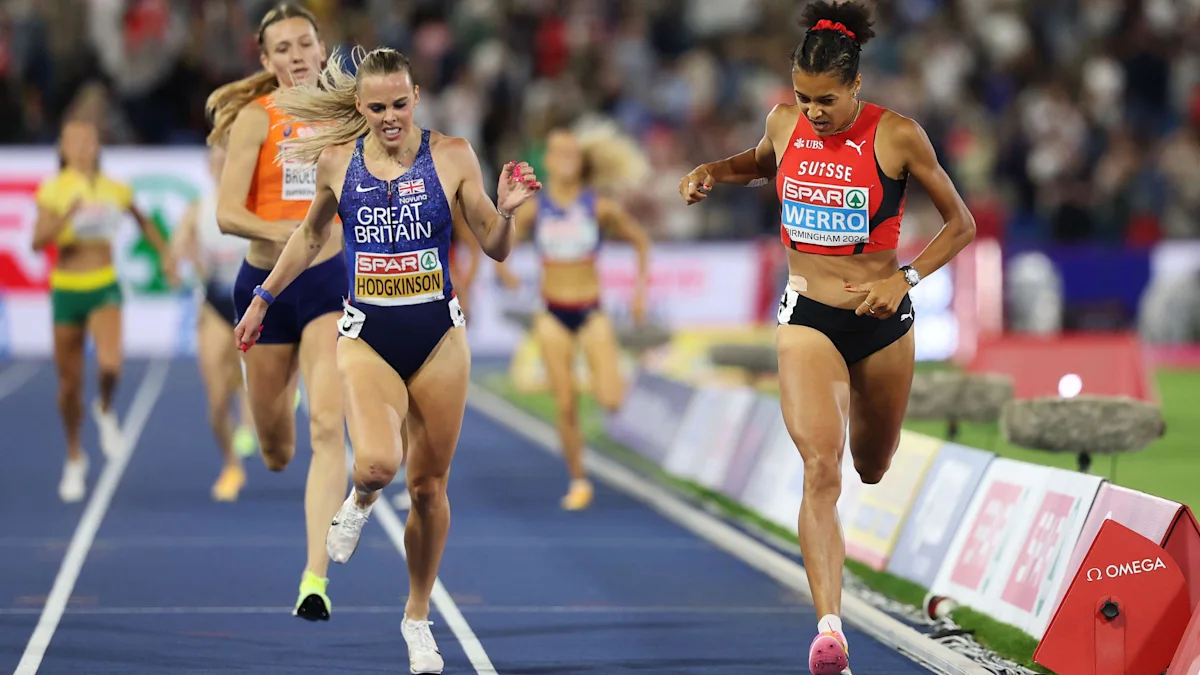
For 32 years, the women's 800m was absent from the Olympics, with its competitors deemed too frail. Now, it is one of the most hotly anticipated events on the track.
This extraordinary story starts at the 1928 Olympic Games, which represented a huge - if temporary - step forward for women's sports.
The Amsterdam Games were the first to allow women to compete in track and field events. Five women's events were added to the programme - the 100m, high jump, discus, 400m hurdles and, controversially at the time, 800m.
German athlete Karoline Lina Radke became the first woman to win Olympic gold in the 800m - but she would also be the last for another 32 years.
The event was removed from the Games after reports - later proven to be false - claimed competitors suffered extreme exhaustion after the race, and the International Olympic Committee decided women were too frail to compete over the two-lap distance.
Fast forward almost 100 years and the event now gets headline status at major events.
In recent times, it's been the battle between Britain's Olympic 800m champion Keely Hodgkinson and the Swiss European champion Audrey Werro that has captivated fans.
So how did the 800m become the 'one to watch'? BBC Sport spoke to the women who helped shape the race to find out.
It was the 1964 Tokyo Olympics, and Ann Brightwell (nee Packer) had just crossed the finish line of the women's 800m to take gold - and set a new world record.
In doing so, Brightwell became the first British woman to win an Olympic gold on the track, in a time of two minutes 01.1 seconds.
She told BBC Sport: "My husband, who was my fiance then, said to me, 'you don't realise what you've done'.
"I didn't give it a thought at the time… but now I realise I played a very small part in women running longer distances."
But the controversy hadn't completely gone away. Brightwell knew all about the claims that had seen women unable to compete for 32 years after the 800m was removed from the Olympics.
Brightwell adds: "Men weren't happy about women competing in these very high profile events…we were considered too frail and too delicate.
"And they took it upon themselves to make it look really bad. They were saying women were collapsing on the way round. But it was all a lie."
After 1928, women's middle-distance shrunk into the shadows for the next few decades.
The 800m was finally reintroduced to the Olympic programme in 1960 and, four years later, the then-22-year-old Brightwell went to her first Olympics, fitting training around her job as a teacher.
"Many people in my era either had to take unpaid leave or resign, or they got sacked because they were trying to juggle their sports with their career," she said.
"My school was very tolerant towards what I was doing, so I was fortunate."
Going out for a run around the local streets or countryside - which seems so commonplace today - was unusual in the era Brightwell was competing.
"If I just felt like an easy run, I would run around my village, around the streets… people commented on it or tooted their horns. And it was funny looking back, but it never troubled me," the now 84-year-old told BBC Sport.
Brightwell's 800m time of 2:01.1 stood for almost three years, before Australian Judy Pollock broke that with a new time of 2:01 flat in 1967.
The next target was to go under two minutes.
Breaking 'sub-two' - and a stubborn world record
"Records are great and medals are the best, but when you break a barrier it's a fantastic feeling," said Christina Boxer-Cahill (nee Boxer).
It was at the 1979 European Cup final in Turin that Boxer-Cahill looked up at the clock and realised she'd gone under two minutes.
She added: "I knew this would probably be my last chance, because there were other girls in Britain trying to do it."
In 1971, Germany's Hildegard Falck had become the first woman to break the two-minute barrier.
Eight years later, it was the 22-year-old Boxer-Cahill who became the first British woman to do so, in a time of one minute 59.05 seconds.
"It's a bit like when Roger Bannister broke four minutes for the mile. Once he'd done it everybody did it because you see what's possible," Boxer-Cahill, who is now 69 years old, told BBC Sport.
"I just think I'm so fortunate that I was in a sport where everybody accepted that you have men and women's races in the Olympics."
From 1971 to 1983, the women's 800m world record would be broken six times.
It belongs to Czech athlete Jarmila Kratochvilova, who ran a time of one minute 53.28 seconds at a meeting in Munich.
Kratochvilova's record has been questioned, with claims it was assisted by her country's doping regime that existed at the time, something she has strenuously denied.
In 2017, European Athletics proposed wiping out records set before 2005 - sending a strong signal that records set before then were disputable.
Several Soviet satellite states - including East Germany - are known to have been operating state-sponsored doping programmes throughout the 1980s.
At the 1988 Seoul Olympics, Boxer-Cahill finished fourth in the 1500m, behind a Russian athlete who was later banned for doping.
Boxer-Cahill said: "I was running during that Eastern Bloc era when, you know, they've looked back and some of the performances, there's sort of a cloud over it.
"I'd just have loved to have been on that rostrum. I wish the Eastern Bloc system hadn't been there, but that's what it was.
"Politics in sport, when you're the performer, it frustrates you. But if you get too frustrated, all it's going to do is upset your own performance."
"We've got not just two but several girls who are running under two minutes every time they turn out," Brightwell told BBC Sport.
Kratochvilova's 43-year-old record is looking increasingly precarious.
The 800m European champion Werro has come closest, running a time just 0.42 seconds shy of the record at the Zurich Diamond League.
Keely Hodgkinson, the current 800m indoor world record holder, told BBC Sport earlier this year that she's never felt closer to breaking the outdoor record.
She said: "I really do believe we can break it, but a lot of things have got to come together."
Hodgkinson is one of six athletes competing in the 800m at Athlos, the all-female athletics event taking place in London, on Friday.
"I do think the [800m] world record will go in the next year or two, and hopefully this season, because we're on a real high, aren't we?" Boxer-Cahill told BBC Sport.
"If it happens towards the end of the season, 2026 [would be] the year of women's 800m running."
Topics in this story
Gathered from external sources. Rights to this text belong to whoever originally published it.