Inside the NFL game management world tasked with preventing snafus like Commanders just had: 'It's irresponsible not to learn from others' mistakes'
Game-management coordinators typically speak more on the gameday headset than their position-coach colleagues. But it's not an exact science, as the Commande...
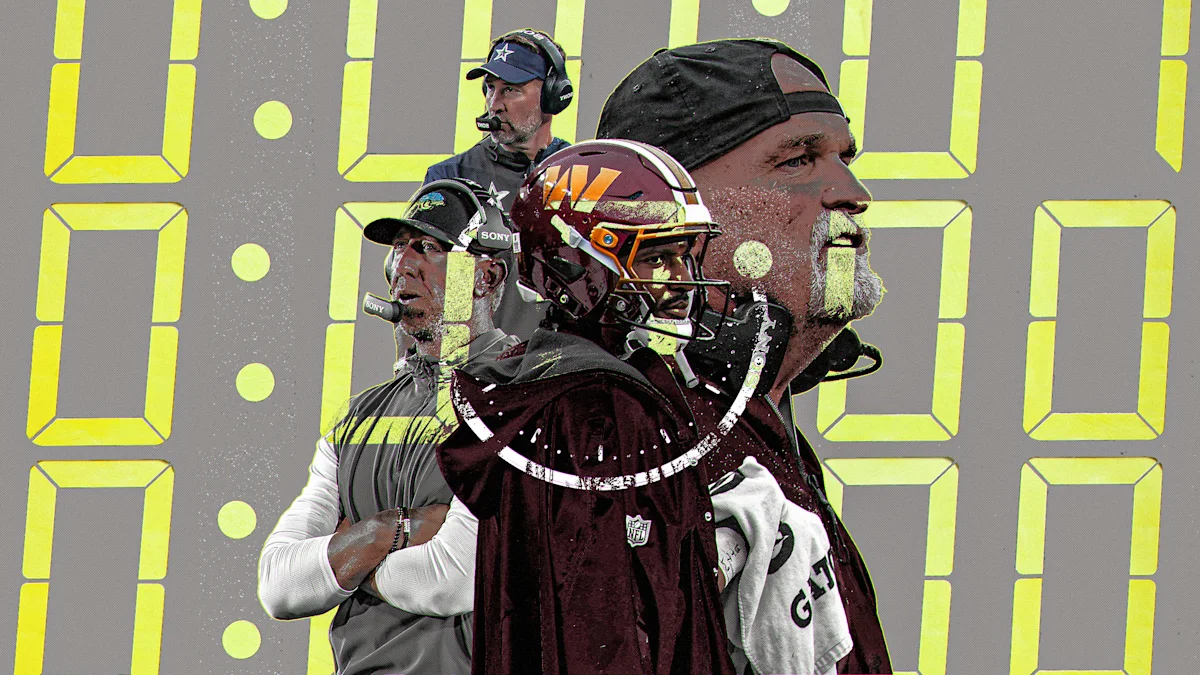
In an ideal world, the Washington Commanders would have had The Conversation before their last drive.
We have no timeouts. We can't take a sack. We need an out-of-bounds or end-zone play that sets up our kicker at his preferred hash.
In this ideal world, the Commanders would have already circulated end-of-game situational awareness through training camp and, to some degree, throughout practice and game-planning during the week. They'd have assessed their time cutoffs during training camp to understand how long several of their plays and operational considerations take, knowing precisely what they need to bleed the clock but still leave time for a spike and field-goal attempt.
And after all that had happened, in this ideal world, head coach Dan Quinn would have directed offensive coordinator David Blough before the Commanders' overtime two-minute drive what the team's yardage and play-clock threshold was to set up a field goal for a kicker who had already missed an extra point that day. Before the play that QB Jayden Daniels ultimately snapped with 12 seconds left, Quinn — perhaps aided by his game management staffers — would have reminded Blough the time cutoff for a spike, Blough would have reminded Daniels he can't take a sack and has no timeouts, and Daniels (perhaps running a play-call that didn't involve a personnel substitution and take more time) would have reminded teammates the situation. Daniels and teammates would have kicked into urgency mode to get the last spike off.
The Commanders still might have missed the kick. But perhaps they would have avoided the operational fiasco that triggered Quinn slamming his headset, part team owner Magic Johnson tweeting he was "in total disbelief my Commanders had such poor clock management," and Daniels telling his teammates of the missed chance that left the Commanders tied with the New York Giants: "It'll never happen again."
How many of these ideal steps happened? It's near impossible to know. But seeing the play triggered coaches and game-management coordinators around the league who know how much has to go right in those situations — and how colleagues' jobs and legacies are on the line.
"There are still paths to victory with basically every decision you make," one game management coordinator told Yahoo Sports. "Everyone wants to point fingers and blame one thing and it's not that simple. …
The Commanders' operational failure spotlighted the role of game management coordinators across the NFL, a group whose jobs help prevent these very snafus from happening.
But how does the process work? How do NFL teams manage game clocks, communicate on headsets and respond to the unexpected in real time? Yahoo Sports spoke to game management coordinators from six NFL teams as well as two former offensive coordinators to better understand. All except former offensive coordinator Scott Turner spoke on condition of anonymity due to concerns about competitive advantage surrounding their team's strategy. (Turner is not currently with an NFL team.) They also emphasized their goal was not to knock the Commanders or other teams with recent late-game struggles, knowing that their own teams and processes have each failed at one point or another.
And yet, "it's irresponsible not to learn from other people's mistakes — and from your own," one game management coordinator said.
So teams are discussing where the Commanders fell short and how to prevent a repeat.
"The fact that it's been so publicized, I think most of the teams are probably having more conversations about it," another game management coordinator said. "But in my opinion, the really good situational teams have already been having those conversations."
What do NFL game-management coordinators do?
Determining with certainty how many teams have an official game management coordinator is complicated. Titles vary dramatically from one game-management staffer to the next, some teams not even sharing publicly who runs this proprietary role for them. But a Yahoo Sports analysis of NFL media guides, LinkedIn profiles and conversations with coaches in the league identified 21 teams with a game-management role on their coaching staff and 11 teams who have tabbed a front office member to oversee responsibilities.
Roles differ among game-management coordinators but tend to start in the same place: managing timeouts; guiding decisions on when to go for it on fourth downs or 2-point conversion attempts; and establishing thresholds in two-minute play to manipulate the clock. From there, roles at times expand to helping head coaches determine when to accept or reject a penalty, devising and sequencing plays during the final two minutes of the half or game, and teaching players and coaches about situational moments that influenced games across the league the prior week.
"We have to be flexible," one game-management coordinator said, "because if you're doing stuff that's not hitting their brains, then it's worthless."
Some game-management coordinators present to the team one or more times each week during the season, while others collaborate specifically with the head coach or head coach and coordinators. Gradually, trusted game managers around the league are spending weekday time in the quarterback room given how crucial coach, play-caller and quarterback alignment is in situational, less-repped moments.
"Those three people need to be on the same page," a game-management coordinator said.
Game-management coordinators typically speak more on the gameday headset than their position-coach colleagues, but how active they are on the headset differs, they say. Excelling in the role often requires a keen understanding of coaches' personalities and temperaments.
Game-management staffers assess: Does my play-caller prefer to know the viability of four-down territory after first down or after second? How concisely can I deliver all necessary information when an offensive play-caller is not in conversation with the quarterback and the defensive coordinator not communicating to the "green dot" mic-ed up player? What's the most important information and who needs it? Does my play-caller prefer a constant stream of reminders or primarily quiet to think?
Different coaches warrant different game-management styles.
"I'd much rather get told to shut up on the headset than to not say something and do something stupid out there," one game-management coordinator said.
Added another: "People do freeze up as the clock's ticking down, and there's so many people that have the ability to speak up, but you'll be surprised in those situations how sometimes people defer or they're scared to say something out of turn in a stressful situation.
"You'll be surprised how often it's crickets."
Some head coaches want game-management coordinators talking on the "main" headset lines for offense and defense (and special teams, if the special teams coordinator wears a headset, which not all do) while other head coaches (often non-play callers) prefer a clean line for their game-management coordinator to relay information directly to the head coach, and the head coach to then relay. Sometimes the goal is to inform a decision; other times, to announce it. Guidance will factor in advance scouting of opponents — how does this opponent defend out-of-bounds plays? Hail Marys?
The nuances of weighing odds and influential factors swirl in coaches' heads, but the decision-making goal remains generally the same.
"We're totally just in risk management," a game-management coordinator said.
Recent Cowboys, Eagles losses a reminder that decision making 'not black and white'
Practicing situational periods across training camp and in-season practices is standard for NFL teams. Visit a training camp, and it's rare to see a practice that doesn't include a situational period given how often NFL games come down to the fourth quarter and game-winning drives.
But one game management coordinator estimated the math as such: Imagine a team practices its bread-and-butter plays three to five times a week. Given the variety of situational outcomes, a team is more likely to practice a single type of situation once every two to three weeks (with other situations practiced in the interim).
"I think most teams hit a two-minute drive every week in practice," the coordinator said. "Now, do they have an end-of-game clock situation that comes up? Maybe, maybe not. Definitely not every week. …
"You can only spend so much time for the amount of times it's going to come up in a game. You'd love to rep them all a million times and be perfect at them, but it's not realistic."
The Commanders aren't the only team to cough up a recent game in the final seconds. The Dallas Cowboys tied the Baltimore Ravens with 7 seconds to play in Rio de Janeiro in Week 3. Overtime seemed imminent, and Dallas opted to kick a touchback that set up the Ravens at their own 35-yard line. A defensive gamble followed, Lamar Jackson completing a 27-yard pass to Zay Flowers and then calling a timeout with 1 second left. Ravens kicker Tyler Loop kicked a game-winning 56-yard field goal to secure the 34-31 victory.
Should the Cowboys have forced a return?
"I hurt our chance to win that game," head coach Brian Schottenheimer told reporters afterward.
The Philadelphia Eagles' loss to the Jacksonville Jaguars last Sunday called into question Schottenheimer's statement.
Playing in London, the Eagles kicked a go-ahead field goal with 8 seconds to play. They chose to kick the ball in bounds, seemingly needing just one good stop from their kick-return unit to guarantee victory. Jacksonville running back Ameer Abdullah executed a well-devised and well-blocked 53-yard return, leaving 1 second on the clock. Kicker Cam Little — who holds the NFL record for longest made kick, at 68 yards — connected from 57 yards. Jaguars win 19-17.
The scenarios weren't completely identical. But they were similar, the Cowboys and Ravens opted for opposite strategies, and each lost.
"Having two different outcomes just shows you that it's not black and white," a game-management coordinator said.
And while game-planning is crucial, strategy can only take a team so far, former NFL offensive coordinator Scott Turner told Yahoo Sports.
"At some point, you still have to tackle people, you still have to cover a kickoff," said Turner, who coordinated the Carolina Panthers, Washington Commanders and Las Vegas Raiders offenses in various stints between 2019-24. "The game management stuff [is] all tools. It's information. But you got to block people and you got to tackle people and you got to catch it and you got to run good routes."
The Commanders have their first chance to move forward from their botched end-of-game on Monday, when they face the 5-0 San Francisco 49ers on the road in prime time. The spotlights will be bright. The opponent, by record, more successful.
Throughout the weekend, expect not only the Commanders but every NFL team to dial in on how they prepare for situational football and how they communicate that preparation in the heat of the game. Expect play-callers to await the advice, and the communication, streaming through their headsets.
"Just that overcommunication, making sure everyone's on the same page," a second former offensive coordinator said. "So when all hell's breaking loose, no one's caught off guard."
Topics in this story
Gathered from external sources. Rights to this text belong to whoever originally published it.