Aaron Rodgers' legendary secret language: How the Steelers' Google Doc of roughly 75 hand signals sets bar for NFL cat-and-mouse game
Yahoo Sports canvassed 17 players and 10 coaches across 11 NFL teams to better understand the chess game of hand signals for Rodgers and beyond. Their perspe...
LATROBE, Pa. — On the first day of Pittsburgh Steelers training camp last year, Aaron Rodgers sat down with quarterback Will Howard .
Rodgers' intent: Initiate the rookie as the latest NFL backup quarterback to manage his starter's hand signals.
"He gave me kind of the baseline of like, 'All right, hitch, slant, routes, a couple of combinations here and there, some formation signals …'" Howard told Yahoo Sports during training camp. "We would kind of evolve it as we went. So it started off with probably 25, 30 signals and then it ended up being like 75 by the end of [the season]."
Most NFL teams in today's game use far fewer than 75 signals at the line of scrimmage during a season, coaches and players say. But most NFL quarterbacks are not Rodgers. No other active quarterback has his deep trove of 260 regular-season starts. No other active quarterback owns four MVP honors.
So as Rodgers' mental bank of the game grows, so too do his signals evolve in concert. Teammates know "you better be tuned in," Steelers receiver Ben Skowronek told Yahoo Sports, because "in the huddle, it's going to be real brief." Opponents know Rodgers is liable to use more signals — real and dummy — than the quarterbacks they face most other weeks.
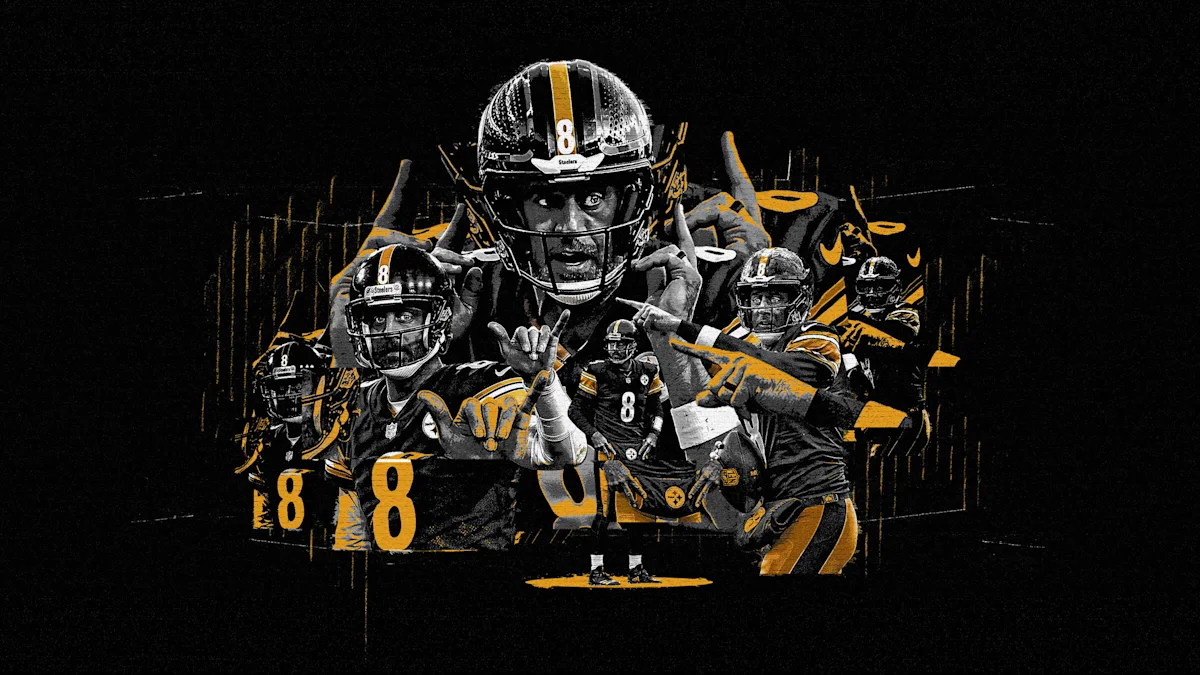
In a 30-27 win Sunday over the Cincinnati Bengals , Rodgers prepared for one snap by touching his towel with his right hand before and after beckoning with his left ahead of a first-quarter completion to Roman Wilson . He tapped his helmet, pointed in various directions, balled his left hand into a fist and motioned a semicircle like a steering wheel — all before the first quarter expired.
Then came the left shirt waist touch in the second quarter, the right fist behind his back followed by crossing his wrists out front on the same play in the third. By Rodgers' fourth-quarter fists, points and beckoning gestures, a viewer had reason to wonder: Which were meaningful and which were decoys? Defenders ask themselves that question weekly.
"He's definitely a savant," Ravens cornerback Chidobe Awuzie told Yahoo Sports. "He's looking, he's looking, he's doing this, he's doing that. Giving a little signal here, he's changing his split here, shifting the back out to empty, shifting the back back in. …
"He's keeping that brand of football alive."
Yahoo Sports canvassed 17 players and 10 coaches across 11 NFL teams to better understand the chess game of hand signals played by Rodgers and beyond. Their perspectives revealed a mosaic of strategies employed by offenses looking to control games and defenses looking to neutralize threats.
Rodgers is far from the only one to channel the fading era of line-of-scrimmage masters. But players and coaches agree that the 22nd-year Rodgers' signals have developed a life and lore of their own. The roughly 75 signals the Steelers used last year exceeds the Denver Broncos ' 15-25, Baltimore Ravens' 20-30, and Philadelphia Eagles and Seattle Seahawks ' 50-60 each, per coach and player estimates at each team.
So as the Cleveland Browns host the Steelers and 42-year-old Rodgers on Thursday Night Football, what should they beware?
"What you're seeing from Aaron, I'm sure it looks different than what you saw from Aaron," Denver Broncos head coach Sean Payton told Yahoo Sports. "It's that house that keeps expanding in the Hamptons. Now we've got a third bedroom up here for the in-law suite and you're like, 'When did that get built?' 'Well, it just got built a couple summers ago. They wanted to see the ocean.' There's no master plan.
"It's just the house that just keeps going with no government or local restrictions. That's what [his system] looks like."
As QB signals get creative, 'it happens a lot more than people realize'
Not everyone relies on a signals Google Doc like the Steelers do.
The Seahawks last year tracked their signals in a hard-copy notebook, quarterback Drew Lock told Yahoo Sports, as then-offensive coordinator Klint Kubiak also limited weekly game plans to hard copies that were shredded in the corner of the room after each contest. No secrecy measure spared.
The Eagles displayed their signals, which sometimes resulted from Jalen Hurts and Tanner McKee Googling sign language, on their meeting room board. But they chose to limit signal usage in training camp so players who were cut and landed on other teams couldn't leak the code to their next team, McKee told Yahoo Sports.
"Pretty much every game there is at least a couple plays [where] nobody really knows, but it means something and it's going to change the whole play," McKee said. "Sometimes it's the obvious ones where you're tapping the helmet and you're yelling out different things and it's a real obvious call. But some of them are pretty discreet.
"I would say it happens a lot more than people realize."
The more a team plays in prime time, the easier it is for opponents to track hand signals and code words given the increase in camera angles and microphones for the broadcast. Dallas Cowboys quarterback Dak Prescott knows his sleights often land on TV copy, so he switches them.
"There's kind of this base one that I have of like, 'Yeah, this means slant,' but if I've done that too much and put it on film, I'm going to change it up," Prescott told Yahoo Sports. "It's actually a fun kind of back and forth to even create them with the guys. Sometimes, I'm like, 'Hey, I need a word for [this]' and they'll all be thinking.
The most common hand signals across the NFL guide teams through two-minute situations, when up-tempo offenses aim not to huddle and thus need to communicate nonverbally. Single-receiver signals build from there. Washington Commanders quarterback Jayden Daniels will motion to a receiver whose one-on-one matchup in man coverage dictates a favorable matchup, he said. Single-receiver signals are often more subtle than signals that change an entire play and thus need to reach 10 other players. Film against the Minnesota Vikings , a blitz-happy team with a high-decibel stadium, is likely to show more signal examples, coaches say. Other signals could indicate a quarterback shifting his protection between right and left, or calling for a player to motion.
Potentially telling motions range from pulling on a chin strap and tapping the sides of a helmet to touching the thigh pad or pulling at the waist of a jersey. Points in different directions could mean different things. A butt pat or thumbs up is often notable. The Broncos began with digits zero to 10 after drafting Lock in 2019, he said. Defensive backs study these signals more often than linemen, whose pre-snap stances might cloud their vision. Linemen instead sometimes listen to "bug reports" to guess code words, Broncos edge rusher Zach Allen keeping scouting reports from past years to track play-callers from one stop to the next.
"I'll literally have my wife go through my office and be like, 'Hey, can you find 2020 this because this coordinator was there and see …?" Allen told Yahoo Sports. "I remember [Shane] Steichen when he was in Philly going to Indianapolis , there was a little bit of similar stuff."
Whether signals or code words, a challenge lingers: The same word or motion means plenty at some times and absolutely nothing at others. Defenses relying on their advance scouting have been burned.
"I stopped doing that years ago," Broncos defensive coordinator Vance Joseph said of emphasizing signal analysis. "It's like chasing a ghost. And if they're smart, they're going to change those signals. … You spend so much energy on it [then] it never happens and you lose track of the basic stuff."
Energy spent scouting former NFL quarterback Tom Brady 's signals touches a particular sore point across the league.
Joseph remembers a 2012 or 2013 game against the Patriots when Brady was signaling a screen by tapping his foot. Joseph screamed "screen, screen" only for Brady to adjust to a screen-and-go.
Safety Brandon Jones remembers playing in a Dolphins-Buccaneers game when the Dolphins thought they disguised their Cover 3 zone defense by aligning as if in man. Brady wasn't fooled.
"He starts screaming out, 'Cover 3,'" Jones told Yahoo Sports, "and I'm just like, 'OK, this guy's just different."
And 49ers linebacker Fred Warner hasn't forgotten a 2022 signal in which Brady prompted 49ers defenders to gun toward an expected screen. Brady instead threw a go ball to Mike Evans, who raced the remaining 68 yards to the end zone .
An offensive holding penalty nullified the score. But the lesson Warner learned stuck.
"You want to be able to pick up on certain things, but it's just not absolute," Warner told Yahoo Sports. "Whether it's hand signals, formations, personnel, something might be like 99.9. But there's just always a chance that it's just not going to be that in a game setting. …
Defenses adopt Rodgers-specific strategies in hopes they won't 'look like an idiot'
Coaches from three teams that have faced Rodgers since he joined the Steelers were split on how to handle his rotation of signals.
One AFC assistant said they didn't pay attention to Rodgers' signals given how often he changes them. An NFC assistant remembered that when Rodgers pretended to put a belt around his waist with both hands, he was most often calling a screen against blitz looks — except, of course, the times when Rodgers changed that call anticipating defenses would expect the screen. An assistant from a different AFC team noted how Rodgers' signals stand out.
"He signals things really fast," the assistant said, speaking on condition of anonymity due to competitive advantage concerns. "Some of the QBs like to be very demonstrative to make sure it's clear. He is very quick and, what did he actually just do there? I don't know.
"You can't guarantee week to week that the same thing means the same thing because then you bite on it and it's a double move or something. And then you look like an idiot."
So defensive coaches have needed to get creative.
Sure, much of game plans this year focus on Rodgers' dipping athleticism and mobility in his 40s. The New England Patriots in Week 2 capitalized on Rodgers' shoddy protection, pressuring him on 38.6% of dropbacks, per Next Gen Stats. Against the Bengals on Sunday, Rodgers fared better against pressure and threw for two touchdowns of 20+ air yards after failing to complete any of his nine deep pass attempts in the first two weeks.
What do the Browns expect as the Steelers arrive in Cleveland as 2.5-point road favorites?
"He's got an unbelievably quick trigger, I mean, he can just flick it, unbelievably accurate," Browns head coach Todd Monken said. "There's not anything he hasn't seen. When you talk about a student of the game, not only has he seen it, but highly intelligent.
"You have to do a great job with your disguises."
Can defenses fool Rodgers? They're more likely to try in today's NFL than a prior era, Washington Commanders head coach Dan Quinn said.
"Because his [football intelligence] is so high, you can do a little bit more from a disguise standpoint to try to mess with him," Ravens defensive coordinator Anthony Weaver told Yahoo Sports. "Some of these younger quarterbacks nowadays, you can disguise all you want and they don't care. They're going to find the space, post up and usually it's a lot of predetermined throws.
"With Aaron, you know he's trying to figure it all out."
Meanwhile, Steelers teammates will keep trying to figure out Rodgers' signals. That's proven a stressful task even for later-career veterans like 12th-year receiver Adam Thielen last year and seventh-year Michael Pittman Jr. this year, each said.
Howard led signal meetings for offensive players the morning before game days last year, he said, a common practice around the NFL that ranges from receivers parroting the signals back in a meeting to occasional signal walkthroughs on the field.
Most signals are covered in meetings. But sometimes Rodgers will give a heads-up to one receiver at the line of scrimmage who then tells the next what to expect after the snap, Skowronek said.
"He definitely takes pride in the signals," Skowronek said. "And then sometimes he signals something [in practice] that maybe he used in the past and you're like, 'What the f*** is that, Aaron?'"
When that happens, it's time to return to the Google Doc. Will there be another entry? Or will self-described "signal dictionary" Howard simply remind players of the tried-and-true existing plan?
"It's a lot of signals," Steelers receiver DK Metcalf told Yahoo Sports. "But I mean, they help us win football games at the end of the day when we're all connected."
Jori Epstein is a senior NFL reporter for Yahoo Sports and the author of 'The Upstander: How Surviving the Holocaust Sparked Max Glauben's Mission to Dismantle Hate.' She previously reported for USA TODAY and The Dallas Morning News. Follow Jori on Twitter @JoriEpstein.
Topics in this story
Gathered from external sources. Rights to this text belong to whoever originally published it.