The Rams think they've figured out jet lag. Australia is about to test their theory
The Rams and 49ers are about to embark on the longest road trip in NFL history. They've also come up with radically different ideas for how to survive it.
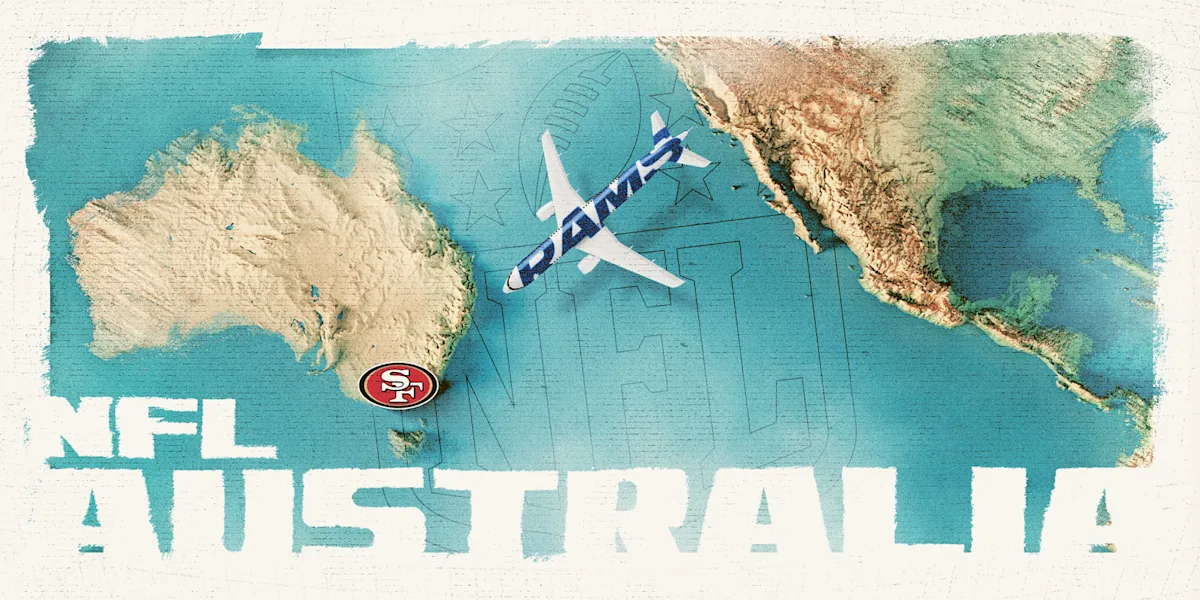
Ten months ago, the Los Angeles Rams conducted an audacious experiment.
They sought to reduce the toll that transatlantic travel takes on players' bodies by approaching a game in London like a hit-and-run mission.
Instead of flying out a few days before kickoff the way most NFL teams do, the Rams arrived in London just a day before facing the Jacksonville Jaguars and began their journey home soon after the final whistle. There would be no need for body clocks to adapt to the eight-hour time difference, the Rams theorized, if the trip was as short as possible.
Poking holes in the Rams' tactics became harder over the course of a crisp 35-7 pummeling of a Jaguars team that lost only three other games last regular season. "The way the guys played showed it was the right decision," Rams head coach Sean McVay told reporters after his team brushed off the absence of injured star receiver Puka Nakua, charged to a 21-0 halftime lead and coasted to a blowout victory.
Emboldened by last year's successful trial run, the Rams are getting even more daring. They're applying the same philosophy to the longest trip in NFL history, a 16-hour flight to Melbourne, Australia, covering nearly 8,000 miles. Australia hosts its first regular-season NFL game at the Melbourne Cricket Ground on Friday, Sept. 11, when the Super Bowl favorite Rams open their season against the San Francisco 49ers. Kickoff is at 10:35 a.m. in Melbourne so that the game airs in prime time on Thursday, Sept. 10, back in the U.S.
Join or create a Yahoo Fantasy Football league for the 2026 NFL season
The Rams plan to fly into Melbourne the day before the game and fly out immediately after, ESPN reported last month . Neither McVay nor team officials have been willing to confirm the team's travel itinerary, but the Rams head coach recently admitted to reporters, "We're leaving later than most people would probably expect."
The 49ers, conversely, are leaving for Melbourne on Sept. 2, a full week ahead of kickoff to give themselves as long as possible to recharge after a long travel day and adjust to the 17-hour time difference. The drastically different approaches have captured the attention of sleep scientists who study athletic performance and sparked spirited debate over which is preferable.
"The Rams will win the game," predicted neurologist and sleep specialist W. Christopher Winter with Joe Namath-like confidence. The basis for Winter's guarantee is not the strength of the Rams' star-laden roster but the timing of their last-minute arrival in Melbourne.
To Winter, the 49ers' decision to fly in early and acclimate to the time difference could backfire because of the morning kickoff time in Melbourne. The timing of the game, Winter said, favors the team whose body clocks are still on Pacific Time rather than the one who has already spent a week in Australia.
"Athletes generally reach their physical peak in the late afternoon and early evening," said Winter, a sleep consultant to more than a dozen teams across American professional sports.
"So what the Rams are essentially doing is saying to their players, 'Look, just keep being athletically awesome at 6 p.m. You're going to open your eyes one day and the sun's going to be in a weird part of the sky, but we're banking on it taking your brain a couple days to figure out what the hell's going on. By then you'll have already beaten the 49ers and you'll be heading home.'''
The kickoff time is favorable to the Rams, Dr. Meeta Singh conceded, but the Michigan-based sleep specialist argued that the downsides to a last-minute arrival in Melbourne far outweigh the potential benefits. Several times during a phone conversation with Yahoo Sports, Singh said she was curious "what the Rams were thinking to come to the conclusion that this travel plan is their best option."
The way Singh sees it, the Rams risk playing the game at a major sleep deficit by journeying to Australia so close to kickoff time. It's difficult for most people to get anywhere close to a full eight hours of sleep on a plane, Singh argued, even an NFL charter flight that no doubt features recliners or lie-flat seats designed to accommodate the massive frames of professional football players.
"The issue is whether they're going to get enough sleep the several days before the game," said Singh, who has served as a sleep optimization consultant for NFL franchises and for other college and professional teams. "If you're exhausted or sleep-deprived, your performance slips. That's the worst-case scenario."
NFL teams have always hunted for opportunities to gain a microscopic competitive advantage over their opponents, but for decades sleep science went overlooked. While nutrition, hydration and strength training and conditioning became part of players' daily regimen, teams seldom prioritized optimal sleep to the same degree.
In 2011, sleep physician and performance specialist Cheri D. Mah and a team of fellow Stanford researchers published a groundbreaking study demonstrating that optimal sleep is a key factor in peak athletic performance. Mah and her colleagues asked Stanford basketball players to aim to sleep 10 hours per night for a period of 5 to 7 weeks. At the end of that sleep extension period, the players collectively sprinted faster, shot more accurately and reported improved performance in practices and games.
Subsequent studies by Mah and others in her field found that elite athletes often competed while sleep-deprived and travel-weary and their performance suffered as a result. Those athletes displayed a range of symptoms, from impaired judgment, to slower reaction times, to reduced speed, precision and endurance, to greater susceptibility to injury or illness.
"It's not even just like having a beer," Mah said. "There's actually a study that shows if you are awake 17 hours, your reaction time is impaired to the same level as being legally intoxicated in the United States."
Eyes opened by the new research, savvy NFL teams began exploring how they could gain a potential competitive edge by altering their travel and practice schedules to optimize how players and coaches slept. Inexpensive methods of monitoring sleep and recovery also hastened the NFL's sleep science revolution, as did the increase in international travel as the league sought to grow its global fan base in strategic markets.
"Sleep is a weapon," Mah often says when speaking directly to NFL players. She recommends they get 8-to-10 hours of sleep per night, urging them to accelerate time-zone acclimatization by going to bed an hour or two earlier in the days leading up to a west-to-east flight and by getting plenty of early morning sunlight upon arrival.
When advising NFL teams, Mah recommends treating travel as a performance tool by designing the itinerary around circadian biology. Teams taking charter planes to international games can reinforce the shift in body clock they're seeking by better timing their mid-flight sleep and meals. Mah also recommends teams provide eye masks, noise control and other tools to help players maximize sleep quality.
"I truly believe that sleep and body-clock strategy is still one of the most untapped competitive advantages in sports," Mah said. "Teams that are leveraging these strategies are going to have such an advantage over those that haven't thought about them."
When asked specifically about the NFL's first Australia game next week, Mah said there are pros and cons to the travel itineraries of both the Rams and 49ers.
The kickoff time favors the Rams' approach of trying to stay on Pacific Time, according to Mah, but the 49ers can mitigate that disadvantage by practicing at 10:30 a.m. in Melbourne once they arrive. Travel fatigue from the 16-hour flight will work against the Rams, but they too can reduce the damage by banking sleep before the trip, appropriately timing meals and sleep and controlling light on board the plane and at the team hotel.
Ultimately, Mah is a pragmatist. She knows how fans will decide whether the Rams or 49ers had the smarter travel plan.
"Whoever wins," Mah said with a laugh, "that's what will be considered the right strategy."
Gathered from external sources. Rights to this text belong to whoever originally published it.