Grading Michael Wilson's $75 million extension to uplift Cardinals offense
Is Wilson ready to be a true WR1? Or was his 2025 breakthrough a product of circumstance that can't be duplicated?
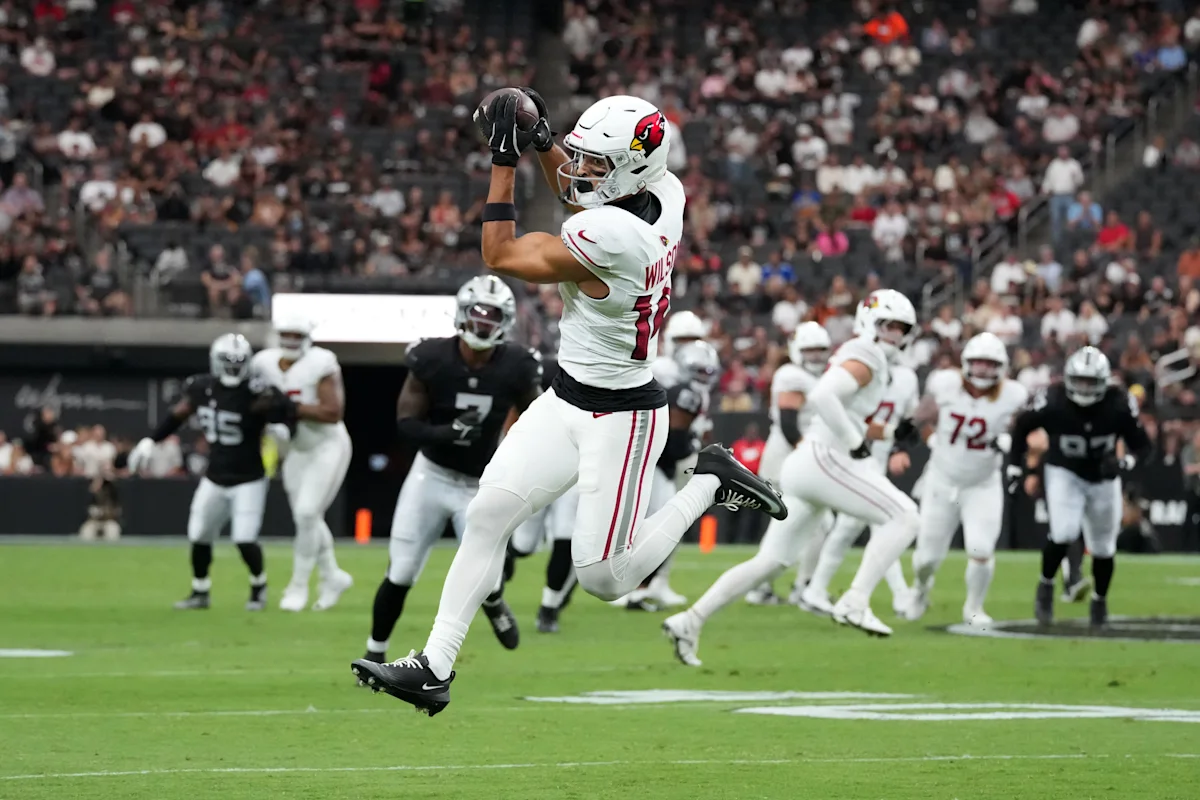
The Arizona Cardinals hoped 2025 would be the year Marvin Harrison Jr. fulfilled his promise as a former top five draft pick. It was a different young wide receiver who rose up instead.
Wilson caught fire late in his third year as a pro. After a modest start, he put up a 119-catch, 1,600-yard, 13-touchdown full season pace after Week 11 for a Cardinals team in desperate need of playmakers. He finished the year with more than 1,000 receiving yards. While a good chunk of that can be attributed to a bad team trailing often and throwing the ball more than any other NFL team, it was still encouraging.
On Thursday, Arizona rewarded his rise. The Cardinals reportedly signed the 26-year-old wideout to a three-year, $75 million contract extension with $47 million guaranteed. It's a deal that will keep him in Glendale to see through another wave of his team's attempt to find a franchise quarterback. But was it the right move?
The deal: Arizona Cardinals sign WR Michael Wilson to a three-year, $75 million contract extension with $47 million guaranteed
Wilson was a pleasant complementary piece in 2023 and 2024. He looked to be locked into a similar role in 2025, but the transition from Kyler Murray to Jacoby Brissett helped spark a prolific finish to his third season.
Was some of that a Marqise Lee/ Jacksonville Jaguars "we're trailing and gotta throw the hell out of the ball in the second half" type opportunity? Certainly! But Wilson's underlying numbers suggest this is sustainable (and, also, Lee was pretty useful in 2017 when Jacksonville probably should have made it to the Super Bowl).
Despite playing with subpar quarterbacks, Wilson has recorded a catch rate over expected (CROE) of at least plus-4.5 percent in each of his seasons as a pro. He's had a positive yards after catch over expected (YACOE) in all of those years as well. He was a positive force on all three levels downfield, but made his biggest impact as an intermediate, chain-moving resource 10-19 yards downfield (plus-8.3 percent CROE, 9.8 yards per target and a ton of contested, Jacoby Brissett-bailing catches).
That's proof he can be an uplifting force for a flawed quarterback. And if there's one thing the Cardinals have lots of, it's flawed QBs. He can be the huckleberry for Brissett, Gardner Minshew II or Carson Beck this season. He can be the huckleberry of whomever the team drafts near the top of the first round in 2027.
He'll also help draw focus away from Harrison. The tantalizing prospect was largely inactive as Wilson rose to WR1 duties, but Harrison's seven target, six-catch performance in Week 13 helped show how these two can help each other. Then again, his average separation per target in games played alongside a surging Wilson was only about 1.6 yards, which suggests he wasn't getting open a ton despite having someone opponents needed to bracket.
So this isn't just a move that shores up the receiving corps; it's a reasonable insurance policy should Harrison never meet his potential. Wilson's $25 million annual average salary ranks only 20th among wide receivers. It's a proper bet, but not a franchise-altering one.
He probably won't average 1,600 yards per season over the life of that deal, but if he's even 85 percent as effective as he was to close out 2025 it will be an underpay. The only concern is the small sample size involved, which knocks this down from an "A" when Arizona could have waited to see if Wilson still had the juice, franchise-tagged him next spring and worked out a (more expensive) deal in the offseason.
Topics in this story
Gathered from external sources. Rights to this text belong to whoever originally published it.