Rams Are Testing the Limits of Sleep Science Before Australia Game
The 49ers are already there, while the Rams have yet to leave.
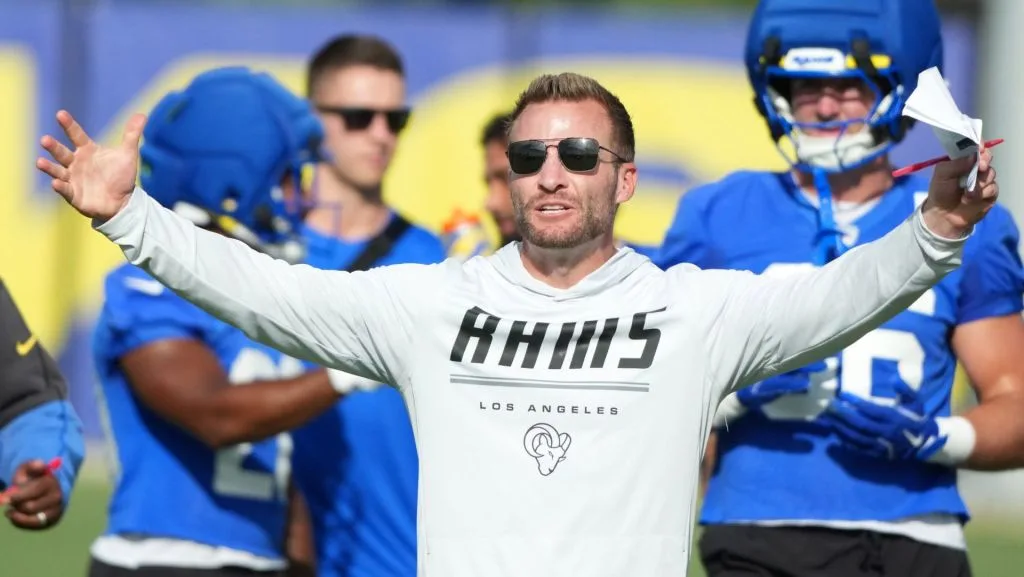
When the Rams and 49ers play next week in Australia on the second day of the NFL season, their game plans will be dissected and debated. Their travel plans will be scrutinized as well.
The NFL is continuing to push the logistical boundaries of its bid to expand its international appeal with this Thursday-night game, played Friday morning in Melbourne.
"This is new," Peter O'Reilly, the NFL's EVP of club business, major events, and international, said in a video news conference this week. "You learn things every year. This is further than we've gone for a regular season game. But we feel really confident in the plan and the work we've done over many, many months working with the teams and our partners on the ground there in Melbourne."
The teams have taken wildly differing approaches to traversing the globe and trying to promote peak on-field performance.
The 49ers made their roughly 8,000-mile, 16-hour flight this week and already are in Australia, giving their players and coaches about a week to acclimate to the time zone, which is currently 17 hours ahead of California. The Rams have remained in Los Angeles to sleep in their own beds and practice at their own training facility for as long as possible before traveling next week; they are expected to arrive in Melbourne about 24 hours ahead of the game.
Dr. Jamie Zeitzer, a Stanford research professor who specializes in sleep medicine, said there are potential risks and benefits with each approach.
If the Rams' attempt is to have their players essentially operate on California time even while in Australia for their comparatively short stay there, Zeitzer told Front Office Sports , "that's kind of difficult to do, even if it's just for a day or two."
The circumstances must be very controlled.
"The main thing that you want to do is avoid light during the nighttime in California. So whenever it's night in California, you want to avoid light when you're in Australia, if you want to stay on California time," Zeitzer said. "My guess is they have the financial resources to do that. They're probably going to have a hotel where it's going to have blackout shades in the room and they can have their meetings in darkened ballrooms if necessary and have private chefs cooking for them breakfast, lunch, and dinner when they're expecting to have it in California, not necessarily the time in Australia."
The other issue with traveling so close to game time, he said, is the lingering effect of such a lengthy flight. Their travel accommodations will be top-notch, but "there are still negative consequences of being in a plane for that long in terms of your physical fitness," he said. "I do think they are risking that aspect of it. Even though it's nicer, it's [still] harder to sleep. And so are they going to be a bit sleep deprived from that plane ride? Is their circulation going to be as good? I think there is a risk there."
As for the 49ers, they might get close to acclimating by being in Australia for a week—but Zeitzer said even they probably won't fully adapt, either.
The kickoff time—10:35 a.m. Melbourne time Friday, which is 8:35 p.m. ET Thursday—will also test both teams' sleep strategies. There are two factors at work, Zeitzer said.
"One is the psychological aspect—like, 'I don't exercise at 10 o'clock in the morning.' But the other is the biological one. If you can spend the previous week basically training your body into expecting to need exercise at that time of day, then in theory it's going to be O.K. But, again, it's definitely a risk," he said.
In many cases when athletes compete in elite competition in a different time zone, they'll arrive far earlier than even the 49ers have for this game. "Usually when people do this—and they'll do it all the time for the Olympics—wealthier countries like the U.S. will send athletes like a month in advance to adapt. And you can basically try to time your exercise or your training to line up with when you're going to be expected to perform in a game," Zeitzer said.
If he'd had to choose, he would have picked the 49ers' approach.
Going any later, "there's pretty significant risk in taking a flight that long of having your sleep be pretty disrupted on that kind of flight and not having enough recovery time once you land … Going down and adapting, I think, is going to be better," he said. "I think there's a better chance of having optimal physical performance there."
The Rams, the widely acclaimed Super Bowl favorite entering the season, took a similar short-lead approach last season to a game in London. They remained in Baltimore following an October game against the Ravens the weekend ahead of their London trip, and practiced at Oriole Park at Camden Yards. They got to London similarly "late" and beat the Jaguars handily, 35–7.
"We felt like staying in our rhythm and routine and then traveling when we do… the thinking in its simplest form is what do we deem [is] the best for our football players and for them to try to be at their best," coach Sean McVay said in a news conference Friday. "There's different approaches and theories. But I do have a lot of trust in our group. And we'll see. Hopefully it works out. And I know that we've got a bunch of guys that I think will feel good about the plan."
The Rams are 3–0 under McVay in international games. He said he accepts the proposition that the Rams' travel approach will be subject to potential criticism if they lose to the 49ers.
Although arriving earlier can, on the surface, have fewer risks, "is there a right and a wrong?" Zeitzer asks. "I think it really has to do with how well you can control the behavior of grown men in this case."
Gathered from external sources. Rights to this text belong to whoever originally published it.