‘This is a hate-hate relationship’: Why Miami-Notre Dame still burns after all these years
When the No. 1 Hurricanes visit the No. 11 Fighting Irish this weekend, it is impossible not to mine the past for an appreciation of the present.
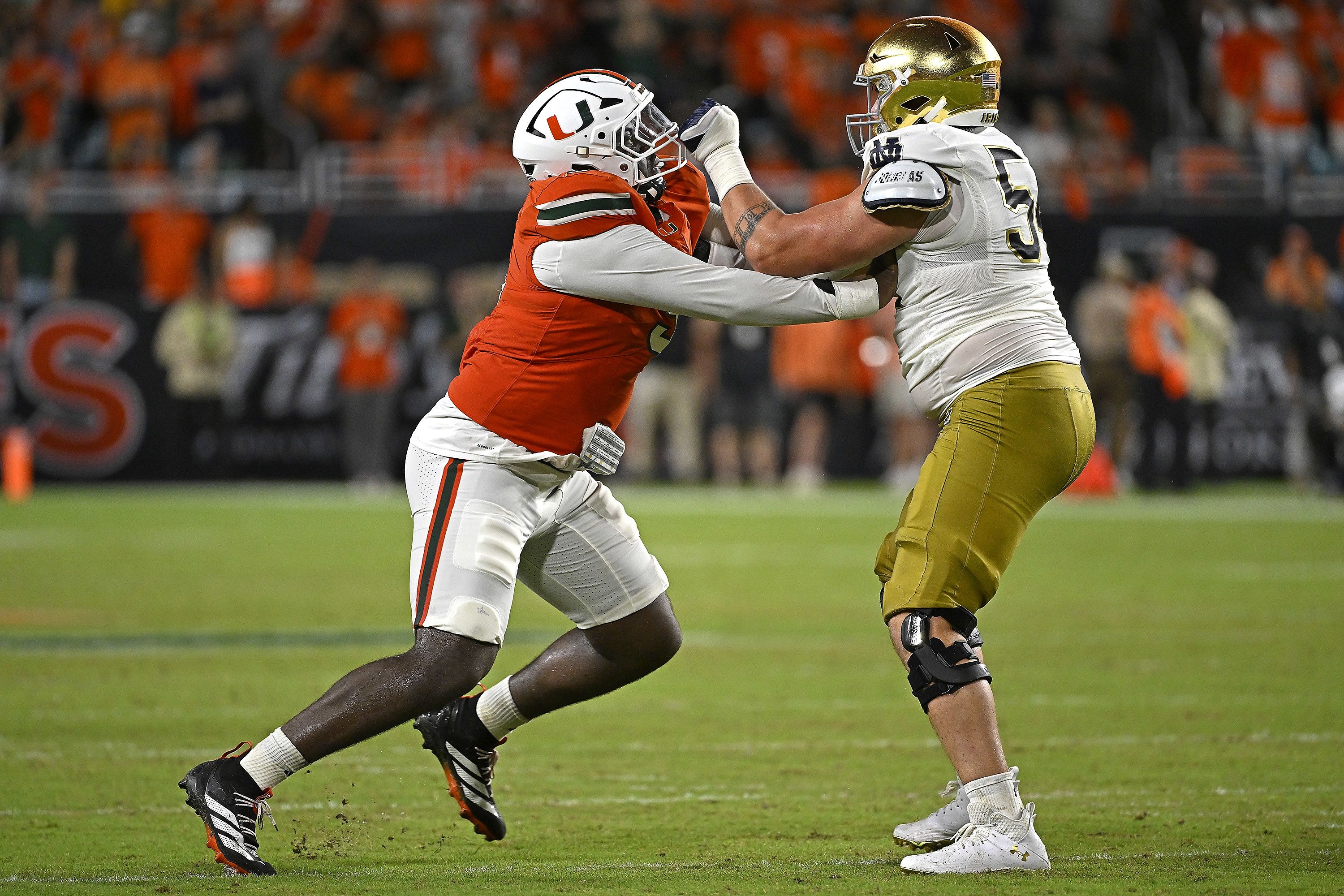
In January 1955, a full nine months before the first kickoff between Miami and Notre Dame, “harried” University of Miami officials announced they would not be selling tickets for the October game until May 1. “A steadily mounting stack of mail from all parts of the eastern United States – and some from across the Mississippi – plus hundreds of telephone calls about Notre Dame tickets are disrupting the routine of the ticket office,” reported the Associated Press. When tickets finally went on sale for “the game of the year”, a then-Florida record crowd of 75,685 forked over the $5 for the regular stand tickets or $3 to find a spot in the end zone as Miami, with only 30 years in existence as a university, squared off against the legendary Irish. So big was the game that the U canceled classes for the Friday night tilt, newspapers wrote stories warning of “horrific” traffic jams, and both schools petitioned for national TV coverage (they didn’t get it). Since its auspicious beginning, the series has gone through various iterations. Notre Dame owned the rivalry early, winning 11 in a row, before Miami brought in Howard Schnellenberger and changed its direction. Then for a spell, it literally defined college football – the winners in 1987, 1988, and 1989 going on to claim the national title – before the animosity and bad blood forced an on-campus cooling-off period for 26 years. The blood has not stopped boiling entirely. “This is not a dislike. This is not a bad feeling. This is hate,” former Miami wide receiver Randal “Thrill” Hill told CNN Sports. “It is hate for Notre Dame and everything it represents. Everything white, pure and clean and we were the thugs. No, this is a hate-hate relationship.” So much of it – the hate, the intensity – stems from the age-old trope of good versus evil, or in the case of this game, from Catholics versus Convicts. The two programs, born on opposite sides of the tracks, made for easy delineation: The school built on tradition and watched over by Touchdown Jesus against the snot-nosed kids from the city who brashly built something out of nothing. It was not accurate then – it’s not accurate now. Notre Dame is not, and was not, perfect any more than Miami is now or was then amoral. But it all made for such epic theatre between the dazzling stars of college football that, when the No. 1 Hurricanes visit the No. 11 Fighting Irish Saturday night, it is impossible not to mine the past for an appreciation of the present. “The text chain, up until a few years ago, it was, ‘Oh, I could do that,” says former Notre Dame safety Patrick Terrell. “Now it’s more, ‘Oh no. Not anymore. I can’t do that. But let me tell you about back in the day.” ‘I was so glad to put 7 on those Notre Damers’ The venom started with a rout. Beaten by Penn State and LSU in back-to-back weeks, Gerry Faust resigned as Notre Dame head coach but stayed on for the 1985 season finale against Miami. The Irish were no on-field match for No. 4 Miami, but the Irish still had what the Hurricanes craved: National relevance. It was built on tradition and earned through years of success. Under Jimmy Johnson, who took over in 1984 after Schnellenberger left for the USFL, Miami players were raised to believe you were entitled to nothing. “We were a meritocracy,” says Bill Hawkins, a defensive end who later became a consensus All-American and first-round draft pick. “If you didn’t bring the heat, some dude was right behind you.” Beating Notre Dame, then, would represent both an arrival and a defeat of what the Hurricanes perceived as an outdated system. Miami led 27-7 at the half but didn’t ease off the gas. Vinny Testaverde threw a 48-yard bomb to start the fourth quarter and later, the ‘Canes blocked a punt to score again. Studio analyst Pat Haden called Jimmy Johnson “terribly bush,” and former Notre Dame coach Ara Parseghian flat-out accused Miami of running up the score. Hawkins was the end result of that blocked punt, the then-redshirt freshman reserve defensive tackle falling on the ball in the end zone for the touchdown. “Jimmy didn’t care about the score,” Hawkins said. “He wanted to assess players, period. If you take the good guys out and don’t stick with your game plan, how are you ever going to know how your underlings are doing?” Nevertheless, Hawkins was delighted. A Notre Dame recruiter once paid him a visit, anxious to get the second-team All-American to visit campus. But Hawkins had started his career at an all-boys Catholic school and let’s just say, the two did not go hand in hand. Chafing at the rules and uncomfortable with the attitude, Hawkins happily moved on to the public school system, finishing at South Broward High in South Florida. “So, when I said to this guy, ‘No, thank you,’ he looked at me like, ‘How could you?” Hawkins says with a chuckle. “And that’s exactly why I said no thank you. That entitlement. That play? It’s the only touchdown I ever scored, in college or in the NFL. And I gotta tell you, I was so glad to put seven on those Notre Damers.” Miami that year would lose to Tennessee in the Sugar Bowl but the win against Notre Dame did what the Hurricanes wanted: let the world know they were coming. Sometimes all it takes is one play For the life of him, Pat Terrell could not figure out what Chris Zorich was doing. A crew of teammates from the 1988 national championship had gathered in the basement man cave at Terrell’s suburban Chicago home to watch the Irish. As most of the guys surrounded the TV, readying for kickoff, Zorich walked the perimeter, thumbs tucked into the front of his jeans, peering intensely at the memorabilia hanging on the walls. Terrell has a nice collection of Notre Dame memorabilia, but Zorich is a two-time All-American and Lombardi Award winner. Surely, he’d seen his share. Finally, after what seemed like forever, Zorich sauntered over to the group. “Man, oh man,” he began, drawing out his words slowly for effect. “I have never seen a basement full of so many pictures of just one play.” Terrell bursts out laughing as he tells the story. By 1988, Notre Dame had recalibrated from its dormancy under Faust by bringing in Lou Holtz, but the programs’ roles had effectively flipped. The Hurricanes, who lost to Penn State in the national title game in 1986, arrived in South Bend as the defending national champions, ranked No. 1 in the nation and winners of 36 consecutive regular-season games. The relevance they craved in 1985 had arrived in full measure. A pair of clever undergrads crafted the now infamous “Catholics vs Convicts” T-shirts. Hawkins says there was an underground market for “Angels vs. Assholes” merch as well. It fanned the flames of a No. 1 versus No. 4 game that needed no additional spark, as evidenced by a pre-game fight between the two squads. Impossibly, the game outperformed all of it. Miami trailed 31-24, but with 2:10 left in the game, Notre Dame quarterback Tony Rice fumbled at his own 15. Four plays later – and on fourth down – Steve Walsh lobbed a pass to Andre Brown for a Miami touchdown. Needing just one point to knot the score with 45 ticks left, Johnson elected to go for two. “We play to win here,” he said afterward. With three receivers lined to his right, Walsh threw toward Leonard Conley, but Terrell knocked the ball to the ground, preserving the Irish’s 31-30 victory. Notre Dame would go on to match Miami’s march from the year before, finishing undefeated to win its national title. “When I was younger, I would do all of these interviews about that play and I’d say, ‘You know I had other plays too, right?’” Terrell says. “But now that I’m older, you know what? One play is good.” 83 X Seam The play was not complicated. Called 83 X Seam, it basically asked four wide receivers to go deep. Lined up on the far right, Randal Hill’s job was even easier – run straight up the sideline as fast as his 4.3 speed could take him. The play’s execution, however? That was audacious, which suited Hill just fine. The off-field straight-as-an-arrow son of a schoolteacher and high school principal, Hill turned into his alter ego, “Thrill.” He once said he dreamt of running with cheetahs and argued that he needed a parachute to slow him down. In the last game of his college career, Hill caught a 48-yard touchdown pass and after crossing into the end zone, proceeded to run straight up and out the Cotton Bowl tunnel. Upon returning, he fired imaginary guns at his opponent, Texas. Thrill especially loved taking it to Notre Dame, still stinging in 1989 from the accusations in 1988. “Going to the University of Miami, it was like the mafia and the older guys, they were the dons,” he said. “You didn’t want to disappoint them. The two teams that came up most were Florida State and Notre Dame. Those games? No. You didn’t want to lose those games.” The teams’ roles reversed yet again. Notre Dame rode a 23-game win streak into the Orange Bowl in ’89, but Miami led, 17-10, before backing itself into a disaster. A dead-ball personal foul and a 23-yard loss via a sack of quarterback Craig Errickson gave the Canes third-and-44 from their own 10-yard-line. Errickson called 83 X Seam and Hill – miffed that people didn’t think he was as fast as Notre Dame wide receiver Rocket Ismail – split two defenders (in a twist of irony, one was Terrell) and got just enough for the first down. “Nobody was bumping me at the line of scrimmage,” Hill says. “Are you kidding me? I knew the ball was coming to me, and there was no way I was dropping it.” The Canes won, 27-10. A year later, after No. 4 Notre Dame exacted revenge by beating No. 2 Miami, 29-20, the series ended. “I do think there has been a certain charge, a certain passion to the series,” ND athletic director Dick Rosenthal said at the time. “Perhaps a year or two off is not without benefits.” The year or two off stretched to 26. The long tendrils of the Notre Dame-Miami rivalry The thing about a sports moment, it’s just that - a moment. Life doesn’t operate in a freeze-frame. For the players involved in some of the most memorable Notre Dame and Miami moments, life did go on. And in some ways, their post-moment lives were even more extraordinary than their sports snapshots. After injuries cut short his NFL career, Hawkins floundered in search of his next phase. He fished and crashed at old teammates’ houses, looking for nothing in particular. Worried that his buddy was languishing, former defensive end Rusty Medearis talked Hawkins – who was always an exemplary student – into applying for law school. Grudgingly, Hawkins filled out the paperwork and got accepted at the University of Florida. When he asked Madeiras where he was headed, Madeiras laughed: “Oh, I didn’t even fill it out. I just wanted to get you moving.” Hawkins went through with law school, even studying abroad for a spell in France. Upon graduation, he worked for four years as an assistant state prosecutor in Palm Beach County – “putting away all those bad guys from my team,” he jokes – before opening his own practice. Hill stretched his NFL career through to 1998, spending his downtime public speaking. After Hill spoke to a law enforcement group during Black History Month, an officer suggested he consider a job with a federal agency himself. So began a 20-year career as a special agent with the Department of Homeland Security, a job that took Hill across the US, to Venezuela and the Caribbean. He investigated drug lords and counterfeiters, and even a fake ticketing scam at the Super Bowl. Several of his cases, he says, were “briefed to the 1600,” meaning 1600 Pennsylvania Avenue. More than a few times, the nattily dressed Hill – starched white shirt, double Windsor knot in his tie – would find himself at work when someone, even once a federal judge, looked at him quizzically. “You’re that guy,” they’d say, bringing up the play against ND. “And I’d laugh,” Hill says. “Yeah. I’m that guy.” After a failed bid for a House of Representatives seat and mandatory retirement from Homeland Security, Hill joined Cogent Bank as vice president for the burgeoning sports and entertainment banking arm, designed to help young athletes manage their money. “Years ago, my mom told me I was the reason she stopped having kids,” Hill says. “I haven’t changed. I’m too hyper to retire.” Terrell has not exactly withered away on the vine, either. Spurred by his grandfather, Grady, who served in the Navy during World War II and befriended members of the Tuskegee Airmen, Terrell developed an early love for aviation. During his 10-year NFL career, he used his off-seasons to earn his pilot’s license and, after leaving football, took a job with American Trans Air, now ATA Airlines, rising to the rank of captain. The ATA, he learned, also had a large military contract and in times of war, civilian airlines allocate fleets of planes to mobilize troops. Consequently, during Operation Iraqi Freedom, Terrell regularly delivered troops all over the Middle East and became one of the first pilots to shepherd a US plane over previously closed airspace above Turkey. “I remember looking out the window,” he said. “We were escorted by two F16s and I thought, ‘OK, this is the most fascinating moment in my life.’” In 2025, Terrrell received the Congressional Patriot Award, which members of Congress give to community members who demonstrate leadership and service. He and his family – he has seven kids, five of whom he and his wife, Beth, adopted – drove to Washington, DC, for the ceremony in a Sprinter van. As they chewed up the miles, one of his sons decided to poke a little fun at his award-winning dad. Adopting a serious commentator’s voice, he intoned, “So, John Doe, you lost a leg. You lost an eye. You have one lung and you saved 14 soldiers. We appreciate your service, but please step aside. This is not your year. No, let me now introduce you to Pat Terrell, who knocked down that pass against Miami.” Retelling the story, Terrell pauses to stop laughing. “I mean, it was a big deal at the time,” he says. “But nothing lasts forever.”
Topics in this story
Gathered from external sources. Rights to this text belong to whoever originally published it.