Any given Sunday: The NFL's parity is its greatest asset
Game-to-game parity is the NFL's crown jewel, what makes the sport so compelling, week after week.
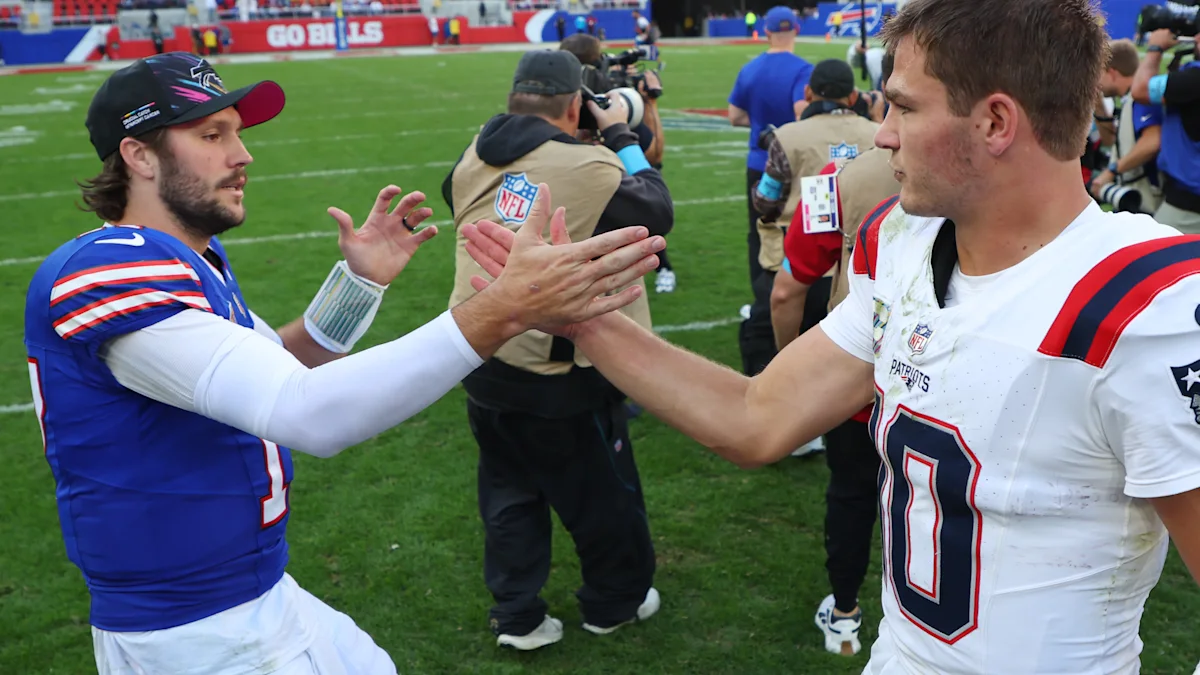
If you happened to be within sight of more than one screen on Sunday around 3:50 p.m. Eastern, either at a sports bar, or with multiview enabled, or with an array of installed man-cave TVs, you would have seen something wonderful unfolding. At almost the exact same moment, you saw multiple late-fourth-quarter scenarios unfolding:
New England, down 26-21, driving against Buffalo;
Los Angeles, down 20-10 against Philadelphia, attempting a miraculous two-possession comeback;
Tampa Bay, down 17-14 to Green Bay, attempting a comeback with a rookie quarterback;
Houston, down 27-23 to Dallas, driving for the go-ahead score … and then Dallas , down 30-27, attempting a scoreboard flip.
Four games, five late defeat-to-victory drives — and four of them were successful. (Sorry, Tampa Bay. And sorry the defense didn't hold, Houston.) Parity reigns supreme in the NFL, as always. Hail to the Shield, and order another round!
"Parity," in this context, doesn't mean there are no dynasties in the NFL, of course. You probably know the famous (and accurate) statistic about how half the NFL's playoff field turns over every year. (The 2025 teams already on pace to miss the 2026 postseason: Green Bay, Pittsburgh, Houston and the Chargers.) But even that's looking from too high a perspective. Drill down to the per-game level, and you'll see the real parity that exists across the league on a weekly basis.
The NFL's perpetual enforcement of parity is no secret, statistically, financially or spiritually. First, some numbers: per a study by NFL Analytics , of the 7,276 games played between 1999 and 2025, 50.7 percent finished with a margin of eight points or fewer between winner and loser. (Another 26.9 percent finished as "blowouts," defined as a margin of 17 points or more.) The percentage of one-possession games is increasing, from 47.9 percent in the 2005-2010 era to 52.7 percent from 2017 to 2025.
Already this year, Week 3 featured 12 of 16 games ending within one possession, tying the most in any single week since 1999. And depending on the outcome of Monday night's Falcons-Saints game, this week, already with 11 of 15 games within a single possession, could match that total.
Statistically, the most common finishing margin of an NFL game isn't just one possession, it's one field goal . According to Pro Football Reference , the top four most common scores in NFL games across history are three-point wins. (Trivia winner for you someday: the most common score in an NFL game is 20-17, achieved 303 times, most recently in Week 2 by Green Bay over the Jets.)
What the NFL has mastered isn't season-long parity. Last season, for instance, featured three 14-3 teams and four 3-14 teams, not exactly a clustering around the median. No, the NFL now specializes in in-game parity — the idea that no matter how far apart two teams may be talent-wise, there's a very good chance the final margin of victory will be within a single possession.
Sunday was a perfect example. Coming into the day, the Bills seemed like the best team in the league by a wide margin, whereas there were real concerns about whether New England's Drake Maye remembered which side of a football to point downfield. Through three weeks, Minnesota seemed like it had leveled up, while Miami looked so bad it might manage to lose 19 games in a 17-game season. And what happened? New England upset Buffalo, while Miami finished an uncomfortably close five points short of Minnesota.
The lesson for teams is obvious: first, no matter the opponent, you can win — or lose — on any given Sunday, so every game matters. Second, the margin between victory and defeat is a tiny one, so the winning teams will be the ones that find those edges, over and over again.
Last year, the Denver Broncos were 11-2 in one-score games, a run that coincided nicely with division rival Kansas City's record of 1-9 in such games. It's better to be lucky than good, but it's even better to be opportunistic than lucky.
This year's version of Denver might be Minnesota, which is 4-0 but won three of those by a single possession. And the hard-luck team of the year — of the last two years, really — is Tampa Bay, which has played 10 straight one-score games and lost eight of them, including all four this season .
The NFL's hard salary cap has created this situation by dispersing talent across the league. Its genius scheduling model, clustering most games within a few time slots, contributes to the energy; there's nothing like those frenetic final minutes of games — what NFL RedZone's Scott Hanson calls "the witching hour" — when teams can vault to victory or collapse in defeat.
And that, for the fan, is what makes parity so thrilling. Your team might win only a third of its games, but it's almost certainly going to be close in a few of those losses. Your team might rack up a division, conference or Super Bowl championship, but it's not going to be a smooth, stress-free ride. Game-to-game parity is the NFL's crown jewel, what makes the sport so compelling, week after week.
So, bottom line: You'd better go set up another screen or two for this weekend. Just in case.
Topics in this story
Gathered from external sources. Rights to this text belong to whoever originally published it.