Latest Fantasy Football Mock Draft After the 2026 Preseason
Summer is winding down—and so is fantasy draft season. Labor Day marks the unofficial end of the former, while the first game of the 2026 NFL season on Wednesday, Sept. 9, effectively closes the latter.
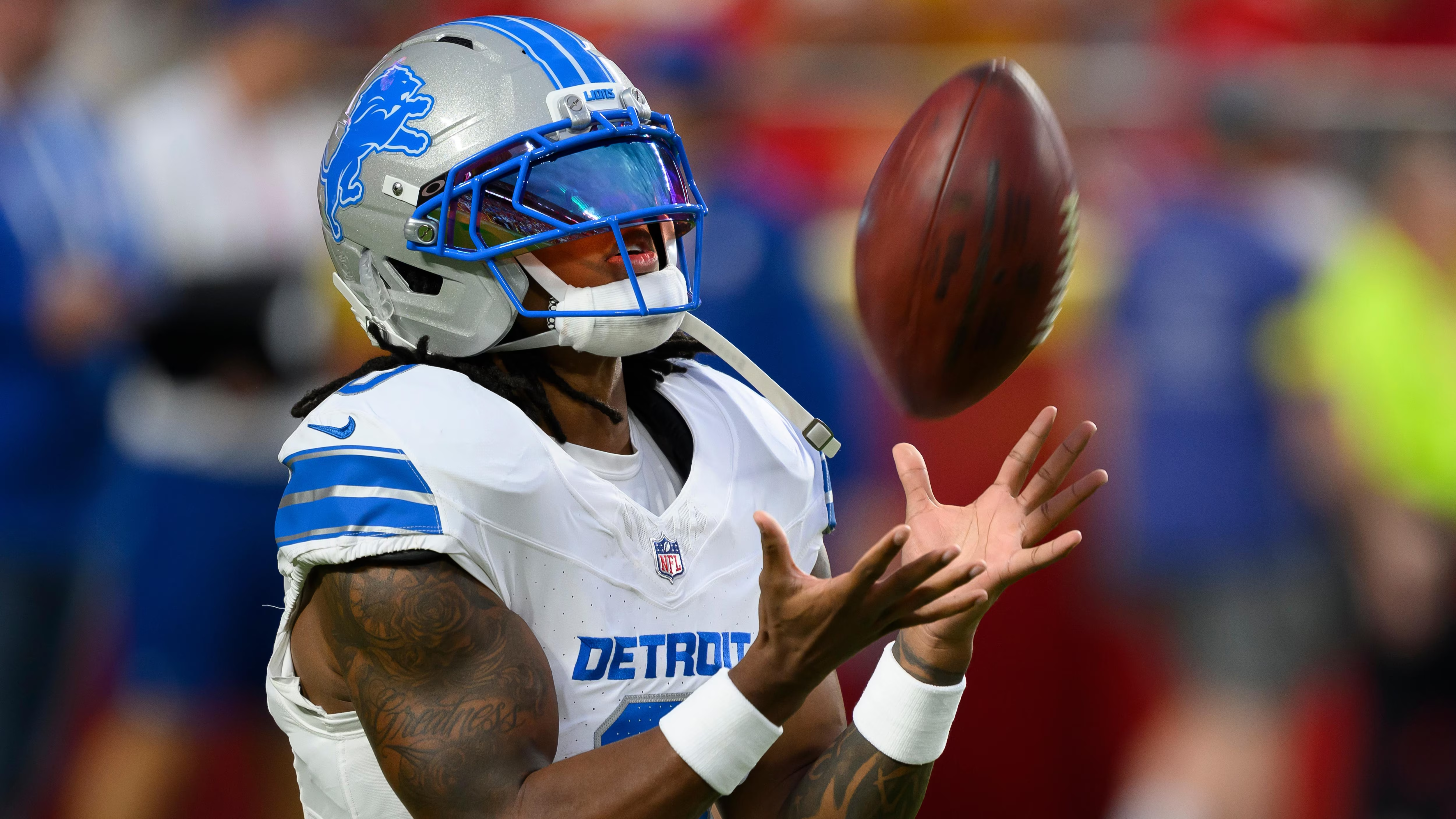
Summer is winding down—and so is fantasy draft season. Labor Day marks the unofficial end of the former, while the first game of the 2026 NFL season on Wednesday, Sept. 9, effectively closes the latter.
Most fantasy managers have already drafted their teams for the coming season, but one final draft weekend remains for those still assembling their first—or perhaps their 21st—roster.
As they have all summer, tools such as rankings and ADP information remain valuable for managers preparing for their drafts. Recent draft trends can be useful, too, especially after all the changes of the past few weeks.
The Bleacher Report Mock That Isn't Charity Challenge is a live fantasy league rather than a conventional mock draft. Participants—including B/R analysts Kris Knox and Maurice Moton , experienced fantasy players and a mystery novelist—will manage their teams throughout the season.
The live-league format helps ensure participants take the draft seriously, making the results more useful to fantasy managers.
The mini-run at wide receiver offered up some values at running back in the back half of Round 1—and Cook was the best of the lot. He led the NFL last year with 1,621 rushing yards, and he has scored at least a dozen rushing touchdowns in each of the past two seasons.
McCaffrey was fantasy's No. 1 back last year, and he's capable of not only finishing first at the position but blowing the competition away. He's also a 30-year-old back coming off a historic season who led the league with 413 touches last year. The seasons following his first two 2,000-yard seasons from scrimmage were ugly: He missed 13 games in each.
Getting Jeanty at the back of Round 1 could be a bargain or a waste—it all depends on his ankle injury and whether that lingers into the season. He was regularly falling into Round 2 after getting hurt, but this selection could signal a rebound heading into the final draft weekend of 2026.
Williams has taken something of a tumble down draft boards this summer—ostensibly because of Blake Corum's increasing workload over the second half of last season. But Williams was more effective on a per-touch basis last year than in 2024, and he has posted top-10 fantasy numbers among running backs three years running.
The Seahawks used their first pick in April's draft on Price, but even with Zach Charbonnet on injured reserve to start the season, there has been no indication that Price will be a bell-cow back. His Average Draft Position is in Round 5 this summer.
Biggest Surprise: Justin Jefferson at 2.02
Yes, Jefferson had a down 2025 season—at least by his stratospheric standards. But it's still a little weird to see him available in Round 2. If you believe that Kyler Murray's arrival in the Twin Cities will spur an offensive rebound in 2026, then Jefferson should be one of the bigger beneficiaries—and a value pick at No. 14 overall.
With the managers in this draft hitting the running back position hard early, there were some values to be had at wide receiver. Collins was the best of those values in Round 3. He has topped 1,000 receiving yards each of the past three seasons and is widely considered a top-10 fantasy option.
McConkey is coming off a disappointing second season—after 1,149 receiving yards as a rookie he failed to hit 800 yards in Year 2. He's a talented wideout who should see a bump in targets this year, but seeing McConkey come off the board ahead of Collins, Malik Nabers and Rashee Rice was eyebrow-raising.
Biggest Surprise: Jeremiyah Love at 3.06
Like Ashton Jeanty, Love heads into the 2026 season with a bad ankle after getting hurt in his preseason debut. Like Jeanty, that injury has caused Love's asking price to ping-pong all over the place. With that said, getting the third overall pick from April's draft in the middle of Round 3 makes the risk a bit more palatable.
The fantasy manager who earned the first pick in the draft played the first four rounds exceedingly well. Joe Mixon was a top-10 back in PPR points per game two years ago as the featured back in Houston, and Montgomery was a top-five fantasy option the only time in his career he logged 300 touches in a season.
Compared to ADP, getting Allen in the middle of Round 4 is good value—he typically comes off the board more than 15 picks earlier. However, selecting the first quarterback does not always pay off: The edge Allen provided at the position last season was only about one fantasy point per game.
Biggest Surprise: Jameson Williams at 4.09
Williams has shown high-end fantasy upside—the young speedster topped 1,100 receiving yards last year and finished as the WR12 in PPR points . But while he has a sky-high fantasy ceiling he can also be high-variance—it was a little surprising to see him go ahead of a higher-floor option such as Tetairoa McMillan.
In terms of average draft position, Higgins is coming off the board with the last selection in Round 3 as the 17th wide receiver. That price (in the opinion of this analyst) is a tad steep. However, getting Higgins over a round after that as the 23rd receiver taken is a solid value pick.
You can argue that Dobbins is going later than he should on average—he'll be the lead back for the Broncos so long as he can stay healthy. But the caveat "so long as he can stay healthy" is a major one, and in this particular draft Dobbins went at No. 53 overall—over three rounds earlier than his ADP of 94.
Biggest Surprise: Running Back Panic Attack
The managers in this draft were not shy about selecting running backs, as they came off the board at an unusually rapid rate in Round 5. Half the round's picks were running backs, including both members of the Denver and Pittsburgh backfield committees. That early run pushed the draft into the "RB Dead Zone" sooner than usual.
In terms of ADP, this is right around where Stevenson is usually going. But this is less about where Stevenson was drafted than who he was drafted after—getting New England's lead running back after backs like Rico Dowdle of the Steelers and Aaron Jones of the Vikings was a bargain.
Lloyd's ADP has risen sharply with Josh Jacobs unavailable, but he is also a third-year pro who has played in just one game over the past two seasons and has only six career carries for 15 yards.
Biggest Surprise: Matthew Stafford at 6.08
Last year, Stafford threw for 4,707 yards and 46 touchdown passes, finishing second among quarterbacks in fantasy points. He plays for a Rams team loaded with offensive weapons. Still, seeing the 2025 NFL MVP selected as the fifth quarterback off the board was jarring given his QB13 ADP and typical 10th-round price tag.
There appears to have been some skepticism among these drafters as to whether it will be Odunze or Luther Burden III who emerges as the No. 1 wide receiver for the Bears this year. But it's hard to argue the value of getting Odunze in the middle of Round 7—that's about a round and a half after he's being selected on average.
Were Kittle 100 percent healthy, this wouldn't be a bad pick at all—Kittle is routinely a top-five fantasy option in terms of fantasy points per game. But Kittle is also a 32-year-old tight end who missed a chunk of last season—and then tore his Achilles in the playoffs. He's a risky choice as a top-five tight end.
In many fantasy drafts this summer, the tight ends in the TE5 to TE10 range have kind of trickled off the board—the gap in ADP between the two is about three rounds. But that wasn't the case in this draft. Five tight ends came off the board in Round 7, tying wide receivers for the most players selected at any position.
No running backs were drafted in the seventh round.
Even at his WR33 ADP, Metcalf has a case as a value after finishing as a low-end WR2 in PPR points per game last season. He was an even better value in this draft, coming off the board more than a round later than his average cost as the 37th wide receiver selected.
Goff has been a valuable fantasy asset in recent years, logging three straight top-seven finishes among quarterbacks and finishing second in the league in passing yards last season. However, he is typically available much later than this: He is the 16th quarterback selected on average, with an ADP near the end of Round 10.
Biggest Surprise: Jordan Mason after Aaron Jones Sr.
As mentioned, this draft was unusually aggressive where the running back position is concerned—by round's end almost 40 were off the board and the cupboard was pretty bare. Jordan Mason of the Vikings was the first back taken in the round, but it was rather surprising to see him get taken after batterymate Aaron Jones given their respective average asking price in drafts.
Sutton was a strong value at this spot, even after Parker Washington came off the board earlier in the round. Even if Jaylen Waddle becomes Denver's top target this season, Sutton topped 1,000 receiving yards and finished among the top 25 fantasy wide receivers last year. At WR44, he was a steal.
This pick would look better if the manager who made it also had Jeremiyah Love rostered—Allgeier is one of the more valuable "handcuff" backs in 2026. But they do not, and there were a couple of backs taken after Allgeier who have a clearer path to carries than Allgeier does in the desert.
At least in this league, the managers appear unenthused about Hurts' fantasy prospects in 2026. Sure, A.J. Brown is gone, but the cupboard is hardly bare in Philadelphia. Hurts also offers significant rushing upside and has posted two top-five finishes over the past four seasons.
Johnston can admittedly be a maddening fantasy option—he'll post a huge game one week and then vanish for three more. But we're still talking about a player who scored eight touchdowns and finished inside fantasy WR3 territory last year. With Keenan Allen gone, Johnston should also see a target bump in 2026.
To be clear, there aren't really any "worst" picks in the double-digit rounds—if you want a guy, go get him. But Sadiq was already regarded as something of a project before he spent much of the offseason sidelined by injury, and the Jets' offense may not offer the same favorable environment Sadiq had at Oregon.
Biggest Surprise: Chris Rodriguez at 10.11
Fantasy managers have spent much of the summer projecting Bhayshul Tuten into a featured role in Jacksonville. However, the Jaguars have praised Rodriguez throughout the summer, and he was available nearly six rounds later in this draft. When choosing between members of a backfield committee, the less expensive option is often the better value.
Best Pick of Round 11: Caleb Williams at 11.08
They say it's better to start a run than to end one, and in the second half of Round 11, a wise manager started one under center with the selection of Caleb Williams. After a solid second season, he is the seventh quarterback off draft boards on average. Here, he was the 11th QB taken.
Best Pick of Round 12: Kaelon Black at 12.06
If you use a first-round pick on Christian McCaffrey, Black is a sensible late-round insurance option. If McCaffrey misses time, Black would likely share work with Jordan James, but he could still offer useful depth and contingent upside.
Best Pick of Round 13: Tre Tucker at 13.02
Someone is going to have to serve as the No. 1 wide receiver for the Raiders this season, and if training camp and the preseason have been any indication, Tucker is that guy. The 5'8", 182-pounder isn't built like a No. 1 wide receiver, but he appears to have developed an early rapport with Kirk Cousins.
Best Pick of Round 14: Malik Willis at 14.03
Miami's offensive outlook has drawn considerable skepticism this offseason. But Willis has quite a bit of rushing upside, and he wouldn't be the first quarterback who became fantasy-relevant largely because of garbage time.
Best Pick of Round 15: Jacksonville Jaguars Defense at 15.09
This is an effective way to draft a defense: target a unit with a favorable Week 1 matchup, such as a home game against Cleveland, select it late and then move on to a new option through waivers when the schedule becomes less favorable.
Best Pick of Round 16: Tyler Loop at 16.12
Kickers are best selected with a final-round pick. The advantage of drafting a high-profile option is typically marginal, so there is little reason to prioritize the position earlier.
Gary Davenport is a two-time Fantasy Sports Writers Association Football Writer of the Year. Follow Gary on X at @IDPGodfather .
Topics in this story
Gathered from external sources. Rights to this text belong to whoever originally published it.