Despite popular narratives, free speech is working in Macklemore’s favor
Despite objections that a billionaire’s wealth shouldn’t “decide who gets to speak,” the system actually worked pretty well.
Almost everyone reveres freedom of speech in the abstract. Too often, however, enthusiasm rises and falls with the identity of the speaker and the subject matter of the speech.
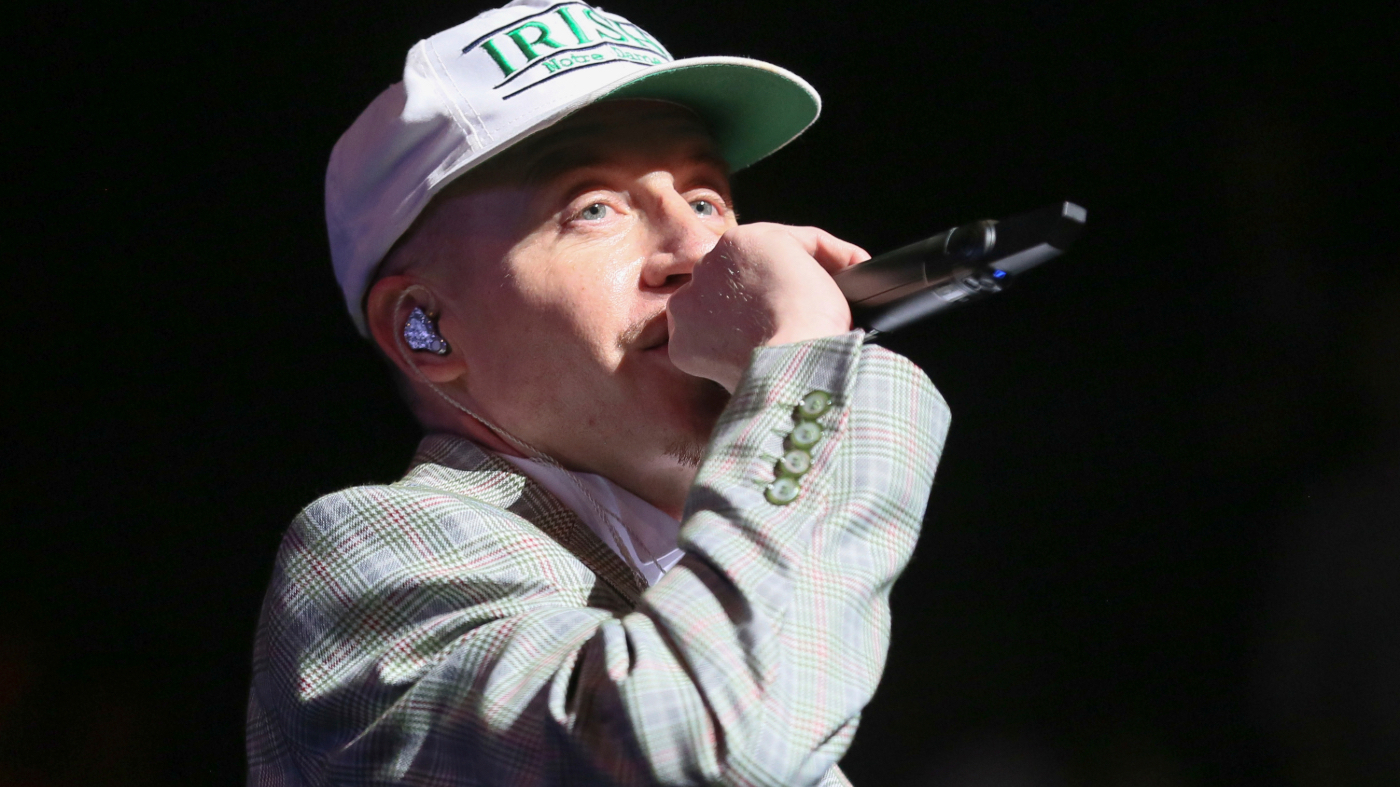
A case in point is the widely reported controversy over comments by the rapper Macklemore, whose many pro-Palestine supporters have taken no interest in the expressive rights of anyone who disagrees with them.
Earlier this month, as an opening act for the much more famous Ed Sheeran at New Jersey’s MetLife Stadium, Macklemore delighted some Sheeran fans and upset others by interrupting his act with a repeated call to “Free Palestine,” to be spread “from Gaza all the way to the occupied West Bank.” During his next song, the large stadium screens showed a video with scenes of Gaza devastation and campus protests.
The reaction of the 80,000 people in the stands was relatively subdued. Some cheered, but most appeared to remain silent. That wasn’t the case outside the stadium, as viral replays of Macklemore’s declaration sparked outrage among certain Israel supporters who objected to the rapper’s “one-sided” imagery.
Robert Kraft, the owner of the NFL’s New England Patriots and the Gillette Stadium, announced that he would cancel Sheeran’s upcoming concert unless Macklemore was dropped from the lineup. Other owners joined in Kraft’s demand .
Sheeran’s promoter acquiesced, and Macklemore was removed from the tour. In response, all four of Sheeran’s other supporting acts withdrew in protest of the “silencing of Macklemore.” Other performers also sharply criticized Kraft’s interference with the concert tour.
The First Amendment itself does not apply to Kraft’s dictate. As a private owner, he has no obligation to make the Gillette Stadium available for speeches he finds objectionable or abhorrent, whether he happens to be right or wrong about Macklemore’s history of performing in a classically anti-Jewish caricature costume.
The First Amendment would apply if Macklemore had also been banned by publicly owned stadiums , where several future concerts are scheduled, but that does not appear to have happened. Instead, it was Sheeran’s tour promoter , a private company called the Messina Group, that evidently bowed to pressure in a futile attempt to avoid controversy.
At Sheeran’s following concert, where he performed alone, he apologized for “making mistakes” in the Macklemore incident. Explaining that he never wanted to be an “activist musician,” Sheeran said, “What is happening in Gaza is catastrophic and unjustifiable and disproportionate. My heart has been broken by the scale of devastation and the loss of civilians’ lives, of children’s lives.”
Free speech, of course, is a broader concept than the First Amendment. Macklemore has indeed been deprived of the huge audiences on Sheeran’s tour, but he otherwise remains quite free to rally support for Palestine anywhere else, whenever and however he chooses to.
If anything, his message has been amplified by the many other musicians who have spoken out in his support. Last week, Macklemore announced plans for his own “Free Palestine” tour, to begin in October in cities across Europe and the U.S.
Despite objections that a billionaire’s wealth shouldn’t “decide who gets to speak,” the system actually worked pretty well. Kraft controlled his own property, without permitting its use for ideas that he rejects. The time-honored response, well known to civil libertarians, was to generate “ more speech ” from many voices, projecting Macklemore’s message well beyond the confines of Gillette Stadium.
The irony, however, is that boycotts much more extensive than Kraft’s have been internationally deployed against Jewish and Israeli performers for years, with virtually no objection from the broader arts community.
The Orthodox Jewish reggae artist Matisyahu has repeatedly had concerts threatened or canceled under pressure from pro-Palestine activists, for the apparent offense of performing under a Hebrew name. He was not the only one .
Jewish comedians have had shows canceled in the U.S. and at the Edinburgh Fringe Festival in Scotland, the latter resulting in a court finding that it constituted unlawful religious discrimination. Poets , authors , novelists, graphic artists and actors have been boycotted, deplatformed or disrupted because they were deemed insufficiently anti-Israel.
None of these cases, among many others, attracted even a small fraction of the national attention devoted to Macklemore’s exclusion from Gillette Stadium. Almost nobody outside the Jewish community has spoken up for artists who have been all but blacklisted, in some cases due to their identification with Israel, and in other cases only because of their perceived silence on Gaza.
If Macklemore himself ever objected to censoring Israeli and Jewish performers, I have found no record of it. Among musicians, who should know better, free speech has been defended only for approved speakers.
Addressing a recent bar conference in Oklahoma, Supreme Court Justice Sonia Sotomayor explained that her “greatest fear” for the future of American democracy is the “lack of quality in our teaching of civics education.” In particular, she worried that people “don’t understand what the First Amendment means.”
Steven Lubet is the Williams Memorial Professor Emeritus at the Northwestern University Pritzker School of Law. He is coauthor of “Judicial Conduct and Ethics.”
Topics in this story
Gathered from external sources. Rights to this text belong to whoever originally published it.