Inspiring story on leadership: "I always define leadership as: do you care about your teammates...and do you care what we're trying to accomplish"- How Tom Brady led teams to greatness
NFL News: Tom Brady spent more than two decades being judged by rings, records and unforgettable performances. Yet when he talks about leadership, his definitio.
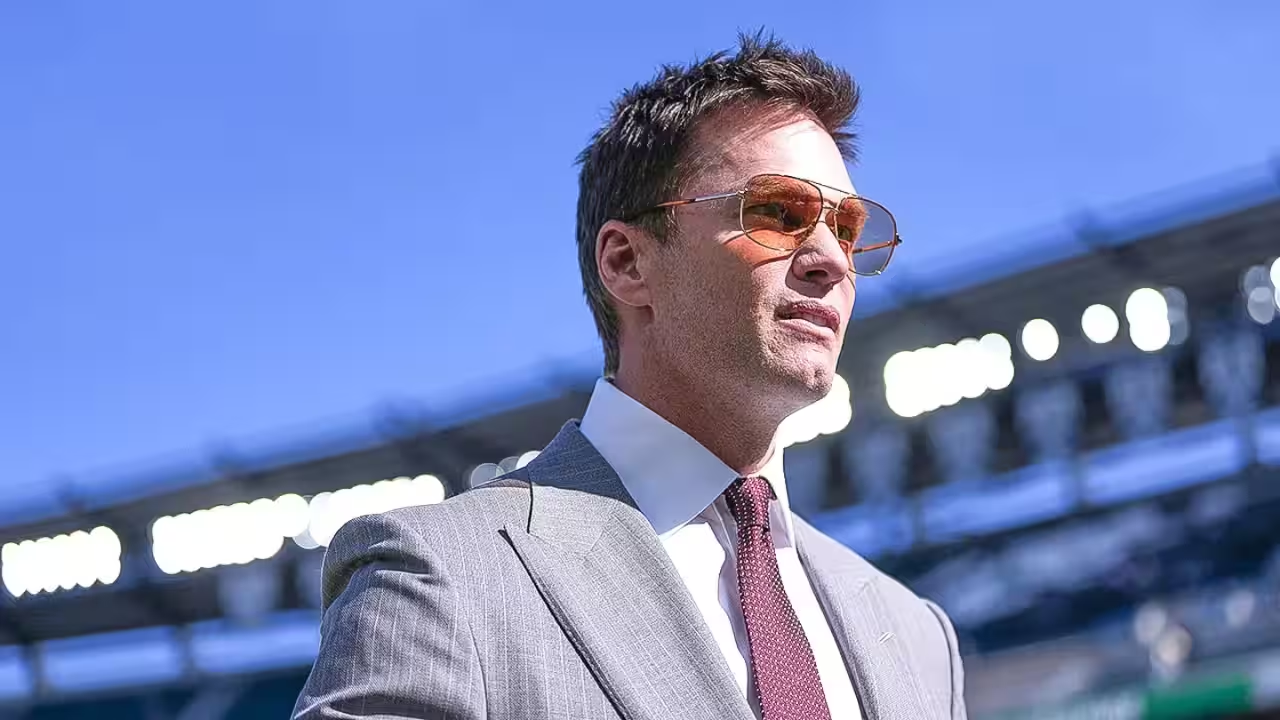
Tom Brady spent more than two decades being judged by rings, records and unforgettable performances. Yet when he talks about leadership, his definition reaches far beyond statistics. In a discussion about motivating teammates, Brady explained why genuine care, trust and a shared purpose shaped the way he led. His words offer a revealing look at the mindset behind one of football's most successful careers.Tom Brady’s leadership philosophy was built around caringBrady's approach to leadership was not simply about demanding more from the players around him. He believed a leader first had to build a relationship with the people he expected to follow him.During the PBD Podcast, Brady discussed his leadership style and what helped him motivate teammates. The conversation, published in 2023, turned toward leadership, when host Patrick Bet-David asked Brady about the methods he used to drive his players.Brady's answer centered on one word: caring.He explained that the relationship between a leader and teammates cannot be purely transactional. Players need to believe that the person beside them genuinely cares about them and about the goal they are pursuing together.That idea also appears in Brady's later Harvard Business Review work, where he expanded on his definition of team leadership. The article, “Tom Brady on the Art of Leading Teammates,” was published in 2024 and explored seven principles he believed helped leaders bring out the best in teammates.The quote at the center of this discussion captures that philosophy:“I always define leadership as, do you care about your teammates or coworkers, and do you care what we’re trying to accomplish?” Brady. “That, to me, is great leadership. And there are a lot of people that go about those in different ways.”The wording is powerful because Brady does not begin with authority, experience or talent. He begins with people.For him, leadership starts with asking whether teammates know they matter and whether everyone remains committed to the same objective.When and where Tom Brady shared the leadership messageThe quote has circulated online in shortened form, but its underlying idea is supported by Brady's own extended comments.In the 2023 PBD Podcast conversation, Brady said his view of relationships in a team environment came down to caring about the other person and collectively caring about what the group was trying to achieve. He argued that trust develops when people know their leader genuinely cares about them.That conversation gives important context to the quote. Brady was not describing leadership as a motivational speech or a title attached to a job. He was talking about the daily relationship between teammates.He also stressed the importance of vulnerability and mutual trust. In his view, players had to feel comfortable relying on one another. That trust could not be manufactured simply because someone was the quarterback or captain.Brady's later HBR article developed the same philosophy in greater detail. He wrote that leadership comes down to caring about teammates and caring about winning together. He connected that belief to trust, arguing that people are more willing to give their best when they feel valued by those around them.Tom Brady learned team-first leadership at MichiganBrady traced much of his team-first mindset back to his time at the University of Michigan.His college career did not follow the straightforward path often associated with a future NFL superstar. He redshirted as a freshman and later found himself behind other quarterbacks on the depth chart. Yet those setbacks became part of his leadership education.In his HBR article, Brady recalled competing with Brian Griese for the starting quarterback position. Griese won the job, and Brady said his role was to support and challenge him in practice rather than undermine him. Michigan went undefeated that season and won the national championship.That experience reinforced a lesson that stayed with him.Individual recognition was not the ultimate prize. Winning as a group mattered more.Brady later described this mindset through an old sports question: whether someone wants to be a star or a champion. For him, the answer was clear. He wanted to contribute to something bigger than himself.That attitude became especially important during his NFL career. As a quarterback, Brady naturally occupied one of the most visible positions on the field. Every touchdown, mistake and major decision could draw attention to him.But he repeatedly emphasized the people around him.How Brady put his leadership philosophy into practiceBrady's definition of leadership becomes more meaningful when paired with the examples he gave from his playing career.At Tampa Bay, he noticed that screen plays were producing poor results because offensive linemen were missing blocks. Rather than simply criticizing them, Brady created his own incentive. He promised to pay each offensive lineman $1,000 whenever a screen play gained more than 15 yards.The money was not necessarily the main point. Brady believed the gesture showed appreciation and made the linemen feel involved in the outcome.He also spoke about recognizing people whose contributions were less visible. Football teams rely on trainers, equipment staff, meal workers and many others whose names rarely appear in headlines.Brady believed leaders should make those people feel valued too.His approach also involved holding teammates accountable. Because he worked to establish trust, he felt he could challenge players directly without making them feel personally attacked. That balance between support and honesty became another important part of his leadership style.Perhaps that is what makes Brady's words resonate beyond football.A quarterback can throw a perfect pass, but he cannot win alone. A business executive can set a strategy, but employees still have to believe in it. A coach can design a game plan, but players have to trust one another enough to execute it.Brady's message is therefore much bigger than his NFL career.Leadership, in his view, is not about standing above everyone else. It is about standing with them, understanding what they need and making sure everyone remains connected to the same goal.That is why his simple question carries so much weight: Do you care about your teammates, and do you care about what you are trying to accomplish together?For a player who spent his career chasing championships, Brady's answer offers a different definition of what it means to win. The scoreboard may measure the final result, but the relationships built along the way can determine whether a team ever gets there in the first place.Get the latest Sports News and Live updates. Download the TOI app.
Topics in this story
Gathered from external sources. Rights to this text belong to whoever originally published it.