15 things to know about Yost Ice Arena, Michigan Hockey’s historic home
Yost Ice Arena is one of college hockey’s most unique venues, but it wasn’t even built for hockey. Here are 15 things to know about Michigan Hockey’s home ar...
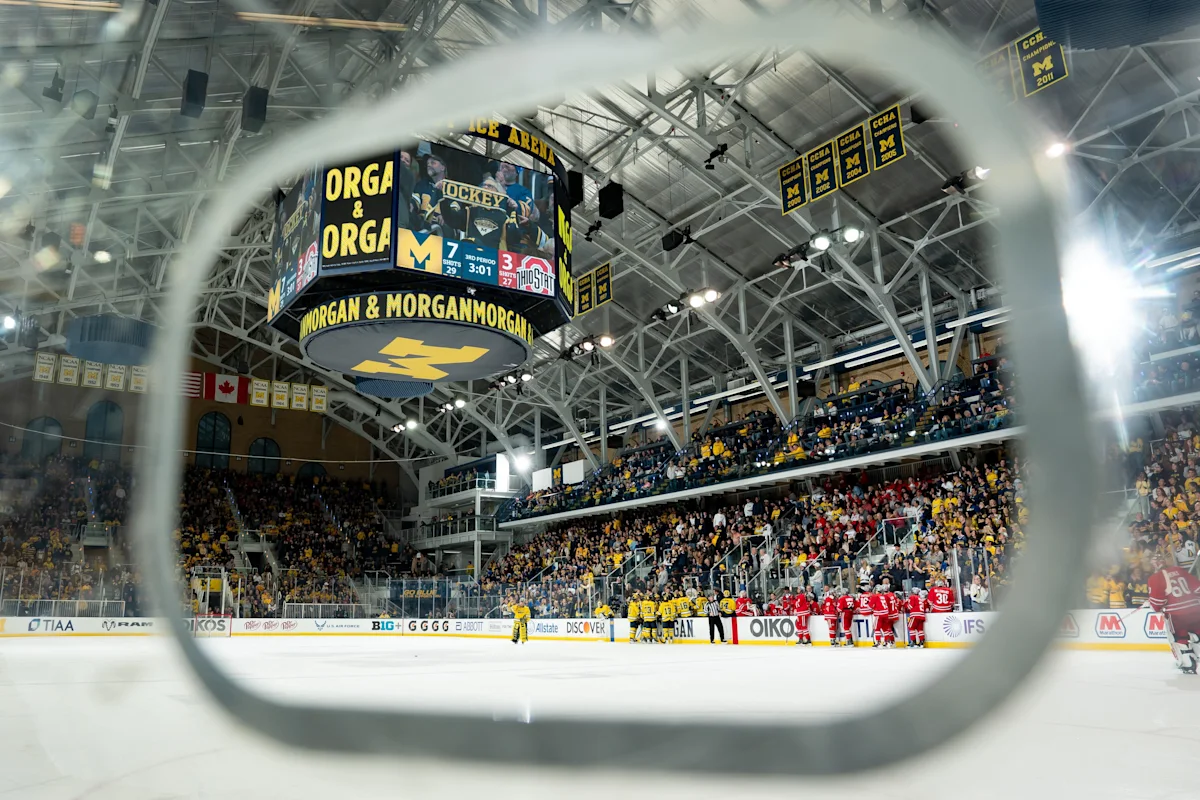
Yost Ice Arena feels like it was built for college hockey. The old-school architecture, students practically on top of the ice and noise bouncing around the building make it one of the sport's most recognizable venues.
But what if I told you that Yost wasn't built for hockey at all? The building is more than 100 years old and housed basketball, track and football before Michigan ever put an ice sheet inside.
Like we did with Michigan Stadium and Crisler Center, let's dig into the history of Yost Ice Arena.
Yost opened in 1923 and was dedicated Nov. 10 of that year. The building cost $563,168 and had one of the largest indoor athletic facilities on a college campus at the time. That makes Yost four years older than Michigan Stadium, which opened in 1927.
For its first 50 years, it was Fielding H. Yost Field House. The massive open floor was used for basketball, indoor track and football and baseball practices. The building even featured an indoor running track around the balcony. Hockey wouldn't arrive until decades later.
Like Crisler Center, Michigan's hockey arena is named after a football coach . Fielding H. Yost coached Michigan from 1901-23 and from 1925-26 before serving as athletic director from 1921-41. Yost was also instrumental in developing Michigan's athletic campus, including Michigan Stadium.
Before Crisler, Michigan basketball played at Yost. The first basketball game was on Jan. 11, 1924, when Michigan beat Michigan Agricultural College, now Michigan State, 23-19. The Wolverines would call the building home for more than four decades.
That means Cazzie Russell played his entire Michigan career at Yost. He helped Michigan win three straight Big Ten titles from 1964-66, while the huge crowds he attracted helped create demand for a new basketball arena. That arena became Crisler Center, also known as "The House That Cazzie Built."
Michigan played its final basketball game at Yost on March 11, 1967, losing to Iowa, 83-76. Later that year, the Wolverines moved across the athletic campus into their brand new home at Crisler.
Yost has some serious track history, too. At its first indoor track meet in 1925, Michigan's William DeHart Hubbard tied the world record in the 60-yard dash at 6.2 seconds. Hubbard was also the first Black American athlete to win an individual Olympic gold medal, taking gold in the long jump at the 1924 Paris Olympics.
Basketball and track weren't the only sports to call Yost home. The building also served as an indoor football practice facility. When Bo Schembechler arrived at Michigan, the Wolverines' locker room was on the second floor of Yost.
After basketball moved to Crisler and football shifted to Oosterbaan Field House , Michigan needed a new use for Yost, so baseball coach Don Lund suggested converting the old field house into an ice arena. Michigan did just that in 1973. Fifty years after Yost opened, the hockey team finally moved in.
10. Michigan won its first hockey game there
Michigan hockey officially debuted at Yost on Nov. 2, 1973 against Waterloo Lutheran. The Wolverines won, 6-2, with Gary Morrison scoring twice. More than five decades later, they haven't left.
When hockey arrived, Yost's capacity was 8,100. Today it sits at 5,800, as renovations have traded some of that capacity for improved seating, accessibility and other modern amenities.
12. The attendance record belongs to Michigan State
No surprise here, as a record 8,411 fans packed Yost for Michigan-Michigan State on Jan. 29, 1988. Even better, Michigan State is the opponent for each of the four largest crowds in Yost history.
Keeping a century-old field house functioning as a modern hockey arena takes some work. Michigan lists major renovations in 1973, 1992, 1996, 2001, 2006 and 2012. The 2012 project carried a $14 million budget and brought new seating, accessibility upgrades, improved concourses, loge boxes and a new media level.
14. The rink is named after Red Berenson
The building is Yost, but the ice itself carries another legendary Michigan name. In 2017, Michigan officially named it Red Berenson Rink at Yost Ice Arena. Berenson coached Michigan for 33 seasons, finishing 848-426-92 with national championships in 1996 and 1998, along with 21 conference championships.
Rather than starting over, Michigan has repeatedly renovated Yost while preserving much of what makes it unique. It went from a 1920s fieldhouse to Cazzie Russell's basketball court, a football facility and eventually the home of Michigan hockey.
More than a century after it opened, and more than 50 years after someone decided to put an ice rink inside, it's still going. And somehow, a building that wasn't designed for hockey became one of college hockey's most recognizable homes.
Topics in this story
Gathered from external sources. Rights to this text belong to whoever originally published it.