Strength in Variety: How Mizzou’s frontcourt protects the paint by committee
With its point-of-attack personnel upgraded, Bryson Tiller, Jaylen Carey, and Trent Burns provide Dennis Gates three distinct interior toolsets to complete t...
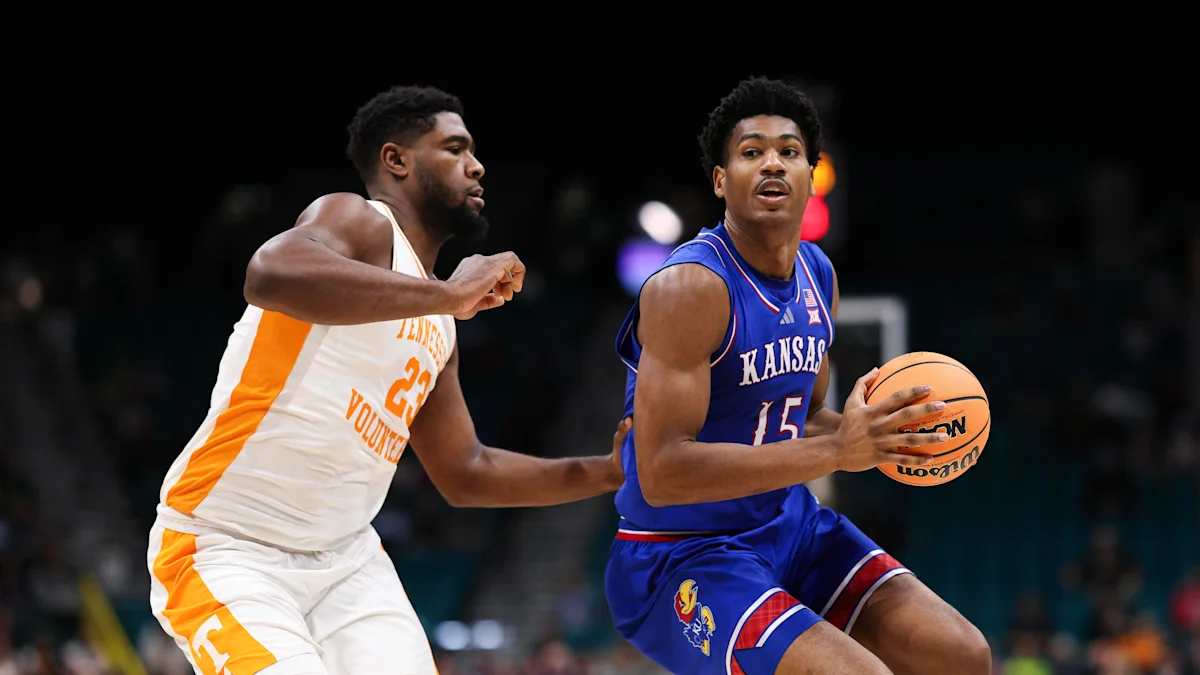
Under coach Dennis Gates, patience defined Missouri's search for a center.
When the transfer portal opened, the Tigers' staff devoted early resources elsewhere to shore up or reboot their roster. Then, usually in late April or May, the program would rummage around for an affordable veteran, a process that turned up the likes of Connor Vanover, Josh Gray or Shawn Phillips Jr. At the same time, MU might take a swing on a project like Jordan Butler, Peyton Marshall or Trent Burns.
Four years in, neither approach has cultivated much continuity.
So, Gates changed tack this spring. He moved swiftly to secure Jaylen Carey as a rugged depth piece and committed real resources to mining Bryson Tiller's upside. Meanwhile, MU kept Burns in the fold rather than abandoning the developmental route.
Ideally, Tiller makes the pecking order easy by claiming the bulk of the minutes. But with Carey and Burns on hand, Gates has some latitude to tailor the job rather than ask one player to handle everything. And that's useful because operating at center involves more than occupying the lane and waiting to contest a shot. Often, the job starts when something goes wrong farther from the basket.
As we've noted before , tMU's late-season slide wasn't tied to a lack of size. The trouble started on the ball. The Tigers couldn't consistently prevent guards and wings from turning the corner, forcing the back line to absorb one breakdown after another. Eventually, it couldn't plug every leak. Starting in late January, the results around the rim made that clear.
At least Gates has more ways to handle that pressure. Bryson Tiller, Jaylen Carey and Trent Burns bring different tools to the job, giving MU some flexibility in how it protects the paint.
There's a catch, though. None carried a starter's workload at center last season. As a group, they averaged slightly more than 16 minutes per game, operating as clear backups or deep-bench options. Their court time was relatively consistent, but hardly extensive.
Does that mean a larger burden is beyond them? Not necessarily. But we're dealing with projections, not proof. In previous seasons, Gates' scheduling philosophy might have afforded more time to tinker and sort out the rotation. This campaign won't afford the same luxury.
Still, scattered throughout those modest minutes are clues about what each player might provide — and, just as importantly, what Gates would need to put around him to make it work.
Bryson Tiller: Versatility — With a Tradeoff
The last time Tiller saw extended time at the five, it overlapped with four minutes as Houston began to pull away in the Big 12 Tournament semifinal.
JoJo Tugler walled off the redshirt freshman from a Mercy Miller drive, then backed him down and spun around a wall-up for an easy bucket. The next trip, Tiller reacted late to Chris Cenac flashing to the mid-post for a soft jumper.
But that sequence didn't raise Kansas coach Bill Self's ire. Barely two minutes in, Tiller let Tugler collect a miss despite having an ideal box-out position. Self immediately called a timeout. At halftime, he pulled Tiller.
"Well, my message is to rebound and play competitive," Self said afterward . "That's it. Be physical, rebound, play competitive. … It's been the message for a long time."
That withering assessment, at least to the west, has shaped the final impression of Tiller's stint in Lawrence.
Reducing Tiller's profile to physicality and rebounding obscures another reality: Self never stopped experimenting with him at center. Tiller appeared there in every game but one, logged at least five minutes in 22 and routinely served as the lone interior player surrounded by four nominal guards or wings.
There's zero point hiding that the results were terrible. Core lineup combinations with Tiller in the post were strafed for a 118.3 raw defensive rating, per EvanMiya.com, a trend mirrored in games where he received his standard allotment at the five.
Yet the tape isn't a gaffe reel. Our charting identified Tiller as the source of just one primary advantage, while 27 of 30 shots were, at minimum, lightly contested. So how did Tiller wind up linked with such putrid outcomes?
Reviewing season-long data also deepens the contradiction. Tiller surrendered 0.813 PPP and ranked in the 74th percentile nationally, per Synergy Sports, while conceding just 0.713 PPP as the terminal defender of ball screens, isolations and post-ups. The tools ($) explain why. Tiller flips his hips, maintains cushion, recovers with length and can survive switches or crossmatches that might sink other bigs.
But look at what happened when he logged his minutes as the sole big. That leaves a frustrating paradox: If Tiller can handle those jobs, why is the accounting so poor?
Exploring Tiller's switching starts to untangle the wires. With him at center, it was treated as an automatic decision to counteract a ball screen. It could snuff out the initial advantage, but at a cost: Tiller left the lane. Tre White slid down from the wing to slot in as a small-ball four, yet rarely replaced him as the low man. Self's group instead relied heavily on weak-side rotations.
Watch the packet twice. The first viewing demonstrates that Tiller is more than functional in space. On the second, watch how KU organizes itself behind him. Frequently, the possession's success has little to do with Tiller.
Charting those possessions made rim replacement the loudest structural signal. When the rim remained protected, Kansas usually survived. When it didn't, every possession in the sample ended in a score. Tiller's versatility only worked if somebody else picked up his shift in the lane.
The second clip provides a textbook illustration. Tiller catch-hedges Cayden Boozer, but White doesn't fully recover and essentially passes off the job to Tiller in a late switch. The sequence saddles Tiller with two poor choices: commit to Boozer and permit an easy drop-off pass or continue to give cushion. Ultimately, Boozer keeps his pace, uses the rim as a shield and converts.
Unfortunately, not every breach can be traced to the scheme. Sometimes Tiller was the last line of defense and, as Self pointed out, didn't act like one.
The miscues vary — a passive wall-up, a missed rotation, positioning a step too high above the restricted area — but the first cut-up shows Tiller can do the job. Consistency is the next step.
That's even more apparent when you study Tiller's handiwork guarding post-ups. Our charted film set captured four examples, and they resulted in just one point. In some ways, Self's frustration is easy to understand. Tiller doesn't sweat absorbing contact, contesting vertically and allowing off-ball help to rotate. And any issues rarely stemmed from an opposing center simply displacing him
For MU, lessening some of the structural strain starts by surrounding Tiller with more positional size. Carey, Burns, Mark Mitchell and Toni Bryant provide it, and even a four-guard alignment could feature a bigger wing like Trent Pierce. That matters on the glass, too. At Kansas, Tiller was often pulled outside optimal rebounding position. For example, our diagnostic sample contained 12 rebound opportunities, and only two were solely Tiller's responsibility. (He secured both.) Yes, he can be more assertive, but lineup construction matters.
The subtler question is how frequently MU switches with Tiller. At pro day, its default ball-screen coverage asked bigs to play at the level or softly hedge, with switches used more selectively. Its off-ball defenders also sit near the midline, positioning them to help aggressively behind the action.
None of that magically turns Tiller into a backline anchor. He still must clean up his low-man lapses, and MU's aggressive help has introduced its own problems. But the structure could ask him to spend less time doing what caused Kansas so much trouble: guarding someone 22 feet from the basket while leaving nobody behind to replace him.
Tiller is probably less a solution to rim protection than a way to change the terms of engagement. His versatility expands Missouri's options; the wager is that its size and help structure can preserve the back line when those tools take him elsewhere.
Yet that's not how coach Rick Barnes used him on Rocky Top.
Instead, the veteran soaked up just 11.9% of Tennessee's available minutes at the five, spending most of last season as the third option behind Felix Okpara and JP Estrella. Barnes only upped that dosage when injuries or foul trouble forced his hand. But while Carey's exposure fluctuated, there's evidence he can be useful when called upon.
Representative lineups accounting for 80% of Carey's minutes conceded 99.7 points per 100 possessions, per EvanMiya.com. That was a slight improvement over the same groups with Okpara in the mix, a hint that Carey can step into an elite defensive shell without compromising it.
Play-type data from games where Carey had his usual shift in the post reinforced that impression. Opponents managed just 0.947 points per possession, but the more revealing detail was how rarely Carey was the culprit for generating a clean advantage.
In that sample, Carey yielded only one advantage, while 16 of 18 shots UT allowed were, at worst, lightly contested. We can't extrapolate those results across an entire season, but it buttresses the notion that Carey wasn't a routine culprit in breakdowns. At a minimum, Carey could diagnose an action, stay connected and give the Vols a chance to see out the trip.
Crucially, Carey wasn't alone on the frontline.
Barnes frequently paired him up with DeWayne Brown II, a 6-foot-7, 247-pound freshman, forging a burly two-big tandem. In those configurations, Carey wasn't moored to the restricted area. In our sample, he spent 15 possessions plying his trade outside the paint, leaving it to Brown or – at least early in the season – Cade Phillips to offer another layer behind him.
Film explains some of that geography. Carey routinely defaulted to drop coverage, and while the results were mixed, the tape gives us a nuanced explanation. Sitting in drop kept the action in front of Carey, giving him a buffer to absorb drives, maintain balance and use his brawny frame to occupy space instead of chasing action. Were there occasions when a roller sealed him off? Yes. But in proper sequence, Carey's ballast didn't drag him down.
That was probably the prudent approach on Barnes' part.
Complications cropped up when more aggressive coverages demanded Carey execute multiple assignments in quick succession. Take the final clip in the packet above. Against Kentucky, Carey hard-hedged a slot pick-and-roll, forcing a long recovery that shifted the burden to Nate Ament, who had to rotate over, wall up and thwart Brandon Garrison.
Carey also had to endure some selective switches. The tape, brief as it is, revealed some encouraging moments: a strong recovery to contest a dribble 3, a competent first slide to force a difficult pull-up late in the shot clock, and a possession where he stayed attached long enough to contest a rim attack from behind.
Those snippets don't erase questions about how Carey would hold up against a steady diet of switches. Or in the more demanding ball-screen coverages that MU prefers. That distinction reappears when assessing Carey's work off the ball.
It's critical to know that Carey was rarely the source of a breakdown. Yet his response to them could be mixed. For example, the film sample below includes a trip where Otega Oweh, a power driver, blew past a smaller defender in Ja'Kobi Gillespie. What did Carey do? He waved his arm in the general direction instead of legitimately stunting into the gap. The next cut-up, from the same game, displays better effort, followed by Carey strongly contesting a spot-up.
Still, a meaningful gap remains between Carey doing one job and carrying an entire possession. Earlier this offseason, we explored how Carey proved vulnerable ($) when he had to execute multiple tasks. Ball screens that made him a helper, tagger or closeout defender made his timing less reliable as responsibilities piled up.
Simply sliding him down the positional ladder to the post isn't a remedy.
Even that role requires guardrails. Obviously, matchups hold some sway. Carey's best suited against opposing big men who, like him, lack overwhelming length or vertical pop. Drop coverage should probably be the default. And the margin for error improves when guards contain dribble penetration.
In late February, the redshirt freshman certainly gave the impression he was ascending toward a breakout . Yet it didn't take long for that appraisal to look as rosy as it was premature.
Sure, Burns still averaged roughly 10 minutes per game over the season's final four contests. But he only posted 1.5 points and 1.8 rebounds, while the opponents outscored MU by 27 points with him on the floor. Then, MU swiftly imported Tiller and Carey to fortify the rotation. Toss in the arrival of five-star freshman Toni Bryant, and Burns finds himself needing to scale the depth chart — again.
His place in the pecking order, however, doesn't render Burns' defensive profile totally irrelevant. If anything, his modest body of work produced one of the more intriguing profiles in the rotation.
The most common lineups with Burns slotted in the post allowed 115.9 points per 100 possessions. To be very clear, that's not a gleaming figure. At the same time, using Shawn Phillips Jr. didn't produce a dramatic swing. The gap – only 2.4 points per 100 possessions – was slender.
Unlike Carey, Burns amassed his body of work as MU's lone five. More interestingly, a review of data from games where he logged his median workload shows opponents averaged only 0.920 points per trip. Through that prism, Burns can look more like a long, sinewy solution.
The crux of his case is the same as it was several months ago: positional defense. In almost half the possessions in the sample, Burns functioned as the low man, and the Tigers conceded only 0.846 PPP. On film, these aren't the most dynamic sequences: Burns lingers around the restricted arc, defends vertically and makes drivers or bigs do real-time geometry proofs to deal with his length.
It's not a montage of swats. Burns merely occupies the right patch of real estate. Often, he was patching a breach instead of causing one. In none of the 21 possessions where we could identify an initial advantage did we pin it on Burns.
Since Burns committed, one of the most persistent questions has been how quickly he can put on good weight and add functional strength. That process was still ongoing, and the consequences also emerged on film. Sometimes, stronger bigs like Florida's Rueben Chinyelu or Arkansas' Malique Ewin used their bodies to seal off Burns from the position he coveted. The leverage they exerted also doubled as a de facto box out.
The rest of his portfolio is mundane. Still, Burns reminded us that discipline is a work in progress, turning sound wall-ups into fouls or goaltends by hunting a block. Meanwhile, his teammates didn't always snatch the misses he created. If Burns hopes to scrap his way toward more minutes, trusting his length and snatching more rebounds might be more material than his value in PNR defense.
None of this makes Burns the favorite to solve MU's center question. That said, he's still useful insurance. Of the vets on the roster, his sample, albeit small, is the cleanest glimpse of a true backline anchor. Should his role remain small, that's handy depth, and there's potentially a foundation to build on.
Diverse as these options are, none of them present Gates a tidy answer.
Again, Tiller, Carey and Burns each spent last season handling only a fraction of a starter's workload. All of them also come with clear questions. Yet the fifth-year coach isn't working with three ill-fitting choices, either. Their utility simply manifests in different ways.
Tiller bestows Gates tactical flexibility, provided MU's defensive shell routinely has someone minding the backline when he ventures to the perimeter. By contrast, Carey's a more conventional option, albeit one who might require MU to be slightly more restrained with the pressure it applies on the ball. With Burns, the job description is niche: stay near the rim, play vertically and wrangle whatever drive breaks contain.
Reasons for cautious optimism also exist. Across all the film troves, first-line breakdowns rarely originated with the big man. It was more common to see one of Tiller, Carey or Burns inherit a problem and repair the damage – a vital distinction considering the Tigers made a habit last season of putting those bigs in binds. Theoretically, Gates' retrofit buttons up the point of attack . Just as importantly, he now has three different ways to calibrate the backline behind it.
Of course, that work means little if MU can't finish the possession.
Rebounding repeatedly surfaced as the final pressure point in our review. The Tigers can execute a coverage, rotate on time and force a difficult attempt. But all that work goes for naught if the opponent collects the miss. For a frontcourt without a proven full-time anchor, those final two seconds might matter every bit as much as the first 20.
Maybe that's the larger wager Gates made this offseason. He didn't necessarily find one veteran capable of blotting out every stain. Instead, he might have assembled enough complementary pieces to prevent the first crack from becoming a full-blown breakdown.
Topics in this story
Gathered from external sources. Rights to this text belong to whoever originally published it.