The SEC’s TV ratings dominance is getting scary for the Big Ten
Despite winning three straight national championships, the Big Ten faces a problem that’s entering crisis territory: the TV ratings gap between the Big Ten a...
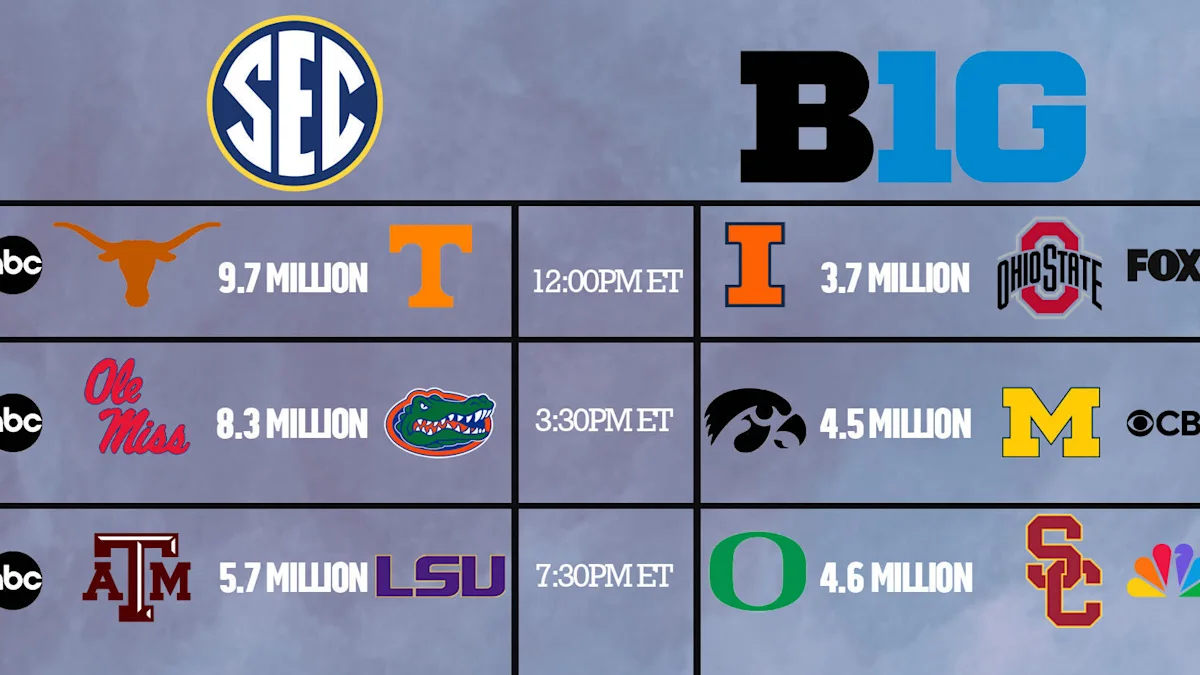
Despite winning three straight national championships, the Big Ten faces a problem that's entering crisis territory: the TV ratings gap between the Big Ten and the SEC is widening.
Some of this can be dismissed by pointing to the soft schedule the Big Ten has opened with, how early we are in the season, or the fact that Ohio State vs. Michigan will, as always, juiced the conference numbers at the end of the season. But all that spin aside, it's a problem that is snowballing… and snowballing fast.
Worse yet, the Big Ten has nobody to blame for its growing problem but itself.
Under Kevin Warren's leadership, the Big Ten went down a path almost no other major pro league or college conference has navigated successfully: it cut business ties with ESPN and ABC.
The business case was there. The Big Ten would move forward with three other broadcast networks: Fox, CBS, and NBC. Plus, ESPN now controlled the exclusive rights to the ACC and the SEC, as well as half of the Big 12. How could the Big Ten even fit into a new reality in which ESPN and ABC had entered the honeymoon phase with the SEC?
Fox, through an arrangement that seemed to rankle sports media executives and is still not very understood by the average fan, owns and controls Big Ten media rights (as opposed to the conference itself owning the rights) and was more or less looking for renters for Big Ten rights it didn't want (games that would get dominated by SEC competition). All networks, including ESPN, were put through their paces, pitching Fox directly on why they should partner with the network for Big Ten inventory.
Ultimately, the Big Ten and ESPN divorce was finalized, a byproduct of ESPN's commitment to the SEC. Meanwhile, out of a desperate need for any marquee college football inventory, NBC and CBS signed on with Fox and the Big Ten. And here we are in Year 3 of our new college football world order.
So, a few years following their divorce from ESPN, how's it going for the Big Ten?
The ratings suggest things aren't going great .
Fox seems content with the current arrangement. They're making money, and the Big Ten has been largely happy cashing checks that are bigger than their SEC rivals by an average of around $400 million per year. Past feedback from fans and schools hasn't registered as a problem for Fox , as they have an effective blueprint for making money, which includes:
A mildly successful alternative to College GameDay
Enough mediocre games on BTN and FS1 to keep validating their cable carriage fees
Cashing checks from NBC and CBS for Big Ten games, the majority of which are pretty mid and get clobbered by SEC games … an arrangement those networks seem less than thrilled with .
It makes money. A handful of noon games do well. CBS and NBC usually have one or two games per year to puff their chests out about.
But in the larger picture, the Big Ten is fading, at least in terms of ratings and its television product. Obviously, three straight national titles have reset the discourse on the best conference on the field, but undeniable problems seem to continue unabated in the short term.
I've been told the conference itself has grown increasingly annoyed by the trend, as well as by Fox's de facto stance that the Big Ten needs to do more to help itself. There is a growing sense at the Big Ten, from those who work for the conference to the individual athletic departments, that, compensation aside, they are at a disadvantage when it comes to the television product. And they fear the situation is only getting worse.
Fox and the Big Ten Have a September Problem
From 2021-2023, Big Noon was the most-watched TV window in the sport. It's now fallen to a third behind ABC's primetime and 3:30 game, both around 8 million viewers per week, compared with Big Noon's 6.3 million weekly viewers in 2025. There's chatter that Fox's noon window could even end up behind ABC's noon game this season.
Fox's ability to compete with ABC's 3:30 and 7:30 time slots went out the window when Texas and Oklahoma moved to the SEC , and ESPN acquired the SEC game of the week, previously held by CBS.
Big Noon will have a handful of great games this year, and every year. But beyond that, the slot is often filled with duds. So far this season, Big Noon has opened with North Texas vs. Indiana, Oklahoma vs. Michigan, Kent State vs. Ohio State, Illinois vs. Ohio State, and Michigan vs. Minnesota.
None of these games featured two ranked teams. The spreads for three of those games were 27, 41, and 52. You can probably understand why Gus Johnson has seemingly been sulking .
Fox didn't even send Big Noon Kickoff to Kent State vs. Ohio State. Ultimately, they knew the size of the Ohio State fanbase might draw a bigger audience than their other options that day, even against a 50-point underdog, but they couldn't even sell their Saturday pregame show for that game.
Fox is ultimately prioritizing a TV ratings projection versus airing a competitive game. This strategy does help maximize viewers, but it significantly diminishes the Big Noon brand and seems to act as a Quaalude for Gus Johnson. While they squeeze out mediocre ratings by going to objectively crappy Ohio State, Michigan, and Indiana games over and over, the cost is that most fans now know Big Noon is only "big" a handful of times each season.
At the end of the day, it's hard to puff out your chest about having the best pregame show and best games when you're broadcasting uncompetitive afterthoughts more weeks than not.
ESPN/ABC Have Way More Games to Choose From than Fox
If you asked me what the best thing to happen to ESPN in 2026 has been, it would be that both the ACC and SEC moved from eight conference games to nine. The end result is eight more conference games for both leagues.
Now, the SEC's second-to-last weekend of the season is no longer a box of cupcakes. This also means both leagues have more conference games before October. At least a dozen blowout games with no national interest have been wiped out in favor of conference games, many of which have significant value to ESPN.
The Big Ten was already at nine games, and unfortunately, some of them feature TV-ratings kryptonite: Rutgers, Maryland , Purdue , and Northwestern, along with the sagging national interest in Minnesota, Wisconsin , Nebraska , and Michigan State. Penn State , reliably the conference's third TV-ratings workhorse, suffered a surprise loss this past weekend, made more noteworthy by the rare sight of large swaths of empty seats at Beaver Stadium.
Oregon and Indiana certainly deliver on the field for the Big Ten, but they don't deliver anywhere near the audience of Michigan and Penn State when those schools are winning (something that is very much in limbo). The competitiveness of each conference's slate of games isn't on equal footing and might get worse depending on how Michigan and Penn State trend.
The SEC is a more diversified television product than the Big Ten, which relies too heavily on Ohio State, Penn State, and Michigan to move the needle. When these teams fall out of the Top Ten, the Big Ten teams that may take their place just don't pull the same TV ratings. This is less of an issue for the SEC, where the bench of programs that can drive ratings when successful is significantly deeper. The SEC doesn't need certain programs to win to be successful.
Another disturbing trend for the Big Ten is that ESPN is starting to schedule better games at noon on ABC versus later in the day on ESPN and is doing so to purposefully chip into Fox's eroding position at noon.
"SEC All Day" Loyalty and Frictionless Viewing is Crushing the TV Nomad
A normal Saturday for SEC fans means waking up and choosing between two pregame shows: College GameDay or SEC Nation, both of which might be on-site on an SEC campus. Often, ESPN has what it has branded "SEC All Day," which gives you two, or even three, ranked-team matchups. From pregame show to bedtime, fans have to change the channel once (from ESPN to ABC). From there, it's familiar announcers, familiar teams, and familiar rivalries.
I believe the biggest reason for the SEC's television trajectory is loyalty to the conference and reduced friction in consuming the product. Fans no longer have to go to CBS in the middle of the day for the best game. The schedule is more potent than ever, with more conference games and fewer cupcakes, as Oklahoma and Texas further bolster the conference's blue-chip brands. Bars and restaurants are also helping the ratings trend, with more televisions set to ABC and left there until 11 p.m.
The SEC on ABC is the most dependable thing on television on Saturdays. There is no Kent State, North Texas, or Rutgers to worry about.
Now consider the Big Ten setup. Big Noon Kickoff was in London earlier this month for a non-Big Ten game. Before that, the show has spent most weekends on-site for mediocre or downright uninspiring contests. Dave Portnoy and the Barstool Sports partnership haven't delivered ratings the way Pat McAfee and his field-goal-kicking contest have for ESPN. Before any game has even kicked off on Saturday, the Big Ten is already behind, ratings-wise and on social media.
In weeks when Fox has a good noon game, and the Big Ten leads the SEC early in the day, that advantage almost always dissipates by 3:30. Some Big Ten fans flip over to CBS, but if there's a better game on ABC, conference loyalty goes out the window.
And that's often the case. The millions of fans watching Ohio State vs. Penn State at noon are not getting delivered to whatever game CBS is airing at 3:30 anywhere near the level at which SEC viewers simply roll into ABC's 3:30 game. USC vs. Rutgers at 3:30 on CBS is just not a game that has any drawing power. Most Big Ten fans are still questioning why either team is in the Big Ten.
The Big Ten's television setup is like when you're bar hopping: You lose people along the way.
Taking that analogy one step forward, SEC fans just drink more. They stay at the same bar (ABC) and drink longer. Fans of other conferences bar hop from channel to channel, but do it for fewer hours, and leave some friends behind along the way, many of whom end up at ABC.
To the untrained eye, this past Saturday's last-second Iowa win over Michigan and Oregon's heated win over USC would suggest the Big Ten fared well against the SEC.
This is what a good weekend looks like for the Big Ten right now.
This is what the ratings look like for a bad weekend of games.
It's not just the friction of following the conference; it's loyalty. Most college football fans watch their team, and if they watch other games, they often just pick the best one on at that time. When a game ends, Big Ten fans are released, and many of them reliably migrate to an SEC game. For SEC fans, that migration is clearly much less of a thing. They stay. The next game on ABC is often the best game on. Big Ten fans are forced to bar hop and often end up consuming huge amounts of SEC football too.
College football, and particularly the SEC, just looks better on ESPN. There are many, many reasons for this.
For starters, football looks better under the lights, when ESPN/ABC schedules its best games. Football games are louder at night, and the overall atmosphere surrounding ABC's primetime games reliably feels bigger.
Second, scorebugs are subjective, but I find the Fox college football scorebugs a step above locally broadcast high school games. Overall, Fox's graphics package seems well below ESPN, NBC, and CBS. They aren't as shiny, clean, or crisp. Even the folksy SEC theme music on ESPN has become an earworm after a few years.
Finally, ESPN invests far more time and energy into capturing the atmosphere before a game. Fox tends to show teams running onto the field, while ESPN shows the slow walk from the locker room through a tunnel and onto the field. There are more crowd shots. They also have impressive Brad Pitt-narrated opening videos. ESPN often has shots of people around campus and outside the stadium. They put a lot of production effort into transporting viewers to the venue so TV audiences feel like the fans in attendance. Fox does some of this, but it's less extensive and less consistent. SEC games consistently feel bigger, and that often is enough to bring in casual viewers with no skin in the game. Other conferences and networks don't consistently match the priority and commitment to ESPN showcasing the pageantry of SEC college football.
Depending on whether Fox is airing the Big Ten championship game (they did last year because NBC ominously chose not to air the Big Ten Championship ), their biggest game of the year is Ohio State vs. Michigan . By 4 p.m. on the last Saturday of November, Fox's influence and role in the sport are all but done.
Throughout the year, ESPN promotes and champions the SEC's superiority (recent results have muddied that narrative). The bias is definitely there . They don't like you pointing it out , but that argument has long been lost. But when you turn the page to December, Fox's Big Ten counterbalance to ESPN's pro-SEC viewpoint essentially vanishes from the sport.
GameDay 's competitor goes away. Joel Klatt disappears. At that point, the Big Ten relies entirely on a network it walked away from. Fox and their enlisted partners hurt the Big Ten by being irrelevant starting in December.
The most-watched games of the year take place in December and January, all of which air on ABC, ESPN, or TNT (which ESPN still produces). Christmas ad spending rolls in, as do huge CFP ratings. No wonder Fox is desperately trying to expand the playoff , so it can have a piece of the pie.
Is the Widening Gap a Problem? And What Can Be Done?
Setting the ratings aside, the Big Ten makes more TV money than the SEC. Others will point out that the Big Ten's footprint encompasses more people (good for cable carriage costs), and Big Ten viewers have higher annual incomes than SEC viewers on average, which is appealing to advertisers.
Those explanations help the suits sleep better at night.
As a Big Ten alum, I don't care if the Big Ten is second in terms of ratings. What I do care about is that the product is falling behind and the ratings gap is widening. I also care that its primary television partner doesn't seem to have answers or urgency about the situation because the current setup works fine for them. They generally view it as the Big Ten's problem for having a weaker schedule from top to bottom than the SEC.
ESPN and the SEC have been in a good marriage. It's elevated the product and conference at a time when the on-field results have actually dipped. The strategy is working. If you're a Big Ten fan or alum, you want the same type of marriage that the SEC has, not whatever this current arrangement is.
You can say the Big Ten's strategy is working. They are winning on the field when it counts and cashing bigger checks. But with a widening gap in interest, excitement, and product quality, I'm just not sold that either of those things will hold true in a decade.
Topics in this story
Gathered from external sources. Rights to this text belong to whoever originally published it.