Murray, Wentz or trade? The pros and cons of Vikings QB options
With the NFL trade deadline approaching, Minnesota faces a difficult decision — and they can't afford to get it wrong again.
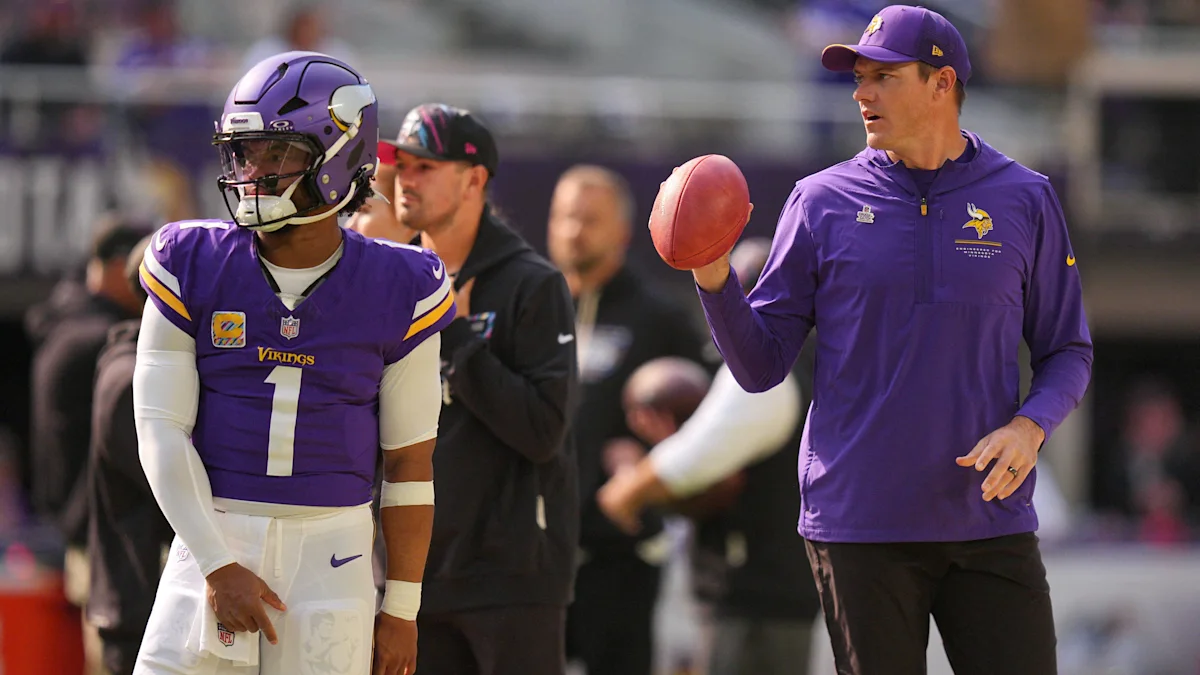
The Vikings are 6-1, have one of the NFL's most talented offensive rosters and somehow find themselves staring at another quarterback dilemma with the trade deadline just one week away.
Head coach Kevin O'Connell says K yler Murray remains Minnesota's starting quarterback , provided his sore hamstring doesn't keep him out of Monday night's showdown with the Buffalo Bills. But a report Monday suggested the Vikings haven't ruled out anything , including a trade for another quarterback.
Names like Daniel Jones, Kirk Cousins, Justin Herbert and even Gardner Minshew have been floated by insiders, former players and fans, with some suggestions carrying considerably more weight than others.
So what should the Vikings do? They have four options, none of which comes without risk.
Pros : Murray has shown flashes of being the right guy, and if he can find a way to play at a consistently high level, the Vikings could have a functioning, perhaps even dangerous, offense. He's more mobile than any alternative option, not to mention the Vikings don't have to give up draft capital or create another public QB controversy if they shift to Wentz.
Cons : Murray and Minnesota's offense are the main reason Minnesota's undefeated start to the season ended in Detroit. There hasn't been enough growth in five full Murray starts to move forward with confidence, and the schedule is daunting, with games against the Bills, Packers and 49ers in the next three weeks. Sticking with Murray could result in the Vikings being 6-4 and at the bottom of the stacked NFC North by the time we get to Thanksgiving.
Pros : Wentz has played seven games since signing with Minnesota last year, and while his performances have been up and down, he's been able to move the ball through the air at a more efficient rate than Murray. He's also gotten Justin Jefferson involved, and that's a priority right now after Jefferson uncharacteristically let his frustration boil over on the sideline in Detroit.
Cons : He's a statue. How many sacks will he take that Murray can avoid? And while Wentz might be better equipped to get the ball to Jefferson, is he really good enough to take Minnesota on a deep playoff run?
It also puts O'Connell and the Vikings in another uncomfortable situation after letting Sam Darnold and Daniel Jones leave after the 2024 season, and then not signing Aaron Rodgers when it was apparent that he wanted to be in Minnesota. Then they traded J.J. McCarthy, who might be turning into a star in New York. Benching Murray would be another QB disaster, but it might be inevitable either way.
Pros : This is where Kirk Cousins fits into the discussion. A reunion would be thrilling, and the fact that he's second in the NFL with 19 touchdown passes and third in the league in passing yards while taking only 11 sacks in eight starts (Murray's been sacked 15 times in five starts) is intriguing. He falls into the "small QB trade" category because the cost to get him wouldn't be anywhere near the price to acquire someone like Justin Herbert. Cousins would give the Vikings' offense a jolt, and the learning curve would be minimal because he's familiar with O'Connell's offense.
Cons : Cousins is 38 and immobile, so the risk of him getting mauled behind a leaky Vikings offensive line is real. His contract is also a bit of a pain. If they acquire him, they'd owe him $10 million guaranteed in 2027, so even if they cut him to avoid the two-year, $80 million club option from taking effect on the fifth day of the 2027 league year, they'd still have to eat $10 million in dead money.
Pros : Daniel Jones and Justin Herbert play in this category. Herbert would be tantalizing, even though he's been horrible this season for the winless Chargers. He's the big-arm, pocket passer who could thrive in O'Connell's system. He's under contract through 2029, meaning the Vikings would have their long-term answer.
Of course, this assumes the Chargers would even entertain trading Herbert. They're 0-7, but he's still a franchise-caliber quarterback under contract through 2029. Los Angeles might be more interested in rebuilding around him than starting over without him.
Jones knows O'Connell's offense, and his return, even though it's after his 2025 Achilles injury, might be ideal because the Vikings reportedly wanted to keep him after Darnold left in the spring of 2025. Jones is the cheaper option, but he's not signed beyond 2027.
Cons : Trading for Herbert would probably cost the Vikings multiple first-round picks. His contract is large enough that it would make it more difficult to sign players who'll need new contracts in the offseason, including core defensive starters Blake Cashman, Andrew Van Ginkel, Isaiah Rodgers and Jalen Redmond.
Jones, meanwhile, just might not be very good. His track record is ugly outside of the first eight games last season, when he had 13 touchdown passes and three interceptions as the Colts got off to a 7-1 start. He had five touchdowns and five interceptions in the next five games before tearing his Achilles, and the Colts lost four of those five games.
The Vikings have spent nearly two years trying to find the right quarterback for O'Connell's offense. They've moved on from Darnold, Jones and McCarthy, passed on Rodgers and now have a 6-1 team that might need another quarterback change to keep its Super Bowl hopes alive.
At some point, the Vikings have to get this right. And with the trade deadline one week away, they're running out of time.
This story was originally published by Bring Me The Sports on Nov 3, 2026, where it first appeared in the MN Vikings section. Add Bring Me The Sports as a Preferred Source by clicking here.
Topics in this story
Gathered from external sources. Rights to this text belong to whoever originally published it.