Arthur B. Hancock III, musician and 3-time Kentucky Derby winner, dies
Hancock won the Kentucky Derby three times, including with 1989 U.S. Horse of the Year Sunday Silence. He also is in the Kentucky Music Hall of Fame.
The Mercedes still sits parked next to the main house at Stone Farm.
It's the one Arthur Boyd Hancock III drove to the 1989 Kentucky Derby when he told a police officer, "I have a horse in the Derby," and the officer responded, "Right, and I'm the governor." After the race, security wouldn't let him in the winner's circle. Hancock not only had a horse in the race, he ended up with the winner when Sunday Silence beat the favored Easy Goer to save the farm.
For nearly four decades, that Mercedes has represented the man who lost a lot of hands but never stopped betting on himself.
Hancock, a musician and songwriter who instead chose the family business and became a thoroughbred breeder and owner, thrice winning the Kentucky Derby, died Friday, Sept. 18, from pancreatic cancer, surrounded by his family on his horse farm in Paris. He was 83.
Born to one of America's preeminent horse racing families, Hancock was known internationally for breeding and raising stakes-winning thoroughbreds, including by that 1989 winner, Sunday Silence, who became arguably the most influential stallion in Japan's thoroughbred history and changed the international breeding industry.
Hancock grew up among the hills of bluegrass in Bourbon County. He received a first-class education in horsemanship from his father and grandfather, at times showing first-class interest in music and, as he tells in his book, drinking.
His was a life of prominence, of top quality and also of juxtapositions, perhaps none more striking than that he both won the Kentucky Derby and was inducted into a music hall of fame. He was inducted into the National Museum of Racing and Hall of Fame as a Pillar of the Turf in 2025, and Kentucky's Music Hall of Fame in 2026.
In 2025, he published a memoir entitled "Dark Horses," in which he wrote, "I'm 100% sure I'd have gone into music if I had been born with nothing."
The day after he published, he was diagnosed with the same disease that quickly took his father. The three-time Kentucky Derby winning breeder and owner spent the past two years quietly battling pancreatic cancer.
He and his wife, Staci, have six children (five daughters and one son) and five grandchildren.
One of the first things in life horseman Hancock had to overcome was his name.
His grandfather, Arthur B. Hancock Sr., founded Claiborne Farm in the early 1900s. The farm is and was the legendary home of many horse racing legends, known for breeding champions and standing the world's leading stallions, including Secretariat.
Arthur's grandfather passed the farm to his son, Arthur "Bull" Hancock Jr., who at one time ran the largest thoroughbred operation in the world, nearly tripling Claiborne Farm's size to about 6,000 acres. Arthur learned how to be a horseman from his father, Bull, who also earned acclaim by breeding to European horses, including Princequillo and the Aga Khan's Nasrullah, two of the world's then-champion sires.
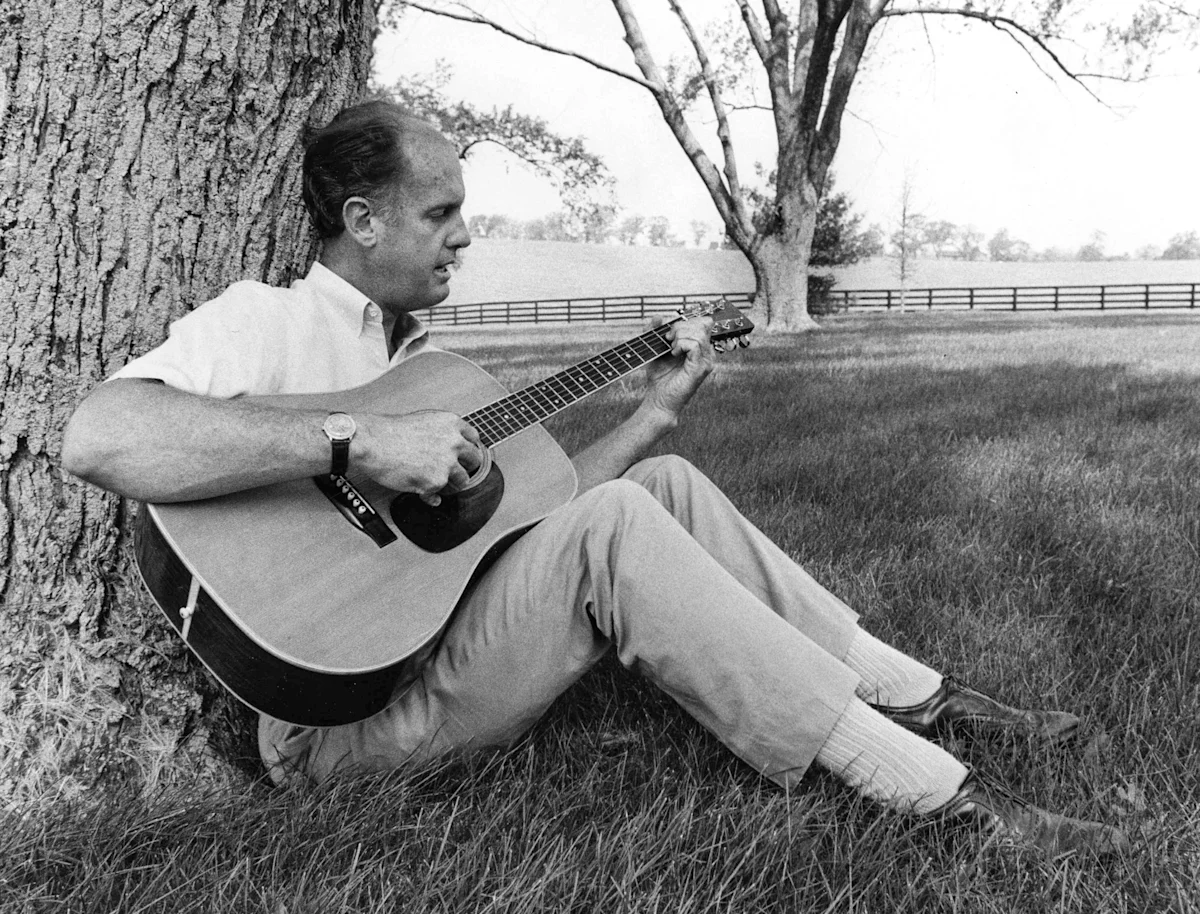
While his father could be in a barn 25 hours a day, Arthur also discovered a passion for music. An accomplished musician, he found a home in bluegrass, writing songs recorded by Willie Nelson and Ray Price, and becoming good friends with Peter Rowan, one of Bill Monroe's Bluegrass Boys.
Music would be a constant in Hancock's life, but his father would often tell him, "You can't do two things and do either one well."
Maybe not at the same time, but Arthur is the only man to be named a Hall of Fame horseman — next to the likes of thoroughbred trainer D. Wayne Lukas and Derby-winning jockey Pat Day — as well as a Hall of Fame musician, next to the likes of Loretta Lynn, Patty Loveless, Dwight Yoakam and Chris Stapleton.
After graduating from Vanderbilt with a bachelor's in history, Hancock left Nashville and its music scene and became an assistant to trainer Eddie Neloy at Belmont Park, working with champion Buckpasser.
Leaving Claiborne for a new legacy at Stone Farm
Bull Hancock died of pancreatic cancer two weeks after he was diagnosed in 1972.
In his memoir, "Dark Horses," Hancock wrote about his exit from Claiborne as a disagreement between two of the executors and legendary pillars of the farm, Ogden Phipps and William Haggin Perry, stating that the two told his younger brother, Seth, then just 23 years old, they were planning to make him president and demote Arthur, while keeping that news from Arthur.
"I thought, if that's how they feel, fine," Hancock wrote in his memoir. "I'm not going to hang around if I'm not wanted. … I was shattered. But I knew I had done the right thing, even though it was the hardest thing I had ever done. I was giving up my heritage and my birthright."
The relationship between the two brothers following their father's death, as well as the decision made by farm management, has long been documented in newspaper accounts, industry publications and, of course, Arthur's memoir.
In May, the family told The Courier Journal there is nothing between the brothers now but respect.
"While it was probably a little messy at times, it worked out how it should have worked out," Seth Hancock said. "He is a terrific horseman. While we didn't work side by side, I learned a lot from what he did because he was as good as there ever was at doing it."
The night Arthur left Claiborne, he went to Halls on the River, a quaint restaurant in Winchester. As he tells it in his memoir, Hancock drunkenly told his best friend, Paul Sullivan, that one day he was going to win the Kentucky Derby and "be bigger than Claiborne."
Sullivan responded, "Waitress, bring this fool another Budweiser."
Hancock left Claiborne management and its four-columned mansion for land six miles down the road and a four-room cottage, purchasing Stone Farm in 1964.
"I was going to be a land baron — spelled b-a-r-r-e-n," Hancock wrote in his memoir. He eventually bought 18 farms of "4,600 acres of prime Bourbon County land," making him "one of Kentucky's largest landowners," he wrote.
When he bragged about it to Stone Farm yearling manager Sam Ransom, Hancock's trusted employee responded, "Well, boss, we may be big in size but Claiborne's big otherwise."
The bet on land would soon place him in dire financial pressures.
A Kentucky Derby 'dream' his father never realized
Hancock did get his shot at the Derby. It first came in 1971, when Tap Shoes ran a disappointing leg.
A little more than a decade later, a grey horse named after a cat that liked to lounge around the barn in the sun entered the 1982 Kentucky Derby at 21-1 odds. Gato Del Sol, sired by a Chilean horse named Cougar, had yet to win a race when the 19 horses went to the post.
Gato started from the next-to-outside position. He came from next-to-last, picking off his counterparts along the backstretch before racing three horses wide in the stretch to win the roses by 2½ lengths.
That moment on May 1, 1982, made Hancock the first member of his family to win America's most celebrated race.
Hancock told BloodHorse, an industry trade publication, in 1982: "I had an out-of-body experience for the only time in my life. It was the damnedest thing to be in the winner's circle of the Kentucky Derby. That was Daddy's dream, and it didn't happen for him. But I thanked him on the TV interview for showing me how to get there."
Hancock continued: "I felt redeemed. I remember sitting in a restaurant in Lexington before Gato won, and some guy at the next table was talking about Claiborne and saying how well Seth was running it. And then he says, 'That other brother is a lost ball in high weeds.' I didn't say anything, but I wanted to. After Gato, people began treating me differently."
Still, Hancock nearly went bankrupt in the 1980s — being that "land barren" and accumulating debt he was unsure how he would pay down. In 1988, when the horse and real estate markets crashed, Hancock owed about $15 million on the farm.
Then came that sickly black foal and the Cinderella story of 1989 in Sunday Silence. A son of Halo, the colt fell ill and nearly died on his first Thanksgiving. Owned by Hancock's friend Tom Tatham, the yearling garnered no interest at the Keeneland sale, so he was brought back to the farm. Hancock tried to sell him again at an auction in California, but again nobody wanted the yearling.
On the trip back from California to Kentucky, the horse van overturned. The accident killed several other horses aboard. Sunday Silence survived. It was a sign to Hancock to keep him. In partnership with trainer Charlie Whittingham, the horse showed promise. Then, he won the 1989 San Felipe Handicap and Santa Anita Derby.
Next came the Run for the Roses. Easy Goer was touted as the superior horse, the best ever bred by Ogden Phipps, who was part of the farm management who made the decision to place Seth at the helm of Claiborne. Based on newspaper reports from the time, Easy Goer was considered the second-coming of Man O' War. He was regally bred, sired by Alydar out of a Buckpasser mare named Relaxing. (Alydar had his own legendary rivalry, finishing second to Triple Crown winner Affirmed in all three races.)
Easy Goer was a favorite to win. But it was Sunday Silence's Derby, and then Preakness. Easy Goer denied Sunday Silence the Triple Crown, winning the Belmont Stakes.
But the fourth and final showdown between the two horses in November 1989, the Breeders' Cup Classic, didn't disappoint. Easy Goer was the betting favorite. As the finish line drew close, Sunday Silence had the lead.
"All of a sudden, there (Easy Goer) was, and my heart was in my throat," Hancock wrote in his memoir. "That great racehorse was rolling like a runaway train, gaining ground with every jump. I dropped down on my knees in the front of the box, praying, 'Please God don't let this big red (expletive) catch us,' and for a minute I thought he might. But he didn't get there in time."
Sunday Silence won by a neck. He was later named Horse of the Year.
In retirement, Sunday Silence drew little hype among American breeders. He never covered a mare in Kentucky and was instead offered for sale to stand in Japan. (He was already part-owned by Zenya Yoshida, who bought into the champion at the end of his three-year-old season.) Sunday Silence was Japan's leading sire for 13 years, helping turn Japan's breeding industry into one that consistently produces Derby contenders and has produced legendary Japanese racing champions. He is argued to be the greatest sire in the history of Japanese breeding.
In Hancock's speech at the Eclipse Awards dinner in February 1990, he talked of believing in Sunday Silence and thanked those who believed in him.
"In closing, I want to thank God for the blessing," he said, "but I feel like Kris Kristofferson must have felt when he wrote that beautiful song, 'Why me, Lord?'"
S tephanie Kuzydym is an enterprise and investigative sports reporter. Reach her at skuzydym@courier-journal.com .
Topics in this story
Gathered from external sources. Rights to this text belong to whoever originally published it.