Lewis Hamilton put £20 million behind a promise to change Formula 1; here’s the foundation he built for motorsport’s future
Lewis Hamilton launched Mission 44 in July 2021 with a personal pledge of £20 million, using his success in Formula 1 to create more opportunities for
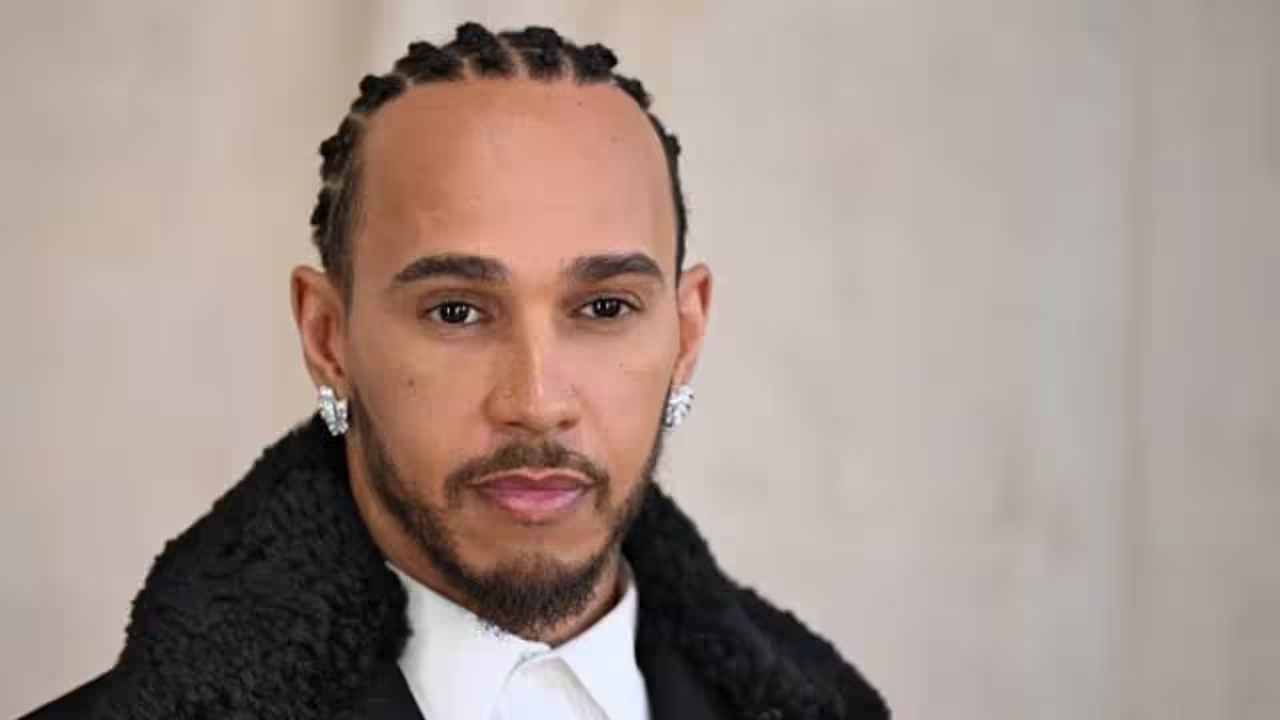
Lewis Hamilton launched Mission 44 in July 2021 with a personal pledge of £20 million, using his success in Formula 1 to create more opportunities for young people from underrepresented backgrounds. The foundation grew from a problem Hamilton had seen throughout his racing career, the lack of Black people across motorsport, particularly in technical and engineering roles. Before launching Mission 44, he worked with the Royal Academy of Engineering on a 10-month study into those barriers. The Hamilton Commission later produced 10 recommendations, giving Hamilton a research-based plan for turning concern about representation into action.Why did Lewis Hamilton launch Mission 44 after looking at an F1 team photoThe idea did not start with a new charity. It started with Hamilton looking at an end-of-season Formula 1 photograph in 2019 and noticing how few Black faces were in it. The problem was bigger than the 20 drivers who compete in F1. Hamilton was looking at the thousands of people who design cars, build parts, work in factories, handle data and support teams away from the cameras.The Hamilton Commission was created with the Royal Academy of Engineering to understand why Black people were so underrepresented in British motorsport. Its report, “Accelerating Change: Improving Representation of Black People in UK Motorsport”, was published in July 2021 after 10 months of research. It looked at education, university admissions, apprenticeships, recruitment and workplace culture rather than treating the issue as something that started when a person applied for an F1 job.The report found that the UK motorsport sector employed about 40,000 people, while estimates from interviews suggested that less than 1% of people working in Formula 1 came from Black backgrounds. It also found that F1 teams often recruited engineering graduates from Russell Group universities, creating another barrier because Black engineering students were not spread evenly across those institutions.One figure showed just how early the problem could begin. In 2019, only two Black Caribbean students in the whole of England achieved an A* in A-level physics. The report also found that just over 3,800 Black students were studying engineering across UK universities, with about 820 at Russell Group universities.How did Lewis Hamilton turn that research into opportunities for Black studentsHamilton did not limit the response to racing teams. Mission 44 looked at the education pipeline first, because a person cannot enter an engineering job in motorsport if they have already been pushed away from science and maths years earlier.One early partnership was with Teach First. In October 2021, Mission 44 announced a two-year programme aimed at recruiting and training 150 Black STEM teachers for schools serving disadvantaged communities in England. The programme also included mentoring, research, networking and other efforts to understand how more Black graduates could be encouraged into STEM teaching.That approach connected directly to one of the Hamilton Commission’s findings. The report said Black Caribbean pupils were less likely to be placed in higher science sets and highlighted concerns around teacher expectations, school behaviour policies and access to science subjects. It also found that fewer than 10 Black students were studying motorsport qualifications in further education in 2019/20.Mission 44 also moved closer to motorsport itself. Through the Ignite partnership with Mercedes-AMG PETRONAS F1 Team, more than £5 million in seed funding was made available for projects designed to improve diversity and inclusion in motorsport. The partnership supported programmes ranging from grassroots participation to specialist engineering education.What has Lewis Hamilton’s Ignite partnership done for motorsport engineeringOne of the clearest examples is the motorsport engineering scholarship programme run with the Royal Academy of Engineering. The scheme was created after the Hamilton Commission identified the gap between Black students studying engineering and their chances of moving into motorsport.The first scholarship cohort was announced in 2023, with five students from Black or mixed Black backgrounds receiving financial and career support for motorsport-related master’s degrees. The programme has since expanded. In the 2024/25 period, eight new students received scholarships, with each getting a £28,000 grant alongside career development support.The programme is still developing. In January 2026, Mission 44 and the Royal Academy of Engineering announced an expanded version of the MSc Motorsport Scholarship. The new scheme offers scholarships worth up to £43,000 and is open to a wider group of candidates.Ignite also backed programmes outside engineering. Its first grants included support for Motorsport UK’s work to increase female participation in grassroots motorsport, showing that the partnership was not built around one route into the sport.How far has Lewis Hamilton’s Mission 44 grown since the £20 million pledgeMission 44 has since moved beyond its original focus on British motorsport. Its latest annual report says the foundation reached 550,000 young people during 2024/25 and expanded its work in the United States. It also launched an education policy campaign and continued funding organisations working on education and STEM access.That change is crucial because Hamilton’s original concern was never only about finding another Black Formula 1 driver. The Hamilton Commission showed that the barriers could appear much earlier, from school subject choices to access to technical education, university pathways and professional networks.The numbers also explain why Hamilton chose to build a foundation rather than simply make a one-time donation. The problem was spread across several stages of a young person’s life. Mission 44’s work has therefore included teachers, schools, engineering students, grassroots programmes and routes into employment.Five years after the £20 million pledge, the most visible part of Hamilton’s work is no longer just the amount of money attached to it. There is now a continuing structure behind the idea, research to identify barriers, partnerships to address them and scholarships and programmes designed to help young people move through the pipeline.The original photograph gave Hamilton a question. The Hamilton Commission helped define the problem, and Mission 44 became the vehicle for acting on it. In 2026, that work is still expanding, with the motorsport scholarship programme itself moving into a larger phase.Stay updated with the latest Asian Games 2026 news, check the Asian Games medal tally and complete Asian Games schedule.Get the latest Sports News and Live updates. Download the TOI app.
Topics in this story
Gathered from external sources. Rights to this text belong to whoever originally published it.