Why the Falcons need to prioritize Kyle Pitts to solve passing game woes
It’s another season where a coaching staff has to figure out how to consistently utilize the dynamic pass-catcher.
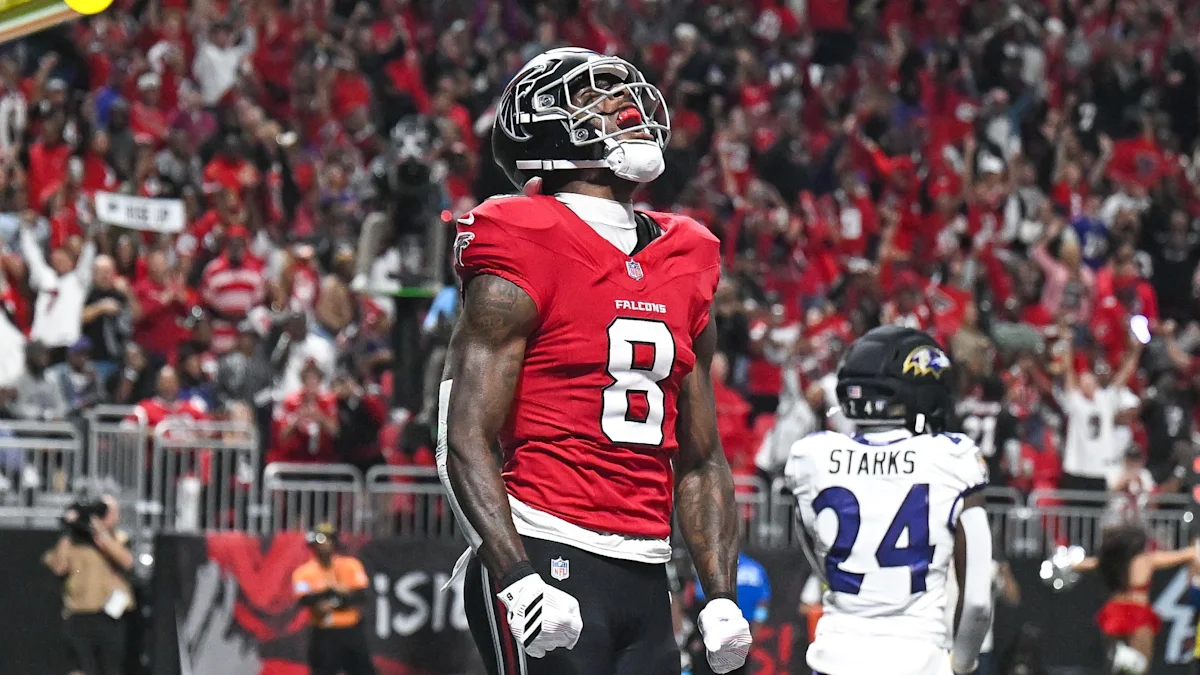
With less than 11 minutes left in the fourth quarter, Kyle Pitts caught his second pass on a quick out as the Falcons trailed 31-7. It's normally a standard route and play for a tight end to make in a lopsided matchup. It became the spark the Falcons needed for an unexpected comeback attempt. It also could prove to be the platform to help combat one of the most pressing issues surrounding the Falcons.
The Bears soundly outplayed them in every phase of the game, making it an uncompetitive matchup at one point in the second half. The defensive front got bulldozed out of gaps and struggled to maintain its rush integrity against Caleb Williams. The special teams were an absolute disaster, headlined by Zachariah Branch's nightmare performance that every rookie dreads.
Despite those glaring shortcomings and breakdowns, the most damaging aspect of the loss was how overwhelmed the offense looked against Chicago's pressure looks.
For the second consecutive game, Michael Penix Jr. looked incapable of making the right reads and throwing accurately under pressure for long stretches. The coaching staff's game plan to combat Dennis Allen's constant schemed-up pressures should raise plenty of questions.
Penix Jr. still could have operated better with quicker processing and better feel for blindside pressure. It took until the fourth quarter for him to find some rhythm against Chicago's defense when they rushed five or six.
That's when Penix Jr. connected with Jahan Dotson for 32 yards on a stop route, where Dotson made a nice hesitation move that turned a solid completion into an explosive gain. It was a sharp play beating Chicago's five-man pressure.
Dotson's career inconsistency and overall limitations make you cautious about his ability to create separation on the outside often enough to give Penix Jr. high-percentage looks against blitzes. What Pitts did on the next play can be replicated, albeit hopefully not as dramatically for the sake of the Falcons.
Per Pro Football Focus, Pitts ran 17 routes from the slot versus Chicago. That was a season high, easily surpassing the seven he ran against Carolina. Some of the high usage from the slot can be attributed to the game script. It was the first game this season where the Falcons were behind all game long with Penix Jr. under center. That proved to be a recipe for success after three quarters of a mostly inept dropback passing game.
Chicago brought six with former Falcon Clark Phillips rushing in unblocked. Penix Jr. had to get the ball out quickly again to Pitts outside the numbers. The throw was inside of Pitts, allowing Elijah Hicks to close in for a potential interception. Somehow, the 2025 second-team All-Pro tight end ripped the ball away and juked past Nick McCloud to produce a remarkable 29-yard gain. In the process, he prevented a certain turnover with his improved contested-catch ability.
Those types of completions could be an instant solution to the Falcons' problems against crowded fronts and blitzes. Whether defenses only rush four or bring the entire house with seven or somewhere in between, Baltimore and Chicago have provided a blueprint to rattle Penix Jr. by crowding the line of scrimmage with bodies.
Combine that with Kevin Stefanski and Tommy Rees falling short of answers schematically, and you get a dropback passing game that severely limits the offense. That can't happen against top-tier teams like the Ravens and Bears.
Three plays after the highlight-reel reception, Pitts was in the slot again on third down. Chicago rushed six, with Allen being relentless in trying to force Penix Jr. into another off-target throw or sack. Instead, the young quarterback found Pitts uncovered, as Hicks couldn't make up the ground to stop him. It was a routine touchdown, but it showed how Pitts can be a dependable solution to a glaring problem.
Despite being such a unique talent as a deep threat, Pitts can be maximized in the short-to-intermediate areas of the field. He proved last year that he can consistently make defenders miss and run through contact after the catch. His blocking has improved enough that he can play more in-line and create more mismatches with his explosiveness off the line of scrimmage.
While he should be used more in the slot following Olamide Zaccheaus' poor play and Branch's disastrous game, Pitts can also line up more traditionally as a tight end to bolster the Falcons' aerial attack.
After Jessie Bates connected on his signature peanut punch to force a fumble, as he does multiple times a year, it didn't take long for Penix Jr. to go back to Pitts. Operating in no-huddle, they slowed Chicago's pressure plan and capitalized on Pitts being isolated inside with an undersized defensive back.
Targeting that mismatch helped Penix Jr. find Pitts to convert on third and nine. They connected again on the next play to get in the end zone, putting the Falcons within striking distance of an outrageous comeback. A slight rub by Zaccheaus on the slant-flat concept gave Pitts the space necessary to score his second touchdown of the game.
As much as fans want to see Pitts be utilized like the unicorn he was projected to be, the coaching staff needs him more than ever as a possession pass-catcher in these situations to give Penix Jr. an immediate option under pressure.
There will be instances where he can thrive in the slot, like against Chicago. He could also line up as an in-line tight end, chipping an edge rusher and serving as a reliable outlet underneath. Whatever the play design, Pitts needs to be a bigger focal point to make the passing game more efficient.
According to TruMedia, the Bears blitzed Penix Jr. on an alarming 48.7 percent of his dropbacks. That could increase in upcoming matchups against Todd Bowles, Steve Spagnuolo, and Brian Flores. Those coaches won't hesitate to ramp up the pressure on any quarterback, let alone a young passer who isn't reacting well when seven defenders are lined up across the line of scrimmage.
The coaching staff will have to do its share schematically to solidify their protection plan. Making Pitts a bigger focal point in the passing game is the other vital step to punish defenses for constantly blitzing. Signs are emerging in recent weeks, as Pitts' target share has increased over the last three games.
That said, those targets have to come earlier in games. Pitts catching only his second pass late in what was arguably the Falcons' most disappointing performance of the season (with a starting-caliber quarterback under center) indicates he needs to be prioritized far more early and often.
Topics in this story
Gathered from external sources. Rights to this text belong to whoever originally published it.