‘If India won a medal, we owe it to her’: Captain Swayams Mishra on Savitha Shri’s Chess Olympiad heroics | Exclusive
NEW DELHI: Across the open and women's sections at the Chess Olympiad, only one player won an individual gold medal for India at the 2026 Chess Olympiad
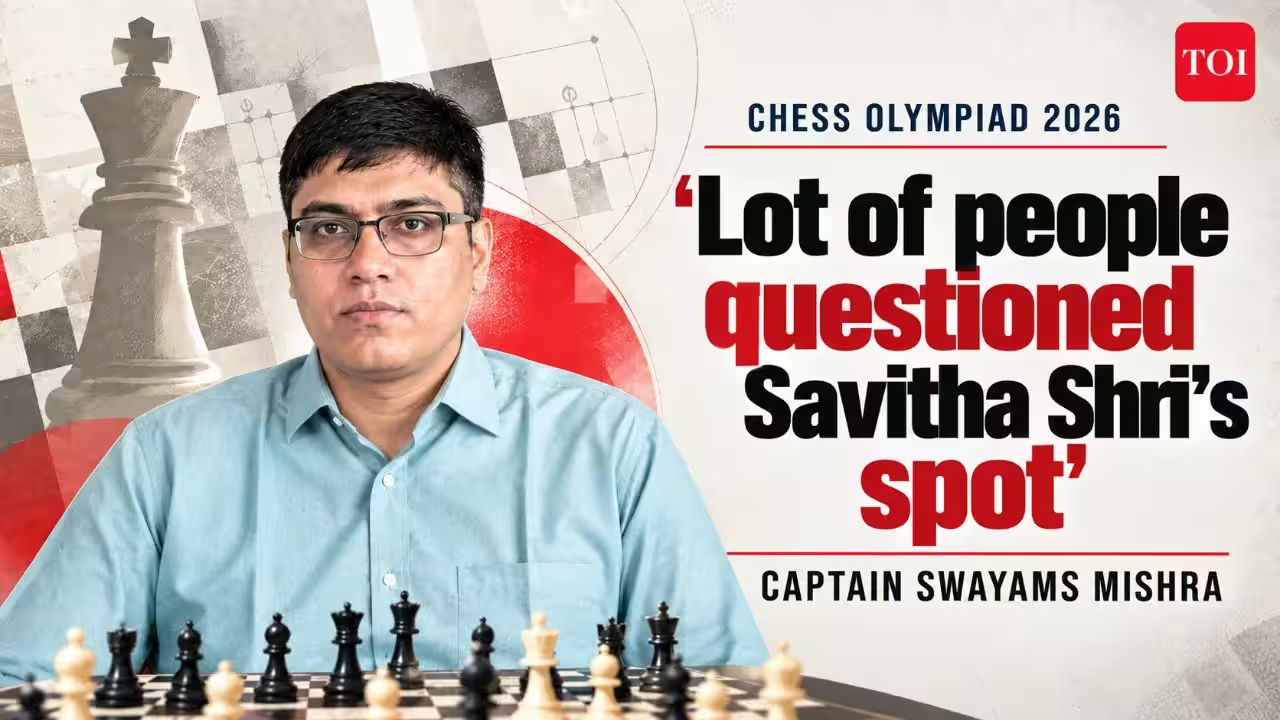
NEW DELHI: Across the open and women's sections at the Chess Olympiad, only one player won an individual gold medal for India at the 2026 Chess Olympiad in Samarkand, Uzbekistan. That was Chennai's 19-year-old Savitha Shri Baskar. Savitha was often the one India could rely on when the team was staring at heartbreak. With her games routinely going down to the wire, she was kept fuelled, game after game, by someone making sure she never had to think about anything other than the board during India's bronze-clinching campaign."If we wanted something, he was always there, giving us everything, like water, bananas, and for me, he was bringing endless coffees because I played till the last moment, making sure that I ate properly and got energy," Savitha recalled, before labelling Swayams Mishra as the "best captain ever".For Mishra, it was new territory in a role he'd long been adjacent to."I've been part of the women's team since 2022, but this was the first time I was captaining completely. In 2024, I had captained for a couple of games, but this was a completely new experience," he told TimesofIndia.com during an exclusive interaction."This time, I have to be there in the tournament hall with the players, especially in the critical games, so the emotions are completely different compared to when you are outside. That was slightly different, and not easy."The coffee, the bananas, and the helplessness of watchingThe job, according to Mishra, was less about tactics and more about manoeuvres of a different kind."It was hectic and exhausting, because as a captain you try to follow all the games going on, not just one player's. At the same time, sometimes you see a player making a mistake; you want to do something, but you cannot; you just have to wait for it to unfold naturally," he admitted. What he could control, though, he controlled."What I tried to do is look at what the players needed. If there's a longer game, they needed some energy or something to eat, so I made sure they had it available instead of spending time getting it themselves around the third or fourth hour."Viewers watching the live broadcast of the games got to witness the results of that instinct in real time, with water bottles, bananas, and coffee cups appearing at just the right moments.Build-up: Virtual camps, and logistics that nearly derailed things againThe challenges for Swayams started even before the tournament. Getting the team to that stage was a project in itself, with busy, overlapping schedules making it difficult for the players to train together in person.With the help of the All India Chess Federation (AICF), the team turned to virtual camps in the run-up to the Olympiad."It all started with the camps, like organising the camp online, where we found that most of the players' schedules were very tight, so we held an online camp because players were not able to find a common timing to able to meet up with their busy schedules," Mishra revealed.The challenges followed the team in Samarkand, where India, like several other nations, faced accommodation and food issues."On the first day, with the issues with the stay, AICF stepped up, and the president Nitin Narang and the HOD Abhijit Kunte ensured that the players got the rooms first," he said. "President Narang was also present, and he went out of his way to help us in most of the things."Food then became another issue, with Mishra recalling that “when food was not very ideal, the options were not great, AICF made sure that food is Indian food people get so that they don't lack energy and they don't go like let's say their routine and other things are not disturbed as well.”The Vaishali decisionThe team bronze did not come easy, without its share of difficult calls. One of the toughest was deciding which four players from the five-member squad would take the board each round."For me, it was not easy choosing whom to play, because it was always a tricky call, with Savitha and Vantika performing very well on the last boards, and Vaishali also having good chances; we wanted her to play. It's a very hard call when one of your top players ends up not being in form, and the others are performing very well. Vaishali tried, gave her best, but it just wasn't meant to be," the captain, who then decided to keep the Women's World Championship challenger on the board for only six out of the eleven games, sighed.With Vaishali, who had just one win in the entire Olympiad and finished with a score of 2.5/6, due to challenge for the Women's World Championship title next year, Mishra also addressed whether this stretch of poor form carried any psychological weight into that bigger picture."We had a discussion, and she was not thinking at all about the World Championship. She wanted to just focus and give her best for India in this Olympiad, but it wasn't working out. I think she's strong enough, a professional player who should be able to get back much stronger and prove herself as a world champion as well. I wish she wins the World Championship."Board-by-board analysis from the captain"Humpy on board one, I think, this would be her best Olympiad. India hadn't won a medal on board one for quite some time, and her winning one (a bronze with a score of 7/10), undefeated, against strong opposition, was very good. We were never on the back foot on board one," captain Mishra explained.Board two, however, told a different story."Vaishali started off decently. She had some tough opponents who didn't make mistakes and played precisely against her. Against Poland, that's where things changed — she had a better position, in fact, and wanted to win. There were a couple of chances to simplify into a draw, but she wanted to win, and in that process ended up making mistakes and losing," the coach added."Then she had another critical game against Kazakhstan, where she again had chances to equalise but wanted to win it for the team. A draw there would have given us 2-2, because Savitha's board wasn't clear yet. So she tried, and it backfired. You can say she was always there for the team, even if her performance wasn't great."By contrast, individual silver medalist Divya Deshmukh, scoring 6.5/10, emerged as one of the pillars."She took a lot of blacks, seven out of ten games, and was always ready whenever the team needed her. She had a consistent performance and gave us a couple of fast wins that put pressure on the other opponents."It came after a rough patch as Mishra continued, "She started completely out of form; Cairns Cup wasn't as per expectations, GCL wasn't great. But from there, she came back very strongly and was always reliable. She lost the last round, but she'd done her job by then."Vantika Agrawal, on board four for most of the tournament before Savitha's emergence, drew measured praise."She was consistent. There was one game, against China, that was very close, where she was close to a draw and missed something under pressure. Otherwise, she did her job, whatever was assigned to her, and gave us points on the last board," he added.And then Savitha. Mishra didn't hold back on addressing the scrutiny that had followed her selection."There were a lot of people who questioned her spot, journalists saying there are players higher than her, and so on. But according to the selection, she was qualified, and she'd won the Asian continental a couple of months ago. She'd also played the World Women's Team Championship, so I knew her as a team player always."Whenever we gave her the opportunity, she delivered. From round seven onwards, her form dropped slightly compared to the initial rounds as she was making some errors; the quality wasn't quite what she'd have expected. But she always compensated in the last hour, changing the result of the match completely. If India won a medal, we owe it to her."Bronze, and what the team takes from itAsked whether anyone inside the camp was satisfied with bronze, Mishra didn't pretend otherwise."We are not satisfied. The colour of the medal would have been different, and we would have been much happier. But even in your not-so-good times, if you're able to get a medal, that shows how strong the team is. We expect to come back even stronger next year and win gold."I know people might be disappointed; the fans might be disappointed; we're equally disappointed. But everyone tried their best. The margins were very close."The tournament's bigger lesson, for him, had less to do with India specifically than with the state of women's chess as a whole."We did not underestimate anyone, but there were a lot of teams creating upsets. Mongolia, whom we played in round four, and Greece in round three, both ended up causing upsets elsewhere. Against the silver-winning Kazakh team, Mongolia were winning too, before it finished 2-2. In the last few Olympiads it was smooth sailing for the top seeds. This year, weaker teams were able to strike. That means chess is growing in general, especially women's chess."It's a tournament Mishra will remember as much for its margins as its medal, a campaign where India were, by his own description, "always on the wrong side of where we wanted to be", rescued more than once by a teenager fuelled on endless cups of coffee, and still, somehow, bronze rather than nothing at all.Stay updated with the latest Asian Games 2026 news, check the Asian Games medal tally and complete Asian Games schedule.Get the latest Sports News and Live updates. Download the TOI app.
Topics in this story
Gathered from external sources. Rights to this text belong to whoever originally published it.