College Football Chaos: Five of America’s Top Seven Teams Lose on the Same Day — and the Playoff Race Just Exploded
One of the most extraordinary Saturdays in college football history has thrown the national championship race into turmoil. But just […]
One of the most extraordinary Saturdays in college football history has thrown the national championship race into turmoil. But just how improbable was this unprecedented wave of upsets?
College football didn't just experience an upset Saturday.
Five of the nation's top seven teams lost on October 17, 2026, turning what was supposed to be another important weekend in the national championship race into one of the most stunning days in modern college football history.
The carnage included second-ranked Notre Dame's controversial loss at BYU , where the Fighting Irish were denied a final offensive play because of an acknowledged officiating error.
Across the country, highly ranked programs watched their championship aspirations suffer devastating blows, creating an almost unimaginable shakeup in the College Football Playoff race.
The results also raise a fascinating mathematical question.
What are the odds of five of the nation's seven highest-ranked teams losing on the same Saturday?
The answer depends on the matchups and the probabilities assigned to each game.
But even with that qualification, Saturday's results were extraordinarily unlikely.
And their impact could be felt all the way through December.
The five losses that shook college football
Rankings entering October 17. Results confirmed by Reuters and Associated Press .
College football had literally never seen this happen before
This wasn't simply an unusually chaotic weekend.
According to the Associated Press , it was the first time since the AP poll began in 1936 that five of the top seven ranked teams lost on the same day during the regular season.
That's 90 years of rankings history without a comparable Saturday.
Sportradar identified January 2, 1989, when five of the top eight teams lost in bowl games, as the closest historical comparison.
But even that wasn't a regular-season Saturday.
Georgia and Notre Dame became the first teams ranked No. 1 and No. 2 to lose on the same regular-season day since 2012.
And Georgia's loss continued another extraordinary trend.
For the second consecutive week, the nation's top-ranked team fell to an unranked opponent, something that hadn't happened since 1990.
The college football establishment didn't just get shaken.
How improbable was Saturday's carnage? Roughly 1 in 1,000
The Wall Street Journal's analysis put the probability of Saturday's collection of results at approximately 0.1%. That's about a 1 in 1,000 of the combined results occurring at any point in college football history.
There's an important distinction between the historical rarity and the mathematical probability.
Indiana's defeat was not an independent upset against an unranked opponent. The Hoosiers were playing fourth-ranked Ohio State, meaning at least one top-five team was guaranteed to lose.
Notre Dame was also playing a top-10 opponent.
The truly stunning results came elsewhere, particularly Georgia's loss to Auburn and Texas' defeat against Florida.
For a rough illustration, imagine assigning the five losing teams the following hypothetical probabilities of defeat:
Multiplying those five probabilities gives a combined likelihood of 0.075%, or approximately one chance in 1,333.
These are illustrative probabilities, not verified closing-market odds. The calculation also assumes independence between the game outcomes. But it demonstrates how quickly the probability of several seemingly unlikely results occurring together becomes extraordinarily small.
Saturday was historically unprecedented, and mathematically remarkable.
The College Football Playoff race has been completely transformed
The biggest beneficiaries of Saturday's chaos might not be the teams that pulled off the upsets.
They might be the contenders that simply survived.
Miami: The Hurricanes could be the new No. 1
Third-ranked Miami suddenly has an opportunity to take over the top spot in the AP poll, despite the fact that the Hurricanes nearly became another casualty.
Miami needed double overtime to escape Florida State, 43-35, in a rivalry game that also included a controversial ending.
Florida State appeared to complete consecutive game-winning Hail Mary touchdown passes on the final play on the second overtime. The first was wiped out by a disputed holding call and the second was ruled a game-ending interception despite Seminole receiver Deuce Robinson and Hurricane defensive back Bryce Fitzgerald appearing to have simultaneous possession, which by rule should have been called a touchdown.
Regardless, The Hurricanes remain undefeated at 6-0, and with Georgia and Notre Dame losing, they have an obvious argument for the No. 1 ranking. But there's an uncomfortable question: If Miami struggled that badly against Florida State, how secure is its own championship status?
For now, the Hurricanes are among Saturday's biggest winners.
Ohio State: A massive victory with a potentially devastating cost
Fourth-ranked Ohio State ended Indiana's remarkable 22-game winning streak with a 19-15 victory in Bloomington.
That result strengthens the Buckeyes' position in the Big Ten championship race and gives them one of the nation's best victories.
But the celebration came with a potentially serious problem.
Quarterback Julian Sayin suffered a shoulder injury and returned to the sideline with his arm in a sling. His availability moving forward could determine whether Ohio State can capitalize on Saturday's opportunity.
The Buckeyes have the résumé of a championship contender.
Now they need to keep their quarterback healthy.
BYU: The Cougars are suddenly legitimate championship contenders
BYU's 28-24 victory over Notre Dame represents one of the most significant results of the season.
The Cougars are 6-0, own a signature victory over the nation's second-ranked team and have positioned themselves as serious contenders for the Big 12 championship.
Quarterback Bear Bachmeier accounted for all four BYU touchdowns, producing the kind of performance that can transform a team's national reputation overnight.
However, the victory comes with controversy.
The Big 12 acknowledged Sunday that officials incorrectly allowed the game to end when one second should have remained, denying Notre Dame another opportunity to score.
The result stands, and BYU's playoff prospects have improved dramatically.
Georgia: The Bulldogs have lost control of their destiny
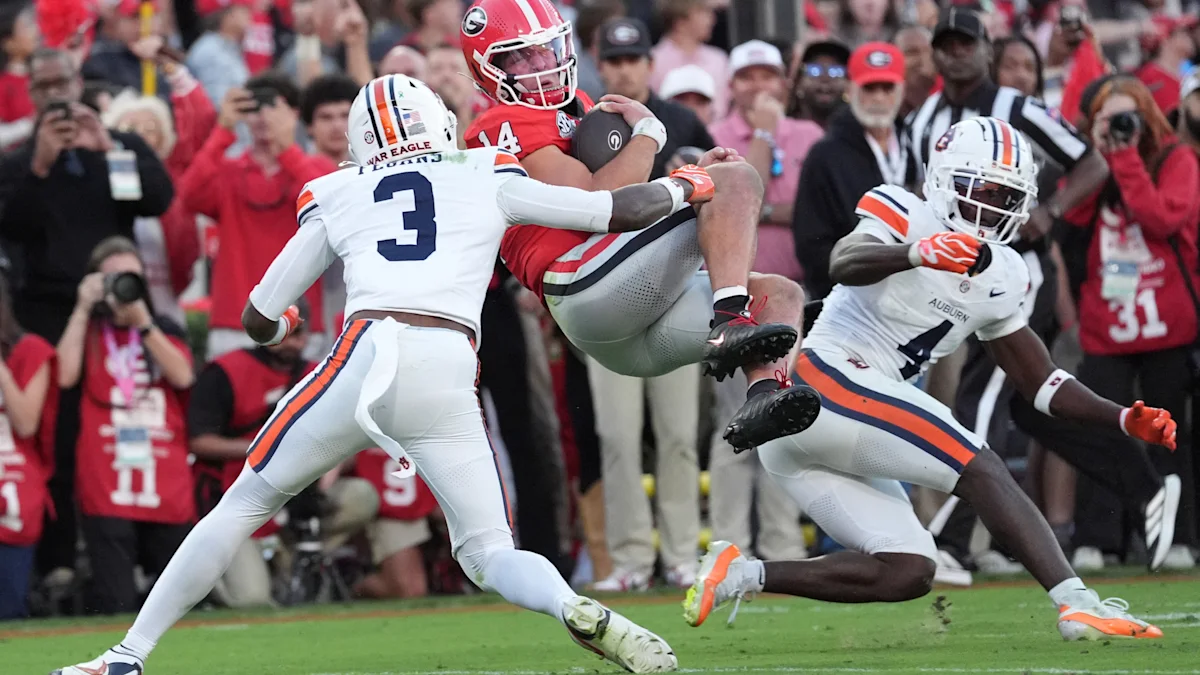
Then Auburn walked into Sanford Stadium and delivered a 27-24 upset on Alex McPherson's 34-yard field goal as time expired.
Quarterback Gunner Stockton committed three turnovers, including a costly late fumble that gave Auburn its winning opportunity.
The defeat ended Georgia's 53-game winning streak against unranked opponents.
Georgia remains talented enough to win the national championship, but its margin for error has shrunk.
The Bulldogs must now navigate the remainder of their SEC schedule without another damaging loss.
Notre Dame: A controversial loss could play in the Irish's favor
Notre Dame's controversial defeat was not the ideal result for the Irish. In fact, it likely thwarted their chances of moving to the No 1 ranking. However, the Irish, with so much other carnage in the Top 10, may get the benefit of the doubt after playing such an exciting, nationally televised game, on the road against another Top 10 team.
Notre Dame is now 6-1 and faces an increasingly important November showdown with Miami.
The Irish remain in control of their own destiny with regard to their playoff ambitions.
Indiana: The Hoosiers are wounded, not eliminated
Indiana's 19-15 loss to Ohio State ended a 22-game winning streak, but it shouldn't destroy the Hoosiers' playoff hopes.
Losing a competitive game against another top-five opponent is considerably different from being upset by an unranked team.
Indiana still has opportunities to strengthen its résumé.
The challenge is avoiding a second defeat that would make the Big Ten championship race and playoff selection considerably more complicated.
Alabama and Texas: Two SEC giants are suddenly in trouble
Alabama's 26-10 loss at Tennessee was arguably the most decisive defeat suffered by a top-seven team Saturday.
The Crimson Tide were outplayed in the second half, raising questions about whether Kalen DeBoer's team can compete consistently against elite SEC opponents.
The Longhorns suffered their second consecutive defeat, falling 27-24 to Florida after losing to Oklahoma the previous week.
Arch Manning and the Texas offense struggled through long stretches of Saturday's game, and the Longhorns now sit at 4-2.
A third defeat could leave Texas needing extraordinary help to reach the playoff.
For both programs, the remaining schedule has effectively become an elimination tournament.
The biggest winners might be teams that weren't in the top seven
Saturday's chaos also opened the door for programs that entered the weekend outside the national championship spotlight.
No. 9 Ole Miss strengthened its position with a convincing 31-3 victory over No. 13 Missouri.
No. 10 Texas Tech remained undefeated with a 53-25 win over Arizona State.
No. 11 Utah also stayed unbeaten, giving the Big 12 multiple teams with increasingly credible playoff ambitions.
No. 14 Tennessee could make one of the largest jumps in the rankings after dominating Alabama.
And No. 12 UCLA continued its undefeated season with a victory over Wisconsin.
These are the programs that could benefit most from the expanded playoff format.
Instead of needing every traditional powerhouse to collapse, they now have an opportunity to establish themselves through victories and conference championship contention.
Saturday may have accelerated that process dramatically.
College football just delivered the strongest argument against a 24-team playoff
There is another important lesson from Saturday's historic results.
College football doesn't need to manufacture additional drama.
The sport already produces it naturally.
Five of the nation's seven highest-ranked teams lost on the same day. National championship favorites became vulnerable overnight. Previously overlooked contenders suddenly emerged as legitimate playoff threats.
That's precisely what makes the college football regular season different from almost every other major American sport.
The possibility that one defeat can dramatically change a program's championship prospects creates extraordinary stakes.
Expanding the playoff to 24 teams would risk diminishing those stakes.
Under such a system, Georgia, Notre Dame, Indiana, Alabama and Texas might all remain relatively comfortable playoff contenders despite Saturday's losses.
But the consequences would be substantially reduced.
College football should be careful about sacrificing the very thing that makes Saturdays like October 17 unforgettable.
Ninety years of history, one impossible Saturday
College football has produced countless memorable upsets since the AP began ranking teams in 1936.
But never before had five of the top seven teams lost on the same regular-season day.
The mathematical probability of Saturday's collective results was estimated at approximately one in a thousand.
The historical significance is even more remarkable.
For nine decades, college football had never experienced anything quite like it.
And the consequences are only beginning to unfold.
Miami could become the nation's new No. 1 team. Ohio State and BYU have emerged as major championship contenders. Georgia, Notre Dame and Indiana face more difficult paths, while Alabama and Texas are suddenly confronting the possibility of missing the playoff entirely.
The next several weeks will determine whether Saturday was merely an extraordinary collection of upsets or the moment the entire 2026 national championship race changed direction.
One thing is certain: October 17, 2026, will be remembered as the Saturday college football's established order collapsed.
Topics in this story
Gathered from external sources. Rights to this text belong to whoever originally published it.