2026-27 Rangers Will Be Better, But Won't Be a True Contender Without Changes
In the 1994 movie Speed, Keanu Reeves' character is an LAPD officer tasked with defusing a bomb on a speeding bus filled with passengers. The bomb is automated to explode should the bus ever fall below 50 miles per hour on the busy streets of Los Angeles.
In the 1994 movie Speed, Keanu Reeves' character is an LAPD officer tasked with defusing a bomb on a speeding bus filled with passengers. The bomb is automated to explode should the bus ever fall below 50 miles per hour on the busy streets of Los Angeles.
What does this have to do with the New York Rangers? Well, we'll get there.
Rangers GM Chris Drury had been slow-rolling a total roster restructuring since 2024. Yes, there was a parade of messy departures, but tearing something down is easy; building anew is where the real work is. Until this past summer, it was a lot more tearing down than building anew.
One cannot look at the opening-night roster and deny that Drury has finally built something new. Eight of the 19 players who will play on Tuesday were not in the organization in January of 2026, and these are not nibbles around the edges.
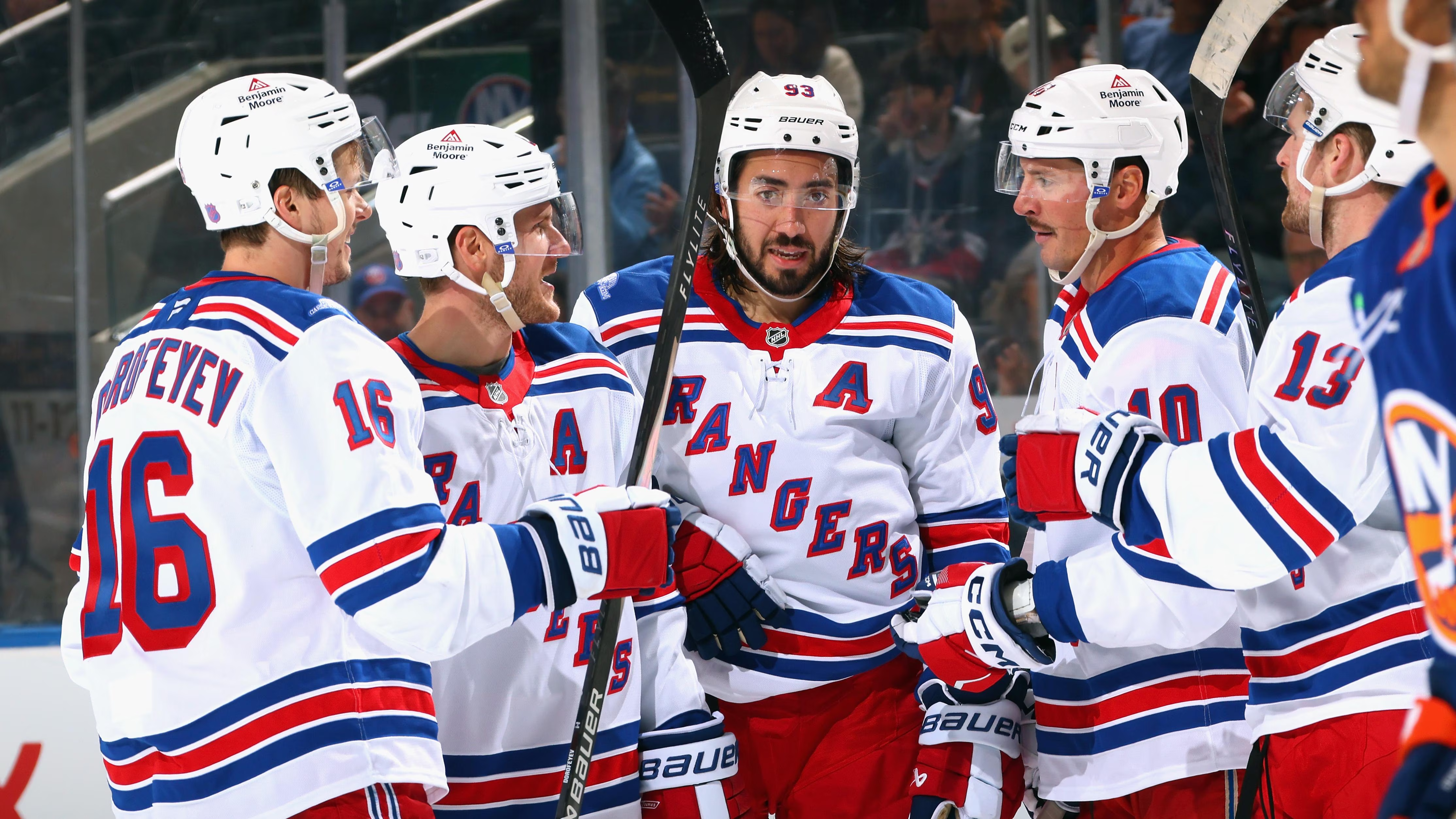
Pavel Dorofeyev is the newest addition up front. The Russian winger is a welcome addition on numerous fronts. The 25-year-old is a much-needed injection of youth for a forward group whose key contributors sat dangerously close to 30. He is also the best pure shooter the organization has had in well over a decade (Marian Gaborik sends his regards), while also heavily tilting the ice. That's an aspect of the game that the Rangers have been losing for years.
To that end, the other forward additions fit a common aesthetic: shot suppression. Middle-six wingers Oliver Bjorkstrand and Eeli Tolvanen, as well as new fourth-line center Joe Veleno, are reputable defensive forwards who can and will eat difficult minutes while limiting opposition offensive-zone time and clogging shooting lanes.
The defense is radically transformed and is the definitive strength of what Drury has amassed. A Marcus Pettersson-Sean Durzi duo is a strong second pairing. Remember, hilariously, that the Rangers opened last season with Will Borgen and Carson Soucy in that spot. Both are strong neutral-zone defenders, and Pettersson is a defensive specialist, while Durzi can move the puck.
Braden Schneider has caught a lot of flak in the last year, but he should be much more serviceable in a third-pairing role alongside a true defensive partner in either teenage phenom Alberts Šmits or criminally underrated Matthew Robertson. From Adam Fox down to Scott Morrow, this is the best defensive group the Rangers have boasted since 2015, balanced well with offensive catalysts and physical defenders against the rush and in the defensive zone.
The Rangers are going to be "hard to play against." Not in the sense of crashing and punching, but in a more cerebral, tactical sense. This is a team with shot-stoppers up and down the lineup and the best goaltender (Igor Shesterkin) in the NHL behind them. They're going to try to make it hard for teams to enter the offensive zone and, failing that, put the puck in the net. From there, Head Coach Mike Sullivan has to hope that there is enough individual skill and power-play excellence to carry the Rangers over the finish line after 60 minutes.
Part of how the Rangers careened into a ditch is that maneuvering often lacked foresight. JT Miller trade aside, almost every big splash from Drury in the past was an ephemeral boost; Andrew Copp, Vladimir Tarasenko, and Patrick Kane all cost a first-round pick plus more, and were rentals. The plan to overpay depth players to fill an immediate hole and turn their contracts into a problem later had hamstrung their ability to make moves. The never-ending drip of prospects and draft picks out the door hollowed out the prospect pool.
One can't accuse Drury of those mistakes this time around. Already mentioned is Dorofeyev, who is signed through his prime at a fair rate. Durzi and Pettersson are bargains in the current environment at a combined $11.5 million, and both are signed beyond this season, with Pettersson's $5.5 million cap hit through 2031 a strong value even at 30 years old. The depth additions have been risk-free. Bjorkstrand, Tolvanen, and Veleno are all paid at or below their respective market value on one-year deals.
Plus, the prospect pool is replenished. At least, to a degree. Alberts Šmits is a bona fide top prospect, while Liam Greentree and Cole Beaudoin are solid B-tier prospects who are close to NHL-ready.
The assessment of Drury's work thus far has been optimistic, but let's not mistake where the Rangers are. The Athletic's model gives the Rangers a 41% chance of making the playoffs. My own accounting, which believes there is missing context that would benefit the Blueshirts' cause, would peg their odds at around 60%. They're a high-floor team, and a repeat in the NHL's bottom five seems nearly impossible, but they're still far from contender status. If the Rangers end 2027 with 98-100 points and a second-round playoff exit, they'll have hit the upper bound of realistic expectations.
How do they build beyond that? There's no easy path. The Rangers are, at minimum, a franchise center and another top-six offensive winger short of the standard. Drury burned three first-round picks this summer just to bring in Dorofeyev and Pettersson.
The Rangers' prospect pool is deep, but they lack the pieces that would entice a team to dangle a top prospect. To that point, it seems very unlikely that the Rangers will find any star power to promote from within; the best of their youngsters, like Greentree, Beaudoin, and Malcolm Spence, look more like future third-liners than first-liners.
While the Rangers have a few rising prospects (Perreault, Šmits), the team as constructed is at the arc of its potential. Adam Fox, Pavel Dorofeyev, and Alexis Lafrenière are in their primes. Igor Shesterkin, Vladislav Gavrikov, Miller, and Mika Zibanejad won't get better with age.
The Rangers Will Be Better, But Won't Be Serious Contenders
Didn't this essay start off with a '90s movie reference? Oh, right.
The first half of Speed is filled with a series of thrilling moments in which Reaves' character manages to escape tragedy. He takes control and pulls off sharp turns. He jumps a gap in a broken roadway. He steers the car to avoid any crashes. He figures out a way to refill the gas tank as it nears empty. All while maintaining a speed above 50 miles per hour. It's creative, nimble, and miraculous.
But even as the acrobatic moments aggregate, the root problem remains. The bus is rigged with a bomb and will explode if it goes under 50 mph. Reeves doesn't have a plan to solve the bus's dilemma. His efforts are geared towards avoiding immediate catastrophe and buying time in hopes of finding a permanent way out later.
The Rangers were a rotting structure on the verge of collapse. The moves Drury has made in 2026 are a successful retool of sorts. The product should be watchable this season, and they'll be competitive, maybe even making the playoffs. But the Rangers still sit in purgatory, with no clear path to immediate contention nor discernible long-term upside. Without further organizational change that makes the team's contention window evident, they'll find themselves back in dangerous territory a few years down the road.
Topics in this story
Gathered from external sources. Rights to this text belong to whoever originally published it.