Jake Bauers vs. Blake Snell: A Breakdown
Breaking down the actual best at-bat of the NLCS
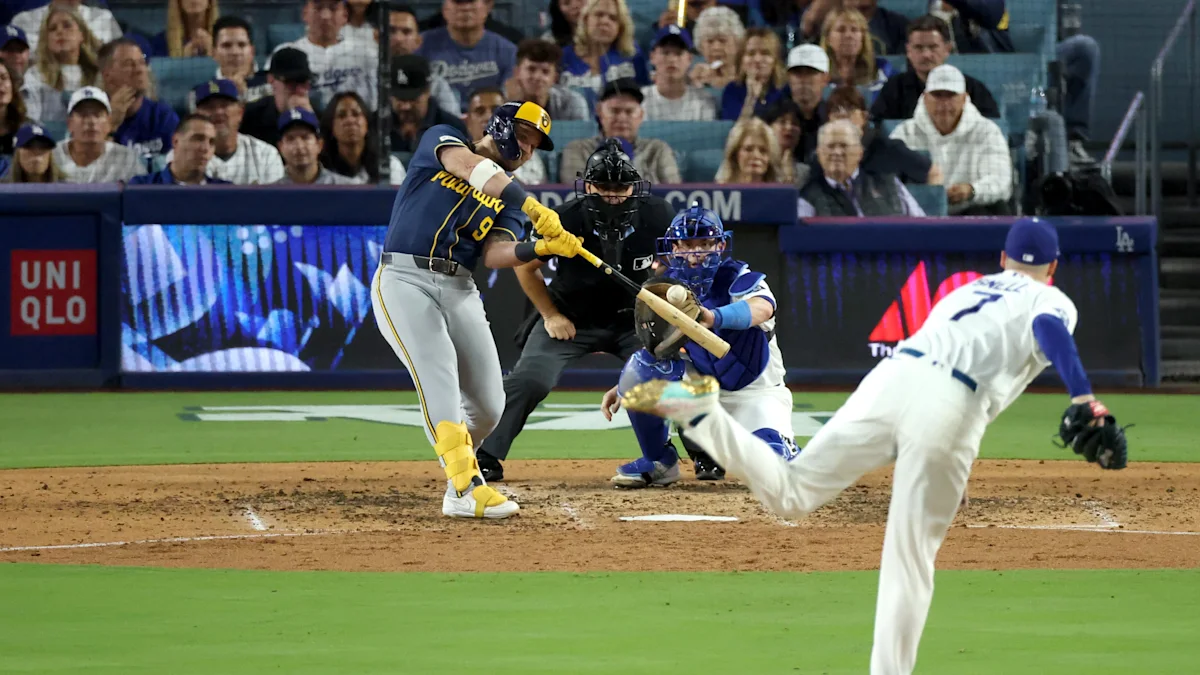
Last week, I wrote an article breaking down NLCS MVP Jake Bauers' 12-pitch walk against Yoshinobu Yamamoto. At the time, I called it "the best at-bat of the NLCS."
That turned out to be incredibly presumptuous: just two days later, he worked an 11-pitch at-bat against Blake Snell that ended not with a walk, but with a go-ahead two-run home run.
Since the first at-bat earned a breakdown, this one deserves one too.
Snell doesn't have quite the pitch variety Yamamoto does, but the two-time Cy Young Award winner is still incredibly nasty. He throws four pitches: a four-seam fastball, changeup, slider, and curveball. His fastball and changeup break in toward a left-handed hitter, while his slider and curveball break away. His fastball has elite "ride," staying up as it reaches the plate, while his curveball drops off the table.
His arsenal is pretty standard; he doesn't throw anything exotic like Yamamoto's splitter. Still, he remains one of the best pitchers in the game for a few reasons:
1. All of his pitches are swing-and-miss pitches: Most starters have one or two put-away pitches, but all four of Snell's miss bats. His curveball is probably his best pitch and one of the best breaking balls in the game.
Snell has missed chunks of the last three seasons due to injury, so he hasn't qualified for year-end leaderboards since 2023, his second Cy Young season. That year, all three of his secondary pitches (slider, changeup, and curveball) had whiff rates around 50%, and his overall whiff rate ranked in the 98th percentile.
2. His fastball-curveball combination is brutal: In Game 3, his four-seamer sat around 97-98 mph with about 18-20 inches of induced vertical break, meaning it rode higher than hitters expected. His curveball came in around 83 mph and dropped roughly four feet. Both come from the same arm slot, so hitters have to guess between a fastball riding up at the letters and a curveball that falls off the table and out of the bottom of the zone. On top of that, the curveball arrives about 15 mph slower, so even a hitter who guesses right on location can be way out in front.
3. He works the edges of the zone: Snell rarely gives in with something over the middle. He lives on the corners and just above and below the zone, which leads to lots of chases and weak contact when hitters do swing.
The tradeoff is that he's more prone to walks and high pitch counts than your average ace. His approach would rather put a hitter on base than give him something to drive. A few more stats from his 2023 season:
Only 44.7% of his fastballs were in the strike zone, the 14th-lowest rate among starters.
His slider had the lowest zone rate of any qualifying starter, at 25%.
In short, Snell has some of the best stuff in baseball, and he doesn't like giving hitters anything to hit. That makes what Bauers did all the more impressive:
Pitchers tend to attack Bauers up and in. He's a patient hitter, but like many power hitters, he'll hunt inside fastballs and try to drive them, which means he can sometimes be jammed or beaten by velocity. Because of that, opponents often pair high, inside fastballs with breaking balls and changeups away, trying to keep him off balance and induce weak contact. Snell was no exception.
Jake Bauers vs. Blake Snell: The Breakdown
Pitch 1: 89.4-mph slider (0-1): Snell's first pitch, a slider, starts up and in. It comes in looking like a fastball, but instead of riding up like his four-seamer, it drops late. Unlike a typical slider, though, this one has almost no horizontal break, so it doesn't sweep away from the left-handed Bauers. He initially looks like he wants it but checks his swing, presumably because he recognizes the late drop and knows he can't drive it. The slider stays in the zone for strike one.
Pitch 2: 83.8-mph changeup (1-1): Snell follows with a changeup, about 14 mph slower than his fastball, that dives 34 inches and runs in toward Bauers. Lefties don't often throw changeups to left-handed hitters (in particular, Snell's changeup performs better against righties), so it's a sign Snell is willing to show Bauers everything. The goal is to stop him from sitting on the fastball, but the pitch bounces in the dirt for ball one.
Pitch 3: 96.3-mph fastball (2-1): Snell throws a fastball low and away, likely hoping Bauers will take it for strike two so he can go for the put-away pitch. He misses, though, and the count goes to 2-1.
Pitch 4: 87.0-mph changeup (2-2): Snell comes back with another changeup, this one starting high and inside before dropping. Bauers is out in front and just barely ticks the top of the ball for a foul tip that ends up in the glove of catcher Will Smith. Strike two.
Pitch 5: 90.6-mph slider (2-2) : Snell goes back to the slider for the first time since the opening pitch. Like that first one, it has almost no horizontal break, so out of the hand it looks like a fastball, and Bauers appears to be sitting on one. His front foot comes down well before the pitch arrives, but he does a great job keeping his weight back and waiting on the slider before fouling it off to stay alive.
Pitch 6: 82.3-mph curveball (2-2) : Bauers is still a little out in front, since he's clearly not expecting a curveball, but he manages to chop it foul.
Pitch 7: 97.6-mph fastball (3-2): Snell follows the slow curveball with the hardest fastball he's thrown Bauers all at-bat, a jump of 15 mph. Bauers wants it and starts to swing, but he recognizes it's a few inches off the inside corner and checks his swing to run the count full.
Pitch 8: 98.2-mph fastball (3-2) : Snell comes back with another fastball, this one even harder than the last one. It starts up in the zone before riding up and out of it. Bauers is already committed and can't check his swing, but he gets enough of it to foul it back and stay alive.
Pitch 9: 86.3-mph changeup (3-2): Snell changes speeds again, coming back with a changeup that's about 12 mph slower than the fastball. Once again, Bauers isn't sitting on the changeup, so he's out in front, but he manages to keep his weight back and just gets a piece of it.
Pitch 10: 90.9-mph slider (3-2): Snell comes back with a third slider. Bauers is out in front again, so his swing is still awkward, but now that he's seen it a couple of times, he's able to do more than just foul it off. Bauers lines it down the right field line, but it goes just foul.
Pitch 11: 97.8-mph fastball (home run): After two straight secondary pitches, Snell goes back to the fastball, presumably trying to blow it by Bauers high and inside. Instead, it runs out over the middle of the plate, and Bauers — who's been sitting fastball all at-bat — doesn't miss it: 109.4 mph off the bat, 412 feet to right field. The two-run homer scores Christian Yelich and gives the Brewers a lead they never relinquish.
So, to correct myself: Bauers' walk against Yamamoto was the best at-bat of the NLCS for exactly one game. I'm done making predictions. (That said, at this rate, he might top this one too.)
Topics in this story
Gathered from external sources. Rights to this text belong to whoever originally published it.