Inside BYU’s unique surge to the top of college football
BYU’s uniqueness isn’t its downfall, many inside and outside the school argue. Having an uncompromising identity is, in fact, its strength.
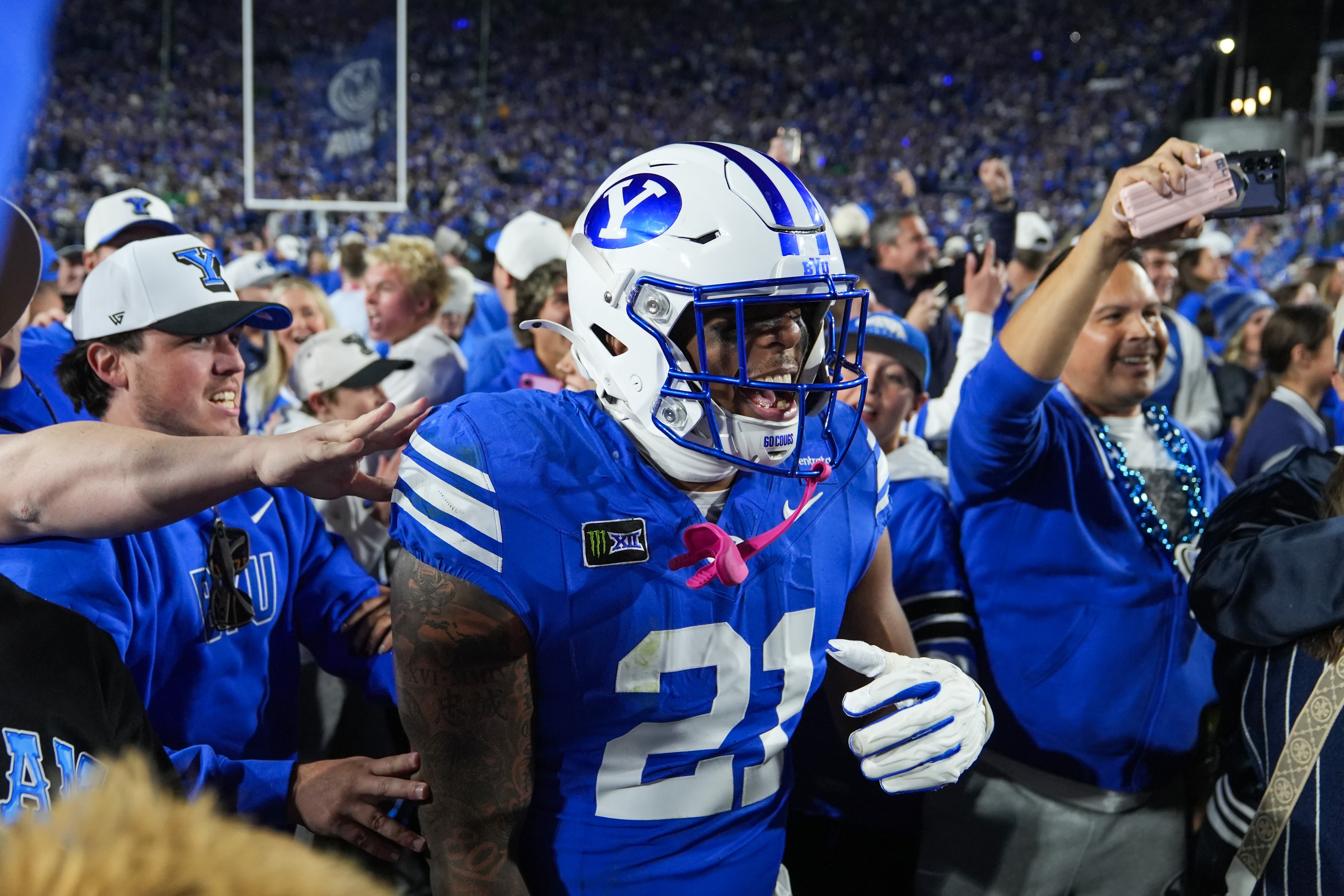
The sun hadn’t yet risen over the Wasatch Range when Kalani Sitake decided to bust a move. Standing alongside Cosmo, the Brigham Young University mascot, the head football coach shimmied and shook ESPN’s “College GameDay” crew to commercial break, mixing steps from his native Tongan ritual dances with straight-up club vibing. On the other side of daylight, Sitake and his BYU football team would welcome No. 2 Notre Dame for arguably the biggest home game on campus in two decades. The Cougars are no beggars at the football feast. Jumpstarted by LaVell Edwards, the true father of the air raid offense, BYU has maintained national relevance through various conference iterations and even a dalliance with independence. But this was the Irish and all their golden-helmeted luster finding their way to Provo, Utah, for the first time since 2004, the enormity of their visit underscored by the pregame show luring people out before dawn. Yet with every eyeball trained on him and his team, there was Sitake, dancing like nobody was watching. The surprise samba left even hard-to-impress Nick Saban, whose rug cutting is limited to boot leg Cupid Shuffle videos on recruiting visits, near speechless. “My hat’s off to you,” Saban said. “You’re up here dancing before a game. I was so nervous before a big game, I couldn’t even spit.” Everything the Cougars are doing these days seems to spit in the eye of convention. Owned and operated by the Church of Jesus Christ of Latter-Day Saints, a church that counts self-reliance and not spending more than it has among its core principles, BYU beat the Irish and currently is ranked No. 2 in the nation in an era of unchecked spending. Required to follow the church’s strict honor code that prohibits premarital sex, alcohol, tobacco, coffee and cursing, talented athletes are not just choosing BYU, they are opting to stay while elsewhere players are entering the transfer portal at the slightest hint of struggle. And, at a school, where 98% of the undergraduate population is Mormon and diversity is largely geography based, the Cougars are led by a quarterback who is Catholic-raised and the son of a Thai mother who named him Bear who, upon beating Notre Dame said, “We put our balls on the chopping block.” Yet asked to explain how BYU is getting over its host of limitations, those who work at, or have long been affiliated with, the school suggest people are looking at it all wrong. BYU’s uniqueness isn’t its downfall, they argue; having an uncompromising identity is, in fact, its strength. “In some ways, because of the realities of being a religious institution with firm beliefs and principles in the wild west of NIL, we have a clearer vision of what we can and can’t do and who we are,” said three-time Super Bowl champion Steve Young, a 1984 graduate of BYU. “In a sort of frictionless system, it’s about, who are you willing to be? We’re willing to be something unique. The complexity is really the beauty of it.” The new face of BYU Ryan Smith first started going to BYU games when he was still in diapers. His father, Scott, was a marketing research professor at the school and home football Saturdays in Provo weren’t optional. “It’s just what you did,” he told CNN Sports. Midway through his own undergrad career at BYU, Smith left school to join his father, who’d happened upon a startup concept involving a way to make sophisticated research more user friendly. As he was readying to launch Qualtrics, Scott Smith was diagnosed with throat cancer, so Ryan joined to help him see the project to fruition. In 2018, a German company bought Qualtrics for $8 billion. Smith has since bought the NBA’s Utah Jazz, relocated the Arizona Coyotes and turned them into Utah’s first NHL franchise, the Mammoth. He’s involved with Salt Lake’s MLS franchise and helped the city land the 2034 Winter Olympics. On Saturday, he tossed in an extra million bucks to sweeten the pot for the student kicker on “GameDay.” Smith is, in so many ways, the new face of BYU: a backward-ballcap-wearing dude who just so happens to rank No. 1,285 on Forbes’ list of billionaires. He is rich beyond measure, but a church member who believes fervently in its principles – actual proof that money and Mormonism do not have to be at odds. Which is the essential push/pull here. BYU long has viewed athletics as an integral part of its mission, intuitively understanding that a school that is constantly fighting misconceptions and stereotypes desperately needs the very American front porch of sports. “It opens a door to understand and learn who BYU is,” BYU president C. Shane Reese told CNN Sports. “A lot of people have not been to BYU or know anything about it. Football gives you a peek into who we are.” But the shift in college athletics has required an internal reconciling that is even more challenging than the external education. BYU at once wants to stay in line with its competition but doesn’t want to compromise who it is. Essentially, it wants to walk the impossible line between adhering to the staunch principle of tithing while simultaneously paying athletes millions to toss a ball around. “The most common question I get asked is, ‘What keeps you up at night?’” Reese said. “For sure I would say it’s the worry about us losing sight of who we are as an institution. Our strength is our distinctiveness. If you’re always trying to become someone else, you’re likely going to lose that. I don’t think that what we hope is a great run in college football is going to change us but we have to be deliberate in saying, ‘This is who we are.’” Living within the church’s rules Reese is something of a nontraditionalist himself. Before getting his “geek on,” and discovering a love for statistics, he fronted a punk rock band called Joe’s Wish. Reese jokes that the fact that it was a punk rock band only proves that he couldn’t sing. But it also means he appreciates the need to branch out, even if he finds solace in order. Before becoming a professor at BYU, he worked at Los Alamos National Laboratory, where he considered the readiness of the nation’s nuclear stockpile. As an academic, he studied everything from locating bowhead whale mating grounds to NASCAR. For a time, he even worked in sports analytics, helping fellow BYU alum Andy Reid when Reid was with the Eagles. All that to say the man understands numbers. Reese’s first day on the presidency job was on May 1, 2023; two months later, after 12 years as an independent, the Cougars joined the Big 12. In the three years since, the athletic departments revenues have skyrocketed from $47 million to $153 million. While the estimated $20 million spent on the football roster, according to The Athletic, pales in comparison to the some $50 million at Ohio State and Texas, it is not exactly chump change either. The statistician president understands the fiscal demands to remaining competitive, and the institutional benefits of being good at sports. But as university president, it is Reese’s job to make sure that, while everyone else around the country is playing with Monopoly money and accruing debt, BYU somehow minds its bottom line. The school is very clear about the church’s role in NIL. Quite simply, it has none. Yet the church also expects that both the institution and the athletic department remain debt-free. That’s the tug. There are other schools guided by religion – Notre Dame and Villanova are about to enjoy an audience with the Pope after playing in men’s and women’s basketball in Rome next month – but none is technically governed by its church. BYU’s board is chaired by the president of the church, who is also considered the church’s prophet, and members of the church’s Quorum of the Twelve Apostles are also BYU board members. The church’s expectation to live debt-free is not just an ask; it’s a requirement. “We absolutely have some reasonable guardrails in place,” Reese said. “Not assuming debt is tied to our sponsorship to the Church of Jesus Christ of the Latter-Day Saints. That is a principle they operate under. So, we might not have the shiniest buildings or maybe the doors squeak a bit on occasion, but those guardrails – we don’t take funds from the church, and we don’t assume debt as an athletic department – have served us well and they’re not going away.” The debate over doing more School officials will be the first to admit that not everyone agrees. BYU has some half a million living alumni. Most are content for the school to live within the means it has long existed under, but there are plenty who have enjoyed the taste of success and would like administrators to push a few more chips to the center. The school, after all, is not merely trying to be a viable independent; it is trying to be a Power 4 contender, with all the benefits that includes. “There are certainly some who feel like, if we’re going to be successful, we have to embrace what others are doing, and go with a more professional model,” says Keith Vorkink, BYU’s vice president of advancement. “But that’s not a tension we feel most of the time. You have to have some professional aspects. We’re not ignorant of that, but the key is do it in a way that aligns with our mission.” There is money in the Wasatch. Along with Smith, two other graduates – Mark Hancock (he’s No. 1,755 on Forbes) and Jason Murray – just agreed to a partnership between their alma mater and their company, PV3, to help fund NIL and facilities. Though the particulars weren’t disclosed, the school said it is the largest philanthropic donation to BYU athletics in school history. And then there is Jason McGowan, the mere megamillionaire owner of Crumbl Cookies, who could be a BYU savior. Last year, Penn State made a serious play for Sitake after canning James Franklin, offering well more than the $4 million BYU had been paying him. “Some people are not replaceable,” McGowan posted on X. “Sounds like it’s time for me to get off the sidelines and get to work.” A day later, Sitake signed an extension reportedly worth $9 million annually. But as critical as donor funding is, those who are providing the funds believe their wallets are not the path for sustainable BYU excellence. Instead, they look to the essence of the school – even with, or maybe because of, all of its idiosyncrasies – as its best value add. Smith sits on the NBA media committee and meets regularly with the people relocating to Utah amid a business boon. He studies the stuff not merely as a BYU fan, but as a businessman. “TV is driving the money in college sports,” he said. “What the Big Ten schools get annually through its TV contracts, you can’t get that through individual donors. The product has to be marketable. The schools ultimately that sit atop the rankings, the ones with name recognition, they’re going to be the most valuable.” The trick, then, is making your product marketable. Some 6.9 million church members live in the US, and while not all of them are football fans, plenty appreciate seeing the Cougars amplify their religion. “GameDay” enjoyed its third-best rating in show history on Saturday and at its peak, the Cougars game against Notre Dame drew 9.2 million viewers, the highest for a Big 12 team since 2022. “BYU draws,” Smith said. “That’s the part no one understands.” The vicious cycle of the current model, of course, is that to become marketable a team needs to get and retain good players, and to do that a school has to spend money, which cycles the whole thing back to the start. That means players have to be paid, and paid handsomely, which – in turn – runs against the very ethos of BYU. It feels like an impossible riddle to solve. BYU, though, thinks it has the solution. “You’ve got what seems like these competing interests,” Young says. “In the one hand you’re holding tight to the fact that we’re in the Big 12 and we have to be committed to the excellence of that. On the other hand, how do you build something that is so resonant to people that they would not actually just go take the last dollar? How do you get them stay for something more than the transaction, or build something that is not purely transactional? We call that the Kalani law of love.” Believing in the coach LaVell Edwards is something like the Joseph Smith of BYU football, both the founding father and the man who established the roadmap for the program’s success. Given the freedom to build something far away from the confines of Top 10 football, he engineered a pass-first offense during a time when most coaches still preferred the three-yards-and-a-cloud-of-dust approach. Beginning in 1972, the year Edwards was promoted to head coach, 11 consecutive running backs won the Heisman Trophy. Meanwhile in Provo, BYU gunslingers, beginning with Gary Sheide, were throwing for thousands of yards every season. A member of the church himself, Edwards leaned into, rather than obfuscated, its mission. He purposefully sought church members, crafting what would be termed the Polynesian pipeline by capitalizing on the heavy population of LDS members in places such as Tonga and Samoa. And after years at balking at holding scholarships for players who served their two-year missions, Edwards came around to understanding it was a way to get and keep his team older. Yet he also welcomed those who craved the school’s structure, if not its religion. Troublemaker Jim McMahon headed to BYU in no small part because his parents wanted him to find a little discipline. Twenty-six years after Edwards retired, one of his own is following his principles nearly to a T. Sitake came via the end around of the Polynesian pipeline. Born in Tonga, he was raised in Hawaii and schooled in Missouri. A fullback at BYU, he wound up team captain in his senior season. Young, who played for Edwards and has attended Sitake’s practices, is stunned at how similar they are. Sitake winds up practice with a prayer and insists that the defense and offense shake hands after going at one another all day. “We’re talking about love in football,” Young said. “It’s like saying, ‘There’s no crying in baseball.’ There’s no love in football, right? Well, yes there is. LaVell was all of that and Kalani is all of that.” Yet Sitake is entirely his own man. A bubble of happiness in a profession largely inhabited by the morose, he takes his job seriously, if not himself. He has, in various victory celebrations, done the cabbage patch and robot, and cracks jokes about both his affinity for ice cream and his fullback frame. His life has not been all jokes. Raised by a single father, he used to sit outside the BYU stadium and listen to games on the radio, the tickets too expensive for his family to afford. He spent one year at BYU before serving his mission in Oakland, California, returning to the Cougars as a redshirt before finally earning his way onto the field. Sitake also has a really hard job, no matter how much joy he brings to it. He is being asked to attract football players to a campus where they must operate under strict social guidelines with zero wiggle room for error. “It’s really hard what he’s doing,” Young said, “but he makes it look so easy.” Daring to be different Though 66 players on the current roster have served their mission, you cannot construct a roster entirely with LDS kids. Bringing non-church members to Provo requires a very different leap of faith. The school has worked hard to knock down the bogeyman perceptions. “We didn’t bring AJ here with the sole intent of converting him to our faith,” said Vorkink of No. 1 NBA draft pick AJ Dybantsa, who spent one season in Provo before leaving for the pros. “We have dozens of student-athletes who are not of our faith and feel like they belong in our community as much as anyone else.” Some have posited that the very thing that outsiders think makes BYU a hard sell – the lack of the normal college rites of passage – might be its best sales pitch. Smith, who spends hours signing and searching for professional basketball and hockey players, has noticed a slight shift in their mindsets. “It’s not the old frat boy college stereotype anymore,” he said. “Parents who want their kids to play at the next level, they want a place where you can keep the main thing the main thing. That’s what (BYU) offers.” But it has to be more than that. At the end of last season, BYU lost 13 players to the transfer portal; none were projected as starters for this season. “We are thriving in a Wild West situation,” Young said, “because Kalani is that special.” He added, “For some people, I know, this is ‘Oh my gosh! What is happening over there? It’s like magic.’ It’s like people think this will pass or something, but what we want people to understand is this is what we’ve been doing. It’s not new news. We’ve been hovering around 23,000 feet at base camp. Now we’re ready to summit Mount Everest.”
Topics in this story
Gathered from external sources. Rights to this text belong to whoever originally published it.