Why Daniil Medvedev Clears the Net Higher Than Anyone in the ATP Top 10
Forehand speed is easy to understand. Spin rate feels almost as straightforward. Put 82 mph and 3,177 rpm on a television graphic, and most viewers immediate...
Forehand speed is easy to understand. Spin rate feels almost as straightforward. Put 82 mph and 3,177 rpm on a television graphic, and most viewers immediately understand that the player has hit a fast, heavily spinning ball. The problem is that neither number tells you what actually happened to the shot.
The forehand data provided by Matthew Willis of The Racquet Substack , sourced from TDI, TennisViz, and Courtside Advantage, provides a much fuller picture. It tracks rally forehands over the last 52 weeks at ATP Tour events, excluding Grand Slams. It combines five measurements: where the player makes contact relative to the baseline, ball speed, topspin, net clearance, and eventual depth.
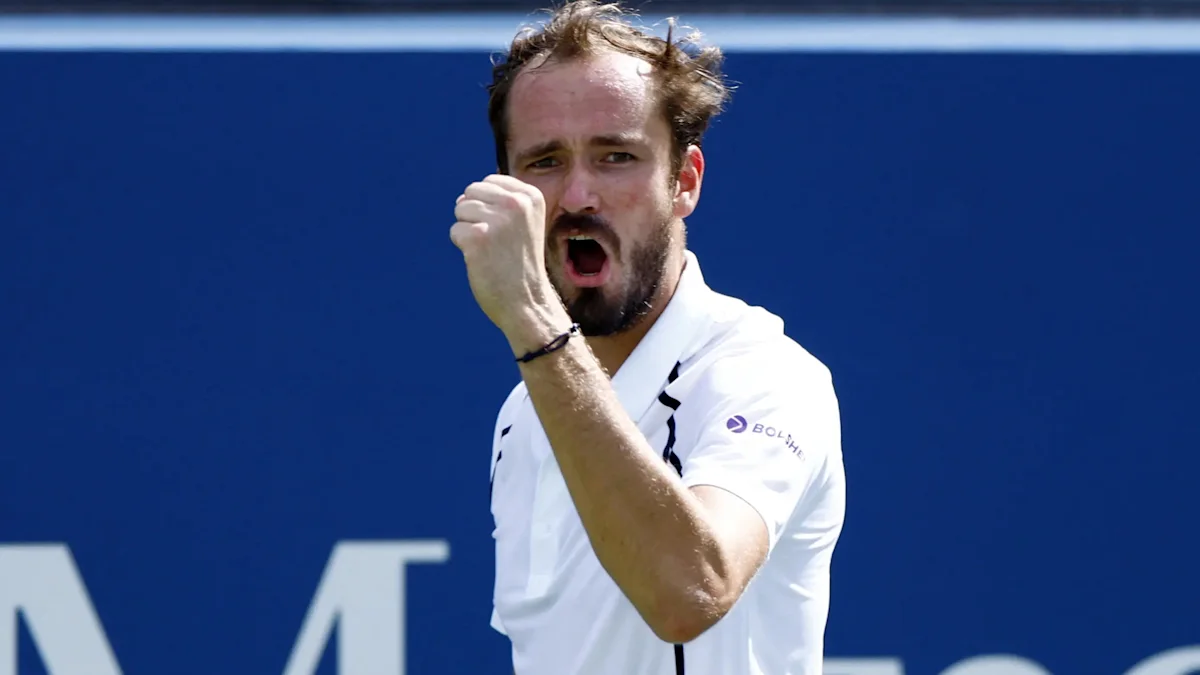
Once you place those numbers side by side, some assumptions about the best forehands in tennis become much harder to maintain. The most surprising example might be Daniil Medvedev . Medvedev owns one of the flattest forehands among the current Top 10, averaging only 2,453 rpm. Only Alex de Minaur produces less spin at 2,210 rpm.
Yet Medvedev's average forehand clears the net by 76 cm. Nobody else in the group clears it higher. That sounds contradictory until you include the rest of the shot.
Why Medvedev Clears the Net Higher Than Anyone in the Top 10
A Forehand is a Chain, Not a Speed Reading
Jannik Sinner sits at the opposite end of the spectrum. His average rally forehand travels at 82 mph, the fastest of the ten players, while also producing the most topspin at 3,177 rpm. He makes contact 1.03 metres behind the baseline and sends the ball only 67 cm over the net.
That is an extraordinarily aggressive combination. Sinner is hitting with enormous pace while generating enough rotation to help bring the ball back down. The International Tennis Federation's aerodynamic research explains the basic mechanism. Topspin creates a vertical aerodynamic force that pushes the ball down, so more rotation lets a player hit aggressively while still controlling the trajectory.
Carlos Alcaraz works in a broadly similar area. His forehand averages 80 mph with 3,113 rpm, but he makes contact significantly earlier than Sinner at only 0.77 metres behind the baseline. His average net clearance is 70 cm and the ball lands 3.90 metres short of the opposing baseline.
The comparison already demonstrates why looking purely at speed can be deceptive. Sinner hits two mph faster than Alcaraz and produces slightly more spin, yet Alcaraz typically makes contact 26 cm farther forward. Their forehands therefore begin from meaningfully different places on the court.
Felix Auger-Aliassime has the most interesting combination of aggression and penetration in the group. Auger-Aliassime averages 81 mph, second only to Sinner, with 3,048 rpm of topspin. He also takes the ball just 0.73 metres behind the baseline.
Despite carrying substantial spin, his forehand lands only 3.60 metres short of the opposite baseline, making it one of the deepest shots in the group. That combination matters. Taking the ball early already reduces the opponent's reaction time. Add 81 mph of pace and substantial topspin, and the pressure isn't captured simply by saying Auger-Aliassime owns the second-fastest forehand.
Taylor Fritz produces another distinct variation. Fritz averages 80 mph but creates less spin at 2,839 rpm. His 66 cm of net clearance is the lowest of anyone measured, while his typical ball lands 3.65 metres short of the baseline.
It is a much more direct flight. Compare that with Ben Shelton. Shelton's average pace is slightly lower at 78 mph, and his spin rate is similar at 2,888 rpm, yet he gives himself 75 cm of clearance over the net. Only Medvedev goes higher. Their speed and spin numbers do not look dramatically different. Their shot shapes do. That is precisely why isolated broadcast statistics can obscure as much as they reveal.
Medvedev makes contact farther behind the baseline than anybody else in the group. His average is 1.30 metres. Alexander Zverev is next at 1.25 meters, while no one else goes beyond 1.03. That means Medvedev's forehand generally has farther to travel before reaching the other side of the court.
He is also hitting it at only 75 mph, faster than just de Minaur among these ten players, and his 2,453 rpm is comfortably below the Top ten median. Put those numbers together, and one might expect a relatively harmless forehand landing short. It does not.
Medvedev's average shot lands 3.67 metres short of the baseline, making it deeper than the corresponding forehands of Sinner, Alcaraz, Zverev, Shelton, Flavio Cobolli and Frances Tiafoe. He does that while clearing the net by 76 cm. That is what makes the shape so unusual.
Medvedev gives the ball plenty of height but comparatively little rotation. With less topspin to create downward aerodynamic force, the ball is not pulled toward the court as aggressively as on the forehands of Sinner or Alcaraz.
The result is a shot that can travel a long way through the court despite relatively modest speed. That does not mean reduced spin automatically produces greater depth. Launch angle, contact height, incoming ball speed, shot direction and tactical situation all matter, and none is completely captured here.
It does demonstrate why describing Medvedev as simply a flat hitter misses much of what makes his forehand unusual. He hits flatter, yes. He also creates considerable margin over the net. The ball then keeps traveling.
Alex de Minaur offers an even stronger warning against judging forehands by speed. His average of 74 mph is the lowest in the dataset. His 2,210 rpm is also the lowest. Yet de Minaur produces the deepest average forehand of anybody shown, with the ball landing only 3.54 metres short of the baseline.
The first clue is his contact position. de Minaur makes contact only 0.70 metres behind the baseline, the closest of all ten players. He is therefore routinely taking time away from opponents before ball speed is even considered.
His forehand does not need Sinner's 82 mph when he is striking it 33 cm farther forward than Sinner on the average rally ball. It also carries relatively little spin, meaning it experiences less of the downward effect generated by heavy topspin.
The combination produces a very different type of pressure. Sinner overwhelms with velocity and rotation. de Minaur pressures with position and trajectory. Again, one number cannot tell that story. Zverev offers an interesting contrast. He hits considerably harder than de Minaur at 79 mph and produces 2,960 rpm, yet his average forehand lands 4.08 metres short of the baseline, one of the shortest figures in the group.
Cobolli is shorter still at 4.13 metres despite averaging 77 mph. Neither fact means their forehands are inferior. Depth itself is not a universal measure of quality. A heavy topspin ball landing four metres inside the baseline can jump aggressively off the court and push an opponent backward. A flatter shot landing much closer to the baseline can rush someone through reduced reaction time.
The quality of the shot depends on what the player is trying to achieve. That is the larger lesson from the data.
No Single Blueprint for an Elite Forehand
The ten players use remarkably different solutions to the same problem. Sinner combines the greatest pace with the greatest spin. Auger-Aliassime nearly matches that speed while taking the ball much earlier and finding considerably greater depth.
Alcaraz sits close to Sinner in both pace and rotation but makes contact farther forward. Fritz drives through the court with relatively little net clearance. Shelton creates substantially more height.
Medvedev stands far behind the baseline, hits relatively slowly and flatly, sends the ball higher over the net than anybody else, and still finds considerable depth. de Minaur takes the opposite positional approach, standing closest to the baseline and producing the slowest, flattest but deepest average forehand.
Even Tiafoe and Cobolli, whose raw speed and spin figures sit in the middle or lower half of the group, produce different outputs. Tiafoe averages 72 cm of clearance and 4.00 metres of depth, while Cobolli clears the net by 69 cm and lands 4.13 metres short.
No single combination defines an elite forehand. There are trade-offs.
More spin changes the ball's flight. More speed changes how much time the opponent has. Earlier contact takes time away before the shot has even crossed the net. Greater clearance creates margin but does not necessarily produce a shorter ball. Depth can pressure an opponent, although depth without sufficient pace or weight may not achieve much at all.
That is why speed rankings are useful but incomplete. The same applies to spin rankings. They describe what happened immediately after contact. Tennis continues after that.
Perhaps the most valuable thing about this data is that it explains why forehands that look completely different can all work at the highest level. Watching Sinner and Medvedev, nobody would confuse their technique or their preferred rally patterns.
The numbers explain some of the difference. Sinner's average rally forehand is seven mph faster and carries 724 rpm more topspin. Medvedev contacts the ball 27 cm farther behind the baseline, sends it nine cm higher over the net, and nevertheless lands it 29 cm deeper.
Those are not small differences, but they are fundamentally different solutions. The same is true of de Minaur. Nothing about seeing 74 mph and 2,210 rpm in isolation would suggest that his forehand should produce the greatest average depth in the group.
Then the contact position appears. Suddenly the picture changes. That is ultimately the problem with the statistics normally shown during matches. Speed and spin are interesting because they are simple. Tennis strokes are not.
A forehand begins with where the player is standing and how he meets the ball. Pace and rotation determine what happens immediately afterward. Trajectory takes it over the net. Aerodynamics alter the flight. Eventually the ball lands somewhere on the opposite side.
Only when you view those stages together does the shot really begin to make sense. And sometimes the player hitting the highest forehand over the net is the one everyone thought was hitting flat.
Topics in this story
Gathered from external sources. Rights to this text belong to whoever originally published it.