A (Semi) Statistical Recap of MTSU
Apparently football is much more fun when you don’t repeatedly give the ball to the other team. Who knew? Kansas gained 700 yards, rushed for 473, allowed 13...
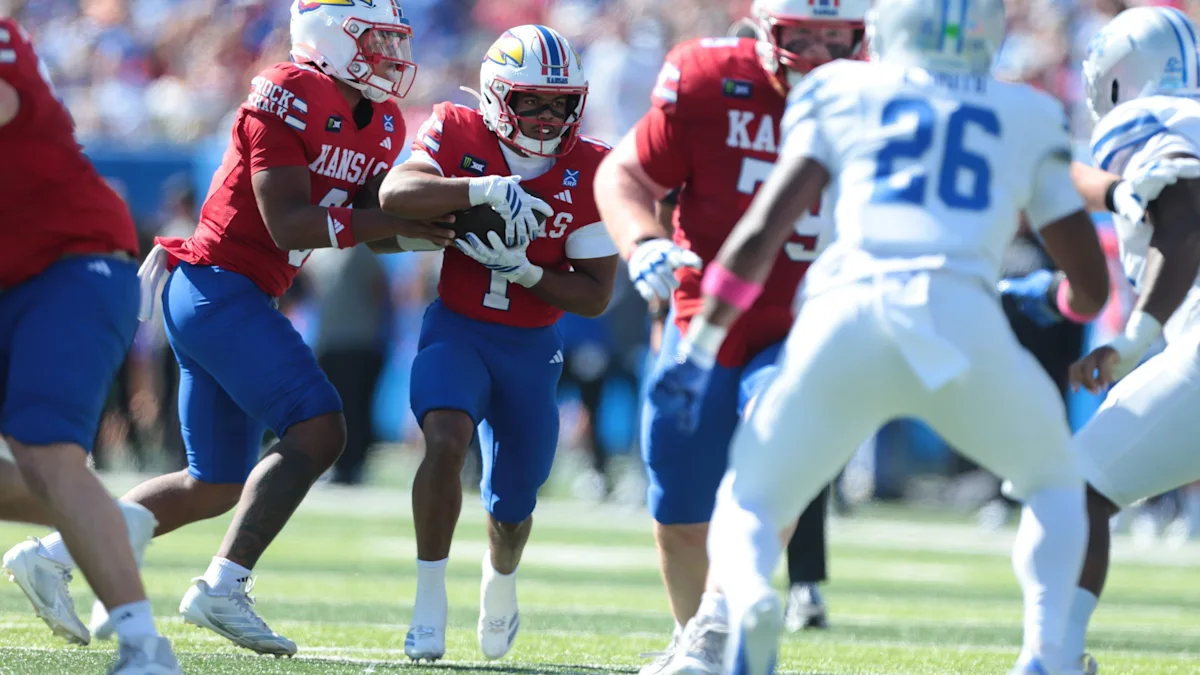
Apparently football is much more fun when you don't repeatedly give the ball to the other team. Who knew?
Kansas gained 700 yards, rushed for 473, allowed 136, committed zero turnovers, and won 55-0. KU ran 83 plays, averaging 8.4 YPP. MTSU ran 42 plays, averaging 3.2 YPP. Kansas had 36 first downs. Middle Tennessee had seven.
Last time out, I wrote that the Kansas defense probably deserved to invoice the rest of the team for emotional damages. This week, the offense paid the bill.
After spending the first three games of the season giving us wildly different things to question about this team, the Jayhawks finally produced the kind of performance you would expect from a Power Four team playing a mediocre G5 opponent at home.
Actually, "the kind of performance you would expect" may be underselling it.
Consider: 700 yards of total offense is a school record. That's more than 2007 Nebraska (572). More than Wagner last year (631). More than Missouri in 1991 (648 in the Tony Sands game). More than Vanderbilt in 1985 (651). So KU didn't just set a school record on Saturday — the Jayhawks shattered it by 49 yards.
Kansas averaged 8.4 yards per play, picked up 36 first downs, rushed for six touchdowns, and scored on nine possessions. Middle Tennessee finished with seven first downs, 136 total yards, and nine punts. It was KU's first shutout since 2008 and the fewest yards Kansas has allowed in the Lance Leipold era. In fact, only three Kansas opponents since 1975 (my arbitrary cutoff for researching this) have gained fewer yards than Middle Tennessee's 136: Kansas State in 1992, Southeastern Louisiana in 2007, and Utah State in 1987.
Kansas is 2-2 heading into eight consecutive Big 12 games — with no byes — beginning next Saturday at #13 Utah. We still don't really know how much beating Middle Tennessee 55-0 tells us about what happens when Kansas starts playing teams like Utah, K-State, TCU, BYU, etc. But after what happened against Missouri and Arizona State, I'm willing to enjoy this one for a minute.
Kansas rushed for 473 yards — the fifth-highest single-game output in school history. The Jayhawks averaged more than eight yards per carry, and the concerning question of who would play behind Dylan Edwards after Yasin Willis' injury suddenly produced multiple answers.
Edwards looked perfectly comfortable as the feature back, carrying 20 times for 137 yards and three touchdowns. He also caught a 30-yard pass, giving him 167 yards from scrimmage. Isaiah Marshall was somehow even more efficient on the ground. He ran 11 times for 110 yards, averaging exactly 10 yards per attempt. Then there was Jalen Dupree.
Dupree entered the game with 13 carries this season. He nearly doubled that workload Saturday, rushing 12 times for 68 yards and a touchdown. His longest run went for only 15 yards, so it's not like there was one busted play inflating the numbers. He consistently found positive yardage and looked perfectly capable of handling meaningful snaps behind Edwards.
And then there was Khijohnn Cummings-Coleman. You may remember him from other positions, such as "safety."
Cummings-Coleman reportedly approached Lance Leipold after the Arizona State game about getting an opportunity on offense. Two weeks later, he carried four times for 48 yards and a touchdown and caught a 19-yard pass.
Kansas had six different players rush for at least 48 yards. This came one game after KU ran for 176 against Arizona State and three weeks after Missouri held the Jayhawks to 81.
So did I underestimate the Kansas offense?
The Missouri game still happened, and Middle Tennessee is not Utah. But the Arizona State game increasingly looks less like an offense incapable of moving the football and more like an offense that moved the ball pretty well and then repeatedly sabotaged itself.
Against MTSU, Kansas eliminated the sabotage. The result was the most total offense in school history.
Middle Tennessee's Santana Fleming returned consecutive second-quarter kickoffs for 38 and 52 yards. The second one gave the Blue Raiders the ball at the Kansas 45.
Fortunately, the defense responded by allowing two yards before forcing a punt. That makes this easier to brush off than the Arizona State game, when the Sun Devils returned the opening kickoff of the second half for a touchdown. It does not, however, make it less concerning.
Lance Leipold called kickoff coverage the biggest blemish afterward, and he's right. Kansas eventually adjusted and produced more touchbacks, but this is now something opponents have seen on film in consecutive games. Against Middle Tennessee, bad field position didn't matter. Against Utah, it certainly will matter.
There really isn't much else to complain about. Kansas didn't turn the ball over. It didn't allow a sack. Martin Connington made both field goals and all seven extra points. KU punted twice.
So we'll leave some manufactured outrage there.
Normally there are at least a couple of things to pick on KU about for this. But let's flip it upside down this week. Have you seen Middle Tennessee's offensive stat sheet?
What KU did to the Blue Raiders was impressive — MTSU finished with 136 total yards.
That is the fewest Kansas has allowed in the Lance Leipold era and, going back 50 years (again, my arbitrary research cutoff), only three KU opponents have finished with fewer: Kansas State in 1992, Southeastern Louisiana in 2007, and Utah State in 1987.
But Kansas didn't merely shut Middle Tennessee out. In fact, the Blue Raiders barely threatened to score. In 12 offensive possessions, the MTSU offense crossed midfield three times. Outside of the possession handed to them at the Kansas 45 by a 52-yard kickoff return, Middle Tennessee never ran a play inside the KU 40-yard line.
Middle Tennessee averaged 3.2 yards per play. They picked up seven first downs. They punted nine times.
Roman Gagliano, who entered the game with eight touchdown passes and one interception, completed 9-of-26 (34.6%) passes for 81 yards.
Cam'ron Lacy, who had caught a touchdown in each of MTSU's first four games, finished with two catches for 25 yards.
Former K-State RB Antonio Martin entered averaging 5.4 yards per carry with three 100-yard games. He finished with 40 yards. Thirty-four of those came on one play. Remove that run, and Kansas held Martin to six yards on his other seven carries.
Bam Crouch also returned after missing essentially the entire season so far following his shoulder injury four snaps into the opener. He finished with two tackles, but 1.5 were tackles for loss, including a third-down stop early in the game.
But this is also the second consecutive game in which KU's defense has been excellent. Arizona State managed 228 yards and 3.5 yards per play. Middle Tennessee followed with 136 and 3.2.
Whatever caveats we want to attach to the competition, that's a trend worth paying attention to.
Isaiah Marshall completed 13-of-22 passes for 161 yards and a touchdown. Those numbers are fine. His rushing numbers were considerably more interesting: 11 carries, 110 yards, 10 yards per attempt. Marshall wasn't sacked and didn't turn the ball over. That's probably the most important part.
Chase Jenkins went 3-for-3 for 65 yards in relief of Marshall and added 53 rushing yards and a touchdown. That's KU's backup quarterback producing 118 yards on six offensive touches. Totally normal stuff, right?
Dylan Edwards had himself a day, racking up 6.9 YPC on his way to 137 rush yards on 20 attempts with 3 TDs. He added just one reception, but for 30 yards.
Jalen Dupree had 68 yards and a TD on 12 rush attempts.
Khijohnn Cummings-Coleman had the aforementioned 48 yards and a TD on 4 rush attempts.
Donald Collier added 50 yards on 5 rushes.
Cam Pickett finally looked like an actual member of the Kansas offense after injuries basically erased the first three games of his season. He caught six passes for 49 yards, leading KU in receptions. Kansas already has Nik McMillan, Nahzae Cox, Bryson Hayes, and others capable of making explosive plays. If Pickett can become a reliable intermediate option for Marshall, that's another piece the offense hasn't really had available.
Speaking of Nahzae Cox , he caught two passes for 42 yards, including a 34-yard touchdown against his former team.
Bryson Hayes had three catches for 50 yards, highlighted by a 47-yarder.
Nik McMillan caught two passes for 30 yards.
Leroy Harris III , Corey Gordon , and Trey Lathan had 3 tackles each. Harris was also credited with a forced fumble and fumble recovery.
Martin Connington made field goals from 43 and 35 yards and all seven extra points.
Matthew Gill hit two punts for a 41.5 average.
At 9:15 PM Jayhawk time on Saturday, Oct 10, Kansas will travel to Utah for a late kick on the four-letter network. Things are about to get real.
Topics in this story
Gathered from external sources. Rights to this text belong to whoever originally published it.