Renee Slegers’ Arsenal are a team weighed down by a debilitating lack of urgency
Renee Slegers wastes no time. The Arsenal Women head coach gets in there, remonstrating at the fourth official. Goalkeeper Misa Rodriguez is squaring up to t...
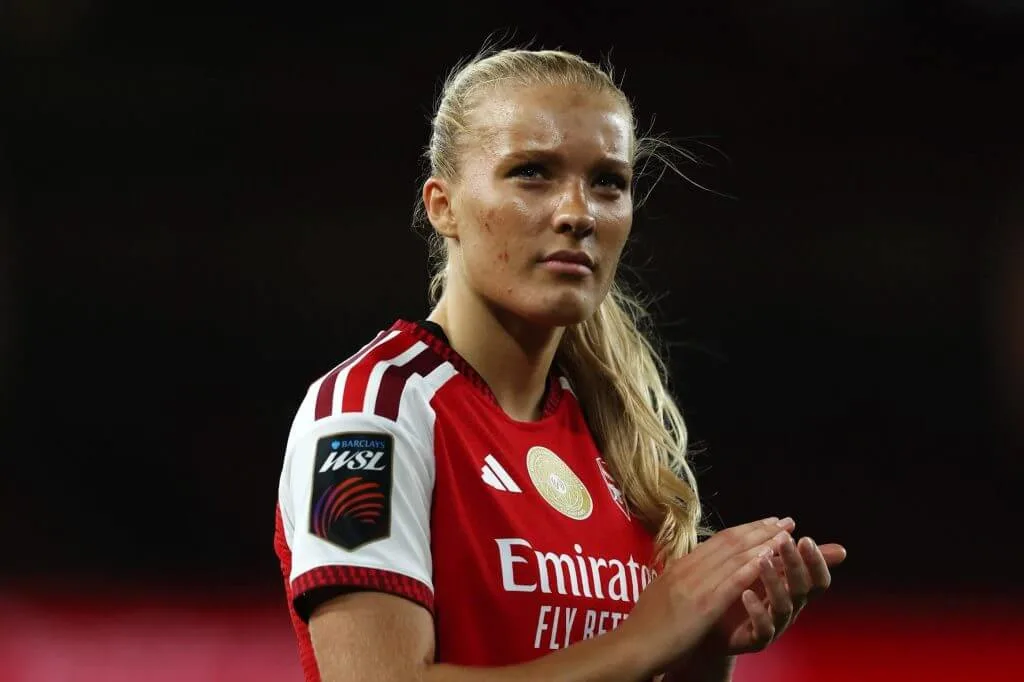
Renee Slegers wastes no time. The Arsenal Women head coach gets in there, remonstrating at the fourth official. Goalkeeper Misa Rodriguez is squaring up to the referee. And really, who could blame them?
The final whistle has gone and who will speak up for the seconds not added on after Smilla Holmberg's last-gasp equalising goal against Manchester United in the fifth minute of six added on? Or the seconds lost to United goalkeeper Phallon Tullis-Joyce failing to register the urgency of the moment as Arsenal try to avoid dropping any more points inside their first three league matches of the season? Who will speak up for those precious opportunities lost in battle, if not them?
Of course, there were plenty of opportunities before those to see off then-bottom-of-the-table and point-less Manchester United: any of the prior 94 minutes (5,640 seconds) in fact. Not that such facts halted Slegers from radiating a kind of wounded sincerity as she assessed her team's 1-1 draw with United, Arsenal's second stalemate in as many matches following their goalless draw with Crystal Palace last weekend, another two points dropped from a possible nine in their opening three Women's Super League (WSL) matches.
Turn it one way and Holmberg's late equaliser represented a kind of salvation. Arsenal had been well on their way to scuppering claims to a club-record 20-match unbeaten run in the WSL, a seventh-successive WSL match unbeaten against United, thanks to Julia Zigiotti Olme 's opener in the 67th minute following miscommunication between Steph Catley and Georgia Stanway . That was until Leah Williamson found her Swedish team-mate blitzing in at the back post at the death, one of 17 shots to, finally, cushion the netting with 60 seconds of stoppage time to spare.
Displeasure rang out among the home crowd as the full-time whistle sounded. Amid the boos, of course, were also sighs, head shakes, and despondent mutterings of inevitabilities. Because the human construct of time is as compelling a scapegoat as any but those watching know the familiar feeling of an opportunity dropped.
Before Saturday, United head coach Eva Olid insisted, despite two league defeats, seven goals conceded and a rock-bottom berth, she didn't want to compromise too greatly on her desire to play attacking football, the task assigned her upon her appointment last month .
Yet, a pretty dependable blueprint for taking points off Arsenal has come to cement itself as a tempting venture even to the most zealous of ideologues. Ask newly-promoted Crystal Palace. Or Brighton & Hove Albion from last season. Or Aston Villa . Or Tottenham Hotspur . Make Arsenal pry you open. Ask them to puncture you. Because if you face Arsenal but defend in a mid-to-low block, did you even really play Arsenal?
That existential question has plagued this pocket of north London for the past few seasons. Of course, the more pressing issue is what this draw with United actually means. No one should leap too far. There are 26 league games to play. Three have transpired. The WSL title race is a marathon, not a sprint. And while reigning champions Manchester City have yet to drop points this season and Chelsea dispatched United with the kind of ease reserved for pre-season last time out, the competitive levels of the WSL are once again at their highest, meaning the likelihood of Chelsea or City failing to drop points from this point onwards is negligible.
And still, this compulsive twitch of Arsenal's to draw, for shared spoils, for final-third profligacy and sporadic but ultimately belated surges of urgency, has become their own silent stumbling block.
Last season, Arsenal suffered just one league defeat, their fewest since the 2021-22 campaign. Yet, they drew on six occasions, a total of 12 points dropped, a club-record high. City, meanwhile, lost three times but drew just once. Chelsea drew four times. In fact, Arsenal's six draws were the second-most in the league behind United.
Consistency in the final third has represented a recurring problem area under Slegers, particularly when met with mid-to-low blocks. Last season, Arsenal finished the WSL campaign having surpassed their xG by +4.6, a league high. Following Saturday's draw, Arsenal have scored just twice from 60 shots this campaign. They have fallen short of their xG (5.9) by -3.9, the greatest disparity in the league.
In their goalless draw with Palace, Arsenal had 70 touches in Palace's final third, the most by a team without scoring in a WSL game since April 2018 when Arsenal themselves failed to score against Yeovil Town. Against United, Arsenal registered 59 touches in the final third, as well as four big chances and 17 shots in total. By contrast, United registered three touches in Arsenal's final third, the same number as their total shots on target.
Holding Slegers solely liable for her team's poor conversion rates and decision-making in the final third would be misleading. The likelihood that chances will, eventually, be converted is high.
Yet questions can be asked of why Alessia Russo — Arsenal's top goalscorer last season with 13 goals and the team's nominal No 9 — remains marooned as a No 10 despite myriad windows to pick up an actual No 10.
Or whether Russo's ability to receive the ball with her back to goal outweighs her ability to do much with it when she does.
Or the value of Ona Batlle , a right-back, playing on the left.
Or why Arsenal have spent successive recruitment windows bringing in wingers with minimal to average goalscoring rates.
Or the ponderous nature of Arsenal's final-third entries when presented with a mid-block, or the general lack of life until Zigiotti Olme's opener reminded Slegers' side of the very real existence of their own jugular.
United's disciplined defence deserves plaudits, but Arsenal's failure to force United into any discomfort deserves scrutiny.
Since the start of last season, Arsenal's pressing intensity has trended downwards. A congested fixture schedule requires energy preservation, yet there was something discomfiting about a squad spoiled with pace and attacking hunger looking so tepid; almost apathetic to press United's back line, despite the joys both London City and Chelsea found when forcing Olid's team to play under any duress.
Instead, the final six minutes of added time painted a familiar scene: Arsenal desperate, shots snatched and blazed, potential penalty shouts pleaded for, and, in the end, a point critically salvaged, but faces contorted in frustration.
Topics in this story
Gathered from external sources. Rights to this text belong to whoever originally published it.