Ranking the 10 Best Athlete Unretirements in Sports History
Father Time is undefeated. At some point, no matter an athlete's caliber, retirement is inevitable.
Father Time is undefeated. At some point, no matter an athlete's caliber, retirement is inevitable.
However, many have attempted to turn back the clock—and several have done so with great success.
During the 2026 NFL season, Aaron Donald is hoping to join the latter category. One of the greatest defensive tackles in league history is aiming to help the Los Angeles Rams put together a Super Bowl run.
In the future, he might deserve a place on this very list. For now, though, he's chasing an impressive group.
The following selections are based on the athlete's production and/or accomplishments after returning to their respective sport.
Andy Pettitte was a staple in the New York Yankees' rotation during the dynastic run of the late 1990s and to close the 2000s as well.
The southpaw had an All-Star campaign at 38 years old in 2010, but he hung up his cleats in the offseason. Pettitte said he lacked the hunger and drive to keep pitching and that his heart was no longer in the game.
But in 2012, an invitation to serve as a guest instructor at spring training reignited the competitive fire in him.
Pettitte logged 42 starts in two seasons, posting a 16-15 record with a 3.49 ERA. Along the way, he became the Yankees' all-time leader in strikeouts and nudged his borderline Hall of Fame career a bit closer to Cooperstown.
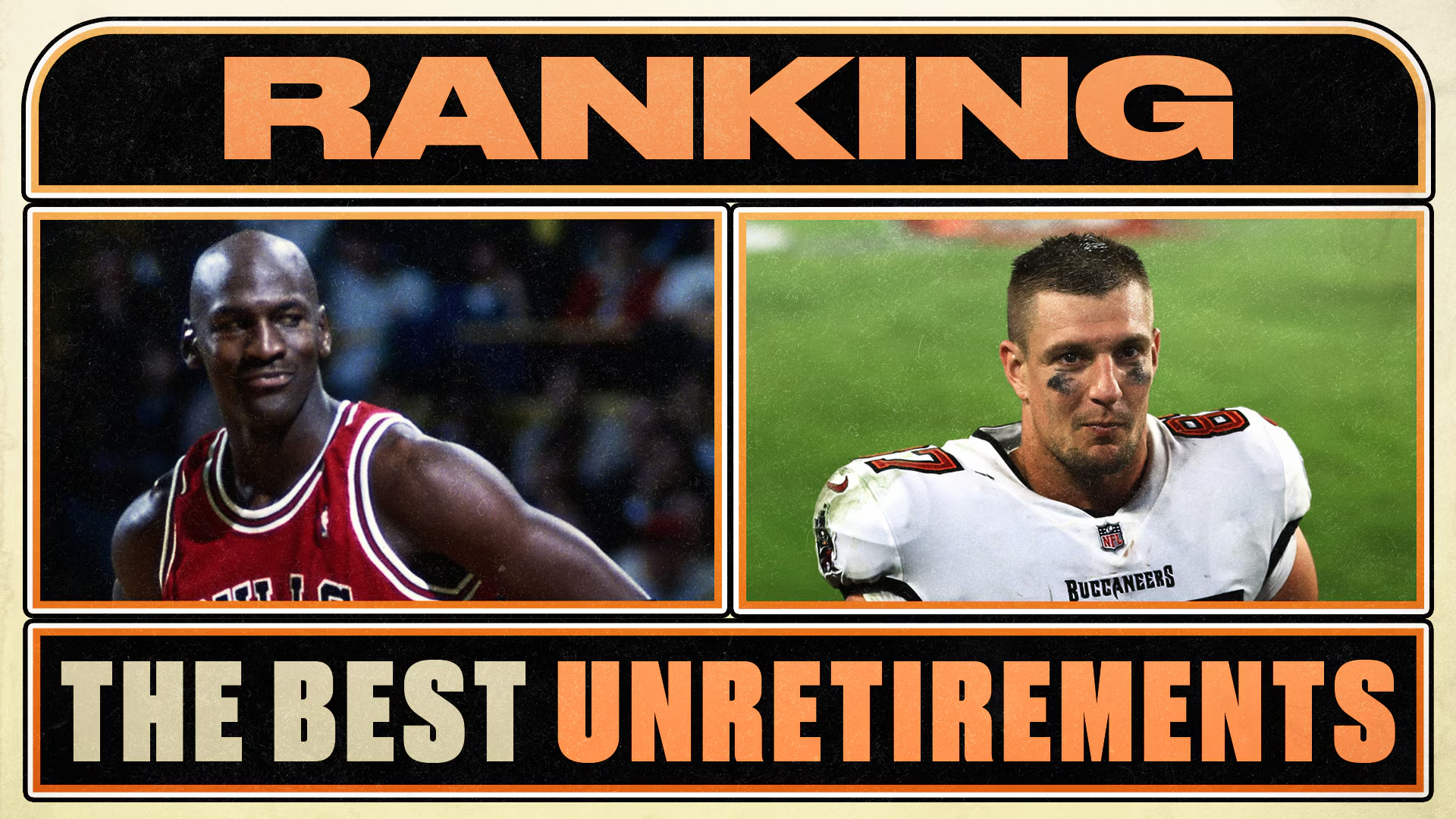
Despite some persistent injury woes, Rob Gronkowski dominated the 2010s as a tremendous tight end on the New England Patriots. He earned first-team All-Pro honors in four seasons and won two Super Bowls.
But at 29 years old, "Gronk" retired. He later pointed to a decline in his mental health and a general lack of desire to play.
New England traded him to the Tampa Bay Buccaneers, reuniting him with longtime quarterback Tom Brady. The partnership picked up right where it left off.
Over two seasons in Tampa, Gronkowski had exactly 100 receptions with 1,425 yards and 13 touchdowns. Most memorably, he caught six passes for 67 yards and two scores in the Super Bowl LV rout of the Kansas City Chiefs.
One day, you're running a custom granite and marble business . The next, you're a quarterback for the Minnesota Vikings.
Such was reality for Randall Cunningham, who retired after the Philadelphia Eagles demoted him from the starting role in 1995. He'd played 11 seasons in Philly, becoming the most prolific dual-threat quarterback in NFL history at the time.
Cunningham didn't play in 1996, but Minnesota Vikings coach Dennis Smith convinced him to throw on the pads again.
In 1998, Cunningham threw for 3,704 yards and 34 touchdowns while leading the Vikings to a 15-1 record and trip to the NFC Championship Game. He garnered first-team All-Pro recognition and ended as the MVP runner-up.
Despite a near-endless string of injuries, a battle with Hodgkin's lymphoma and various other setbacks, Mario Lemieux was a phenomenal center for the Pittsburgh Penguins. He amassed six scoring titles in the first phase of his career.
Lemieux retired in 1997 due in part to his health but also a growing frustration with a notable shift in the NHL's style of play.
Incredibly, he spent the next few years as the president, chairman and CEO of the Penguins and pulled the organization out of bankruptcy. (That achievement deserves far more than a sentence. Alas.)
Lemieux returned to the ice in the 2000-01 season and collected 76 points while finishing as the runner-up in Hart Trophy voting. He won a gold medal for Canada at the 2002 Winter Olympics and tallied 91 points in 2002-03.
Kim Clijsters soared into tennis prominence as a teenager, rising to No. 1 in the world in both singles and doubles in 2003.
Throughout the next few years, however, a few injuries derailed her career. Clijsters won often—including the 2005 U.S. Open, her first Grand Slam singles title—but chose to retire in 2007 because of health challenges at just 23.
Clijsters, who gave birth to her first child in 2008, picked up the racquet in 2009 and wasted no time reestablishing herself.
Following earlier upsets of both Venus and Serena Williams, an unranked Clijsters won the 2009 U.S. Open. She repeated as champion in 2010.
Clijsters added a 2011 Australian Open title and—even if only briefly—reclaimed the world No. 1 ranking that season.
Martina Hingis flooded the record books as the youngest in the Open era to—deep breath—win a Grand Slam doubles title (15 years old), win a Grand Slam singles title (16), and become the world No. 1 player (16).
By 2003, the then-22-year-old Hingis had dealt with enough injuries to retire. However, she returned to the WTA Tour in 2006.
The comeback was not immediately a feel-good story.
Following a failed drug test in 2007, Hingis served a two-year suspension. She began playing competitively again in 2010 and morphed into a doubles specialist after making her official return in 2013.
Hingis won a combined four Grand Slam doubles and six Grand Slam mixed doubles titles from 2015-17.
Following the 1992 Summer Olympics, accomplished swimmer Dara Torres traded her goggles for a headset as a commentator in sports media.
The pool beckoned, however. At the 2000 Sydney Games, she secured two golds on U.S. relay teams and brought home three bronzes from individual events. Then 33, she became the oldest woman to win an Olympic swimming medal.
Jump ahead to 2008, and Torres again returned to represent the United States. She won three silver medals at 41 years old, even setting an American record during the 50-meter freestyle at the Beijing Games.
Torres, who first won gold at the 1984 Los Angeles Games, tied the record (at the time) for the most Olympic medals by a female swimmer with 12.
Michael Phelps captured the world's attention with a stunning eight gold medals at the 2008 Beijing Games. Four years later in London, he claimed four golds and two silvers to close that chapter of his career.
"I'm done. I'm finished. I'm retired. I'm done. No more," he said in 2012.
Of course, that did not last. Phelps returned to the pool and eventually starred at the 2016 Summer Olympics, adding five golds and a silver to his legendary trophy case. At 31 years old, he became the oldest swimmer to win Olympic gold in an individual event.
Phelps pushed his all-time records to 23 gold and 28 overall medals at the Games, far above the current second-best marks of 11 and 18, respectively.
It was only one moment. One punch, really.
But following a decade-long hiatus and two unsuccessful bids at winning a belt, George Foreman took a shocking place in boxing history.
Foreman had exited the ring in 1977 and didn't return for a decade—when he was 38 years old. He lost world title bouts to Evander Holyfield in 1991 and Tommy Morrison in 1993. Foreman didn't fight for the next 17 months.
And then, on a November night in 1994, it happened.
For nine rounds, 26-year-old heavyweight champion Michael Moorer controlled the fight. Knowing the scorecards all leaned in Moorer's favor. Foreman, at 45 years old, needed a knockout to snatch the title.
One punch—one ferocious, debilitating punch—sent Moorer to the mat, securing Foreman's legacy as the oldest heavyweight champion by nearly eight years.
On the heels of a third straight NBA championship with the Chicago Bulls, Michael Jordan made the startling decision to retire from basketball in 1993. His father had been murdered that summer, and he'd lost his passion for the sport.
Jordan, 30, soon traded the hardwood for the diamond, signing with the Chicago White Sox. But a work stoppage led MJ to retire from baseball in March 1995.
That month, the iconic press release happened: " I'm back ."
Jordan quickly rediscovered his powers on the court, winning two MVPs and guiding the Bulls to another three-peat in 1996, 1997 and 1998. He garnered first-team All-NBA and first-team All-Defense honors each season.
Although he'd return again for the Washington Wizards in 2001, Jordan rode off into retirement again following his sixth career NBA title in 1998.
Topics in this story
Gathered from external sources. Rights to this text belong to whoever originally published it.