B/R's Favorite 10 Sports Photos of All-Time
Photography has evolved just as rapidly as the rest of the digital world, but the goal has remained the same: Tell a story without saying a word. Sports photography, in particular, adds the challenge of capturing athletes and their biggest moments in motion.
Photography has evolved just as rapidly as the rest of the digital world, but the goal has remained the same: Tell a story without saying a word. Sports photography, in particular, adds the challenge of capturing athletes and their biggest moments in motion.
An iconic sports photo captures more than just a win or a loss. It can paint the picture of a career, define an entire era, or immerse you in a once-in-a-lifetime atmosphere.
All legendary sports photos have something in common, though: They're conveying one of the many emotions that make us love sports in the first place. Whether it's triumph, defeat, or the struggle in between, the best sports photos make you feel something.
The list of great sports photos is almost endless, but here are our 10 favorites of all time.
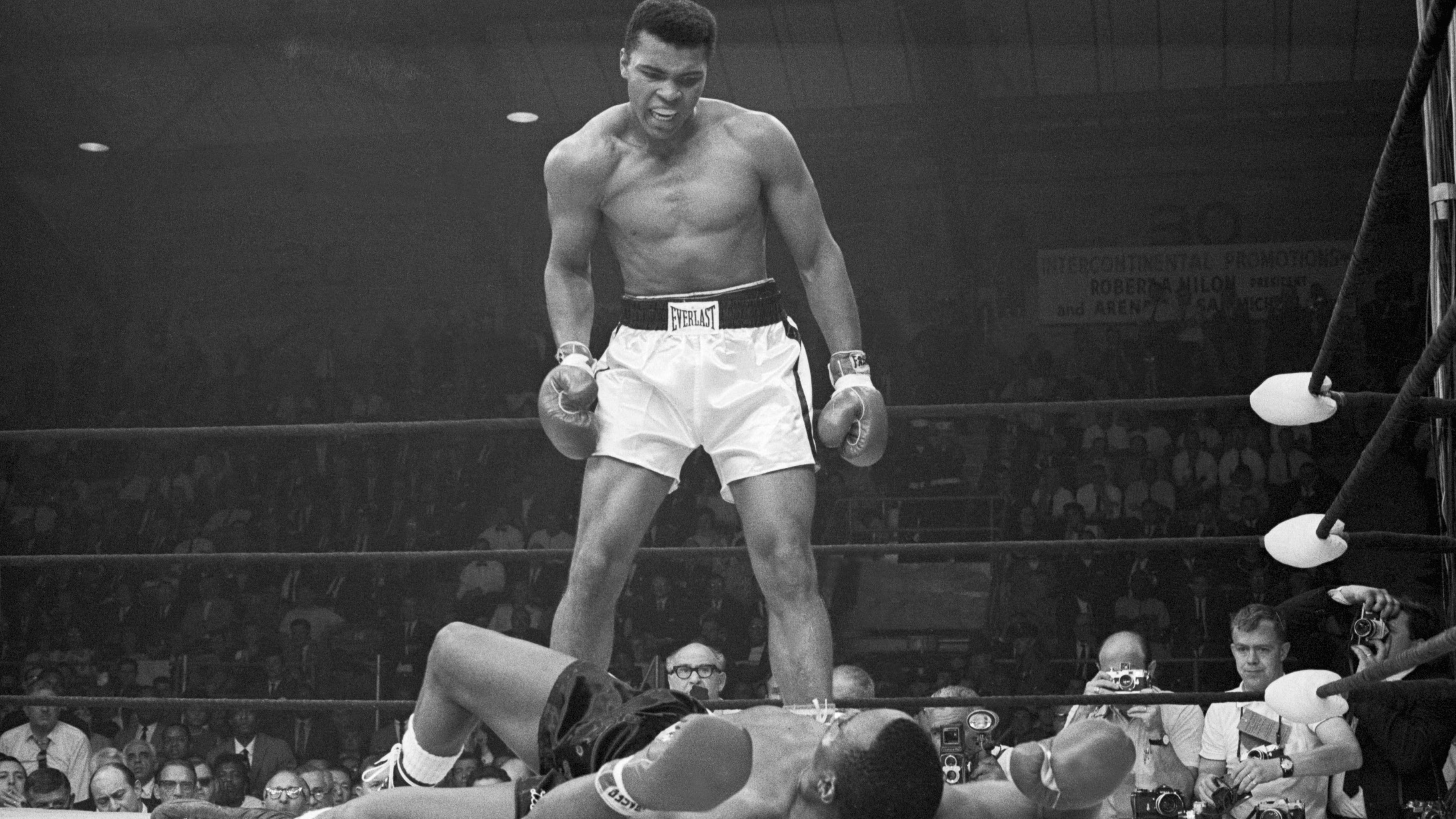
You're just not going to see a reasonable list of iconic sports photos that leaves off Muhammad Ali hovering over Sonny Liston after their title bout on May 25, 1965.
It's funny. The image captured by Neil Leifer didn't even make the cover of Sports Illustrated at the time. The moment itself wasn't particularly significant among Ali's many achievements – he'd already defeated Liston decisively before this rematch – yet the photo has become a lasting representation of Ali's career and impact.
The quality of the photo and the skill of the photographer are really what separate this from the thousands of other Ali photos and elevate it to legendary status. The angle, with larger-than-life Ali hovering over Liston (and all of us), has come to represent the man and his legacy better than words ever could. The beating of the chest, the bright lights, and Ali's roar all capture the charisma and fearlessness that have come to define his legacy.
Michael Jordan's Air Jordan Photo From the 1988 NBA Slam Dunk Contest
Michael Jordan is arguably (folks, please, we're not going there right now) the best NBA player of all time. He's got six rings, six Finals MVPs, and played the most important role on the Bulls' dynastic run. His accolades are plentiful, his iconic moments are abundant, and yet the greatest picture of him was captured in a dunk contest.
It was the 1988 Slam Dunk Contest at the All-Star game in Chicago. Of course, Jordan won – with a perfect score – in dramatic fashion. He famously took flight from the free-throw line; the picture by Bulls team photographer Bill Smith would not only epitomize Jordan's "Jumpman" nickname, but also serve as absurdly effective marketing for the Air Jordan shoe.
Jordan's greatness was fueled by a relentless competitiveness in all things. On the surface, the visual of him suspended in the air makes this picture special. But when you really think about it, it's also because -- not in spite -- of the fact that this was during a dunk contest. He treated every day like Game 7. This photo is a testament to his mentality.
Lou Gehrig Declares Himself "The Luckiest Man on the Face of the Earth"
It's hard to even look at this photo of Lou Gehrig announcing his retirement without getting teary-eyed.
It was July 4, 1939. "The Iron Horse" stood at home plate in his Yankees uniform, leaning into a sea of microphones to deliver his famous "Luckiest Man on the Face of the Earth" speech. Forced to retire due to ALS, the disease that he brought awareness to and that bears his name, Gehrig addressed more than 60,000 fans during "Lou Gehrig Appreciation Day" to thank them and share his gratitude for the game and his life in it.
"So I close in saying that I may have had a tough break, but I have an awful lot to live for," he ended.
The solemn day and photograph, as sad as they are, show the power of community that sports give us.
Tommie Smith and John Carlos Raise Their Fists in Protest at the 1968 Olympic Games
During the 1968 Olympic Games in Mexico City, U.S. sprinters Tommie Smith and John Carlos won gold and bronze in the 200-meter event. At the medal ceremony, they stood barefoot, wearing black gloves, and raised their fists during the U.S. national anthem.
The Olympics have long served as a reflection of the state of the world and its countries. It's an opportunity for the best athletes in the world to use the platform to stand up for what they believe in.
Smith and Carlos have called the gesture a "human rights" salute. It was carefully planned: They took off their shoes to draw attention to poverty, wore beads to recall lynch scenes, and raised their fists as a symbol of the struggle. The silent protest/gesture came just years after the Civil Rights Act of 1964 and the Voting Rights Act of 1965, and months after the assassination of Martin Luther King Jr.
The image became one of the most iconic images of the Black Panther Movement, which intended to end racial inequality in America.
Smith and Carlos faced backlash and consequences like expulsion from the Games at the time. Now, we look at this photo as one of the most overt protests in sports history. It involves two members of a nation representing that nation on the world stage while simultaneously reckoning with its past, present, and future. Smith and Carlos received an Arthur Ashe Courage Award at the 2008 ESPY Awards honoring their action.
Brandi Chastain Celebrates After USWNT Wins 1999 World Cup
Brandi Chastain's celebration of her 1999 World Cup clincher for Team USA is epic in and of itself, but it's fair to say the impact the photo had on women's soccer in the US was even greater.
It was USA vs. China in the final of the Women's World Cup in the Rose Bowl. After a goalless 120 minutes, the game went to a penalty shootout. Chastain took USA's fifth penalty. As the ball hit the lower right corner of the net, she tore off her jersey, knelt on the grass, and swung her jersey in the air in jubilation.
This was a groundbreaking moment for women's soccer and the sport's growth. Chastain became the figurative -- and literal -- poster child of it all. The image appeared on the cover of most sports magazines that week. In 2015, her Sports Illustrated cover was voted the second most iconic cover in the history of the magazine.
The entertainment factor of that World Cup, paired with the photo, inspired a new generation of girls to take an interest in the sport. Of course, the events on the field were enough to see a surge in popularity, but there's no doubt the photo was the perfect finishing touch to elevate the moment and put a face to the movement.
One of the greatest plays in baseball history, "The Catch" also remains up there with the greatest photographs in sports history.
A 12-time Gold Glove winner, Willie Mays made the most iconic defensive play of his career in Game 1 of the 1954 World Series. In the eighth inning, with the game tied 2-2, Mays made an improbable over-the-shoulder catch while running at full speed to record the out. Then, his throw back to the infield prevented one of the runners from advancing. From there, the Giants took the momentum, won Game 1 5-2 in extra innings, and went on to sweep Cleveland.
The beauty of this photo is in the crowd reaction. You can almost feel the silence as Mays is in the process of pulling it off. It was the perfect storm: a high-stakes situation, a legendary athlete making a legendary play, a stunned crowd, and the moment momentum shifted.
Wilt Chamberlain Scores 100 Points in an NBA Game
Did you know that this classic photograph of Wilt Chamberlain after the first (and only) 100-point night in NBA history was taken by a fan?
Yeah, there are unfortunately no highlights of Chamberlain's 100-point game, a record he set on March 2, 1962, that he still holds today. There were no official photographers in Hershey, PA, that night. The game wasn't televised. As legend has it, most New York sports reporters were at baseball spring training. The fan who took the photo, Paul Vathis, was actually a professional photojournalist who happened to be in attendance and would later win a Pulitzer Prize for an unrelated photo.
So how did they make do? Vathis realized history was unfolding at the end of the third quarter and ran to his car to get his camera. In the locker room after the final buzzer, Warriors PR professional Harvey Pollock grabbed a piece of paper, wrote "100" on it, and handed it to a seated Chamberlain.
This moment serves as a cautionary reminder that you never know when -- or where -- sports history is going to strike. The story behind the photo adds to the lore of the event itself. The sports history world is forever grateful for an off-duty Vathis among a crowd of fewer than 5,000 folks who witnessed the historic night.
Jesse Owens' Gold-Medal Ceremony at the 1936 Olympics
Berlin was hosting the Olympics during Hitler's reign in 1936. The Nazi regime set out to use the Games for propaganda and a showcase of Aryan supremacy, but African American track athlete Jesse Owens had other plans.
Owens won four gold medals and set three world records against a backdrop of swastikas and Nazi salutes, defying Hitler's agenda all around him.
This moment transcended sports and reflected the pre-World War II Era. While the USA's decision to attend the Berlin Olympics was controversial, Owens' dominance was a bright spot. The bravery and prowess of an extraordinary athlete and man lives on forever in this photo.
Great photography skills, high stakes, an iconic moment, and a legendary player combined to give us the photo every hockey fan thought of when clicking on this article. There's a reason this one has been turned into a statue outside of TD Garden. They don't do that for just anyone in Boston.
Bobby Orr's "The Goal" depicts Orr scoring the game-winner for the Bruins against the Blues in overtime of Game 4 of the 1970 Stanley Cup Final.
An elated Orr saw the puck slip into the net and jumped into the air with joy, but opponent Noel Picard had hooked his stick, causing him to hover over the ice as if he were flying. He then flew right into the arms of his teammates as he lifted his Bruins to their first title in 29 years.
It's now simply known as "the goal" for many reasons, including the timing of the now-iconic picture taken by Ray Lussier. Lussier has told some great stories about behind-the-scenes from the night .
Michael Phelps' Photo Finish Win at the 2008 Summer Olympics
Few iconic photos in sports history actually influenced the event in the photo, but Michael Phelps' win over Serbian swimmer Milorad Čavić by 0.01 seconds at the 2008 Summer Olympics is one of them.
The 100-meter butterfly final was one of the closest calls in Olympic swimming history, requiring video slowed to one frame per 10,000th of a second to declare Phelps the winner. To the naked eye, it seemed like Cavic touched first because he was already reaching for the wall, but Phelps was just a fraction of a second quicker.
The stakes were ridiculously high, as Phelps tied the record for seven golds in a single Olympics with the win. He'd go on to break the record with eight.
Topics in this story
Gathered from external sources. Rights to this text belong to whoever originally published it.