Brewers payroll breakdown: How Milwaukee built World Series contender on a small-ball budget
The Brewers have defied the odds by reaching the precipice of a championship. Here's how they did it.
The numbers don't lie: there is a correlation between payroll and winning in MLB, but it's far from an exact science.
The Brewers have defied the odds in 2026, taking baseball's 19th-ranked payroll and winning 103 games before cruising to the doorstep of a championship. Even the 2015 Royals, often propped up as the most recent example of a team with a reduced payroll winning the World Series, ranked in the top half among all teams.
How is it possible? The Brewers left no stone unturned to find quality players, from David Stearns' tenure atop the front office to Matt Arnold's four years at the helm.
Here's a look at how Milwaukee built a World Series roster with a lower payroll than more than half of the league.
The Brewers rank 19th in baseball with a $146.2 million payroll, behind a group of 18 teams that includes the 62-100 Angels, 65-97 Giants and 69-93 Royals.
Even more impressive is the fact that most of Milwaukee's highest-paid players weren't the biggest contributors to the team's success this season. Christian Yelich regressed, Brandon Woodruff missed most of the year with shoulder trouble, and trade deadline additions Dustin May and Antonio Senzatela have been complementary pieces at best.
So, how did the Brewers build a roster capable of winning the World Series? Here are all of the key moves.
Of the 26 players on the Brewers' World Series roster, here is the breakdown:
Of the four players signed by the Brewers as free agents, only one was an actual major-league free agent. The remaining three were teenage international free agents. More than half of the roster, meanwhile, was brought in through trades.
Here's a full look at the roster and method of acquisition.
Eight Brewers draft picks are on the World Series roster, including five drafted outside the first round. Jacob Misiorowski and Aaron Ashby were both small-school draft picks, while Cooper Pratt became a top-100 prospect despite falling all the way to the sixth round.
Jackson Chourio, Abner Uribe and Luis Lara were all international free-agent signings, so Sanchez, at just $1.75 million, is the only major-league free-agent signing on the Brewers' roster.
More than half of the Brewers' roster was acquired through trade. Kyle Harrison, David Hamilton and Shane Drohan have all played smaller roles in the postseason, but they came over in February's Caleb Durbin trade, while Joey Ortiz and DL Hall were acquired in the 2024 Corbin Burnes deal. Robert Gasser was also brought in as part of a larger trade, as he was part of the return for Josh Hader in 2022.
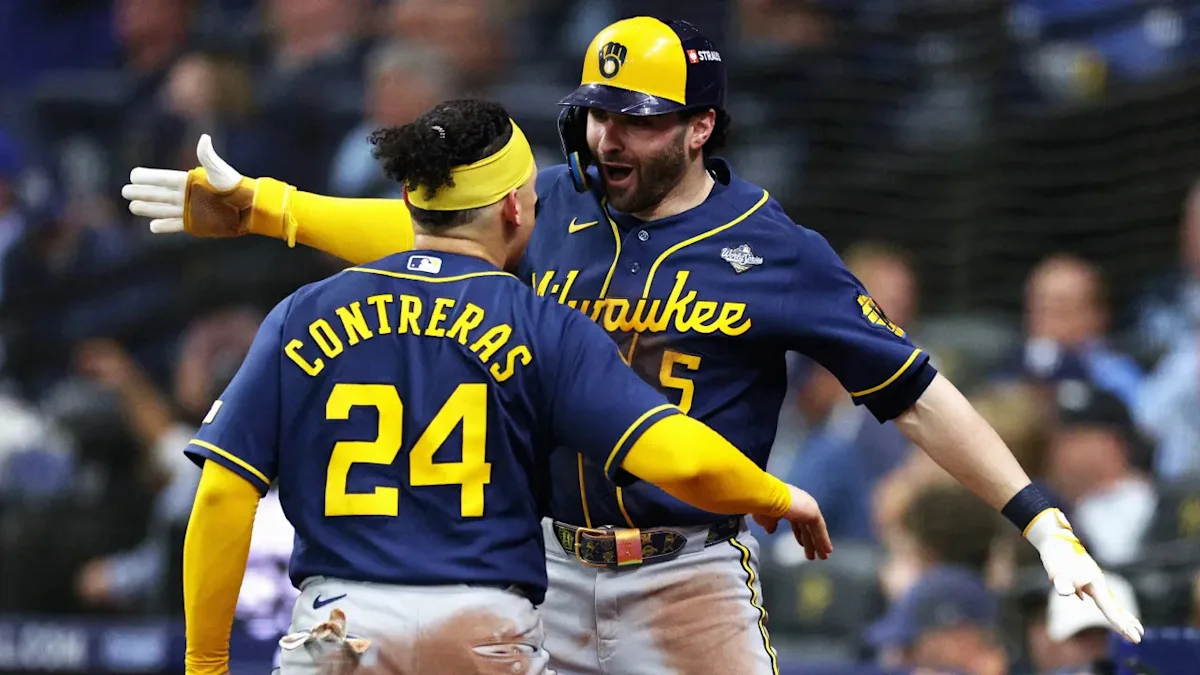
William Contreras was tossed into the three-team Sean Murphy trade with the Braves and Athletics but quickly proved to be a steal for the Brewers, while Jake Bauers and Trevor Megill were acquired in minor deals — Megill was dealt for a player to be named later — but have become critical pieces in Milwaukee.
Topics in this story
Gathered from external sources. Rights to this text belong to whoever originally published it.