“We May Have to Score”: When Notre Dame’s Defense Took Over Against Stanford
Looking back at Notre Dame’s 2002 win over the Stanford Cardinal to get back the Legend’s Trophy.
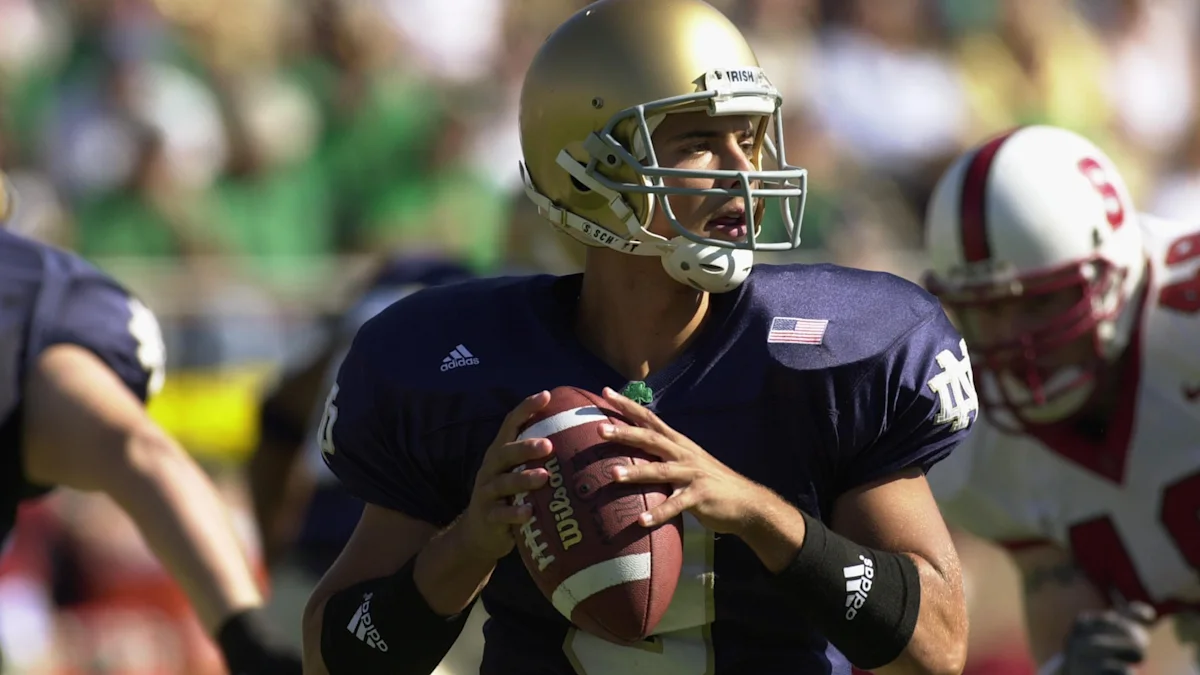
Looking at the final score from Notre Dame's October 5, 2002 matchup against Stanford, you might assume the Irish had a relatively easy afternoon. Notre Dame won 31-7, improved to 5-0 in Tyrone Willingham's first season as head coach, and continued what was quickly becoming one of the biggest surprises of the college football season.
But anyone who watched the first half probably remembers things a little differently.
Notre Dame entered the game 4-0 for the first time since 1993 and was coming off a dramatic 21-17 victory over Michigan State. That win had provided one of the early memorable moments of the Willingham era when starting quarterback Carlyle Holiday injured his shoulder and walk-on Pat Dillingham came off the bench. With just over a minute remaining, Dillingham connected with Arnaz Battle for the game-winning touchdown.
One week later, the unlikely hero was suddenly Notre Dame's starting quarterback.
Dillingham would be making his first collegiate start against Stanford, which added another layer to an already interesting game. Willingham had spent seven seasons as Stanford's head coach before taking the Notre Dame job, meaning that many of the players standing on the opposite sideline were young men he had recruited and coached.
There were plenty of storylines. What Notre Dame needed, however, was simply to keep winning.
Early on, that proved more difficult than expected.
The Irish had opportunities almost immediately. After Stanford was forced to punt on its opening possession, Notre Dame moved to the Cardinal 34 before the drive stalled. Nick Setta's 51-yard field-goal attempt fell short. A bad snap on another Stanford punt soon gave Notre Dame the ball at the Cardinal 33, but a personal foul followed by a five-yard loss helped squander that opportunity as well.
Stanford eventually began moving the ball, but Notre Dame's defense held when the Cardinal reached the Irish 14, and a 37-yard field-goal attempt was blocked. Then it appeared Notre Dame had finally found the spark it needed when Vontez Duff returned a punt 92 yards for a touchdown.
Notre Dame was penalized for roughing the center, wiping the touchdown off the board and giving Stanford another opportunity. Willingham later called the penalty "unusual," which may have been one of the more diplomatic descriptions available to him at the time.
Stanford made the second chance count. Quarterback Chris Lewis connected with Teyo Johnson for a 14-yard touchdown, and the Cardinal led 7-0 at the end of the first quarter.
Notre Dame's defense made sure Stanford wouldn't do much more offensively, but the Irish offense continued to struggle to turn opportunities into points. A second-quarter drive finally reached the Stanford six before Setta kicked a field goal, sending Notre Dame into halftime trailing 7-3.
The most frustrating part was that Notre Dame had possessed the ball in Stanford territory on six of its seven first-half possessions.
And the Irish had three points to show for it.
Willingham would describe it as Notre Dame's worst half of the season, and defensive coordinator Kent Baer apparently came to an interesting conclusion while watching the offense struggle. He told his players, "We may have to score a touchdown here to win this thing."
As it turned out, his defense was listening.
First, however, the offense had to provide a little help.
Notre Dame's opening possession of the third quarter ended with a Dillingham interception, and another promising drive ended when Setta missed a 38-yard field goal. The Irish defense continued to keep Stanford pinned down, giving the offense good field position and another opportunity.
This time Notre Dame finally finished a drive.
The Irish marched 57 yards before Rashon Powers-Neal scored on a three-yard run, giving Notre Dame its first lead of the afternoon, 10-7, with 4:22 remaining in the third quarter.
And then the game changed almost instantly.
Two plays after the ensuing kickoff, Shane Walton intercepted a Lewis pass and returned it 18 yards for a touchdown. Just 24 seconds after Notre Dame had taken its first lead, the Irish were ahead 17-7.
Walton's interception was already his fifth of the season, but apparently the defense wasn't satisfied with one touchdown.
On Stanford's next possession, Lewis completed a pass to tight end Alex Smith. Courtney Watson wrestled the football away from him and took off in the opposite direction, returning it 34 yards for another Notre Dame touchdown.
Baer had told his defense it might need to score a touchdown.
In a span of just 3 minutes and 13 seconds, Notre Dame scored 21 points and transformed what had been a frustrating, uncomfortable afternoon into a 24-7 lead.
The defense still wasn't finished. On the first play of the fourth quarter, Gerome Sapp intercepted Lewis at the Stanford 45. Notre Dame's offense took advantage this time, using its ground game to move down the field before Ryan Grant scored from one yard out.
It was a remarkable turnaround considering how the afternoon had started. Notre Dame had trailed 7-3 at halftime, struggled repeatedly in Stanford territory and watched a 92-yard punt-return touchdown disappear because of a penalty. By the end of the game, the Irish had won by 24 points.
Dillingham's numbers in his first collegiate start weren't spectacular. He completed 14 of 27 passes for 129 yards and threw one interception, but he didn't need to be spectacular. Stanford coach Buddy Teevens credited Dillingham afterward for remaining composed, saying Notre Dame had allowed him to play within his strengths and that the players around him seemed confident in his ability to run the offense.
It certainly helped that Notre Dame could run the football.
The Irish finished with 249 rushing yards, led by Powers-Neal and Grant, who both topped the 100-yard mark. Willingham was particularly pleased with the performance of his offensive line, crediting the group for being physical, communicating well and putting themselves in the right positions throughout the afternoon.
But once again, the story of this Notre Dame team was its defense.
Through five games, the Irish defense had become remarkably good at doing more than simply stopping opponents. It was creating points. Against Stanford, Walton and Watson turned two turnovers directly into touchdowns, while Sapp's interception set up another score. When Notre Dame's offense needed time to find itself, the defense provided it.
That alone felt significant. The Irish hadn't started a season with five consecutive victories since 1993, and a team that had finished 5-6 the year before had already matched its entire 2001 win total.
Naturally, people were beginning to wonder just how far this team might go.
Willingham wasn't interested in joining the speculation.
"We'll just kindly take 5-0 and just keep going," he said afterward. "All I want to be is a team that plays the best the next Saturday afternoon. That's all I want."
There was also a quieter moment after the game that said something about just how unusual the afternoon had been for Notre Dame's new head coach.
As Willingham was conducting a television interview, Stanford quarterback Chris Lewis made his way through the group of reporters surrounding him. Willingham stopped the interview to greet his former player, embracing him and speaking briefly with him. Other Stanford players approached their former coach as he eventually made his way toward the tunnel.
For seven years, those had been Willingham's players.
Now he was walking away with Notre Dame at 5-0.
More than two decades later, the 31-7 score makes this game easy to overlook. It looks like a comfortable Notre Dame victory tucked into the middle of an undefeated start.
For one half, almost everything that could frustrate the Irish did. Drives stalled. Field goals were missed. A touchdown was erased. Stanford led at halftime. Notre Dame's backup quarterback was making his first start, and Willingham was trying to defeat the program he had left less than a year earlier.
Then Rashon Powers-Neal finally found the end zone, and Notre Dame's defense took it from there.
Kent Baer had suggested his defense might have to score a touchdown to win.
Topics in this story
Gathered from external sources. Rights to this text belong to whoever originally published it.