Golfer Tim O'Neal talks PGA diversity at Phoenix Charles Schwab Cup
Pro golfer Tim O'Neal spoke to The Arizona Republic about his late mom inspiring his career comeback and financing for Black golfers.
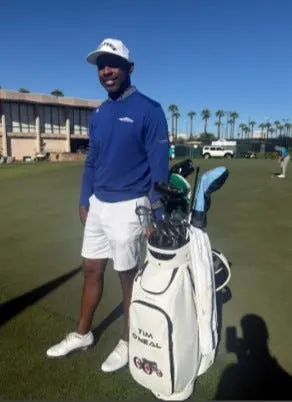
Tim O'Neal had a calm smile during his practice shots at the Phoenix Country Club. Clad in his crisp blue long-sleeve shirt and Servpro badge, white hat and matching shorts, O'Neal was in the Valley competing in his third straight Charles Schwab Cup Championship, Nov. 12-15.
O'Neal was among 36 qualifiers for the PGA Tour Champions season finale. He is the lone African-American competing for his first title.
"Hopefully, other golfers of color will realize and see if I can do it, they can do it too," O'Neal told The Arizona Republic earlier this week.
O'Neal is approaching nearly 30 years as a pro and fourth PGA Tour Champions season. He started on the Korn Ferry Tour as a rookie in 1997 out of Jackson State University, a rarity for a player from a historically Black college or university (HBCU). That was the same year Tiger Woods turned pro and became the first African-American to win the Masters.
Since then, golf diversity has reached an all-time high of 25%, or seven million, among Black, Asian, or Latinx players in 2024, up from 8% in 1990, per the National Golf Foundation (NGF) and United States Golf Association (USGA).
Black pro golfers also on the current tour include Harold Varner II, Joseph Bramlett and Cameron Champ.
"With Tiger getting on tour, winning majors and dominating for a long time, that definitely I would think has had an effect," O'Neal said.
O'Neal, 52, has had a strong 2026, with five top-10 finishes through 27 events. And he's still riding the coattails of his sole career victory at the Dominion Energy Charity Classic in October 2024.
See final round of 2026 WM Phoenix Open in photos
That's a turnaround from the multiple heartbreaks at qualifying school (Q-school) earlier in his career. He missed earning his PGA Tour card twice by one stroke in 2001 and 2004, before finally securing it in 2008.
"You get a little smarter, course management's a little bit better," O'Neal said. "Probably in my younger days probably a little more aggressive on the course. I'm now a bit more conservative. ... But once I got on the Champions Tour, I think for me I still need some more work, but short game was the main thing. I've improved there but I still have some room to grow there as well and just getting more comfortable with these guys out here, some of the best players in the world."
O'Neal was sponsored by actor and hip hop legend Will Smith earlier in his career. The loss of his PGA card, Nationwide Tour privileges and lack of money nearly caused O'Neal to quit for good.
From 2010-11, O'Neal worked and gave lessons at Edwin Watts golf shop in his native Savannah, Georgia, while he played in mini tournaments over the next two years. His late mother Eva O'Neal, who passed away in 2020, urged him to stick with the game that she and his dad taught him to play.
In 2013, O'Neal played in the eGOLF Tour in Charlotte, which helped jump-start his career. He then went to Morocco in the Moroccan Golf Federation and played six tournaments and earned $7,500 in each of his three wins. He continued to fund his own comeback as that prize money got him into another bigger European tournament, Trophy Hassan II, and he won $18,000 by finishing in the top 20.
Then got into Q-school at the PGA Tour Latinoamérica in South America in 2013. Then, in 2014, he played again on the Korn Ferry tour.
"Twenty-something years ago, you could probably skimp here and skimp there to find a way to get through, but now it's impossible," O'Neal told The Arizona Republic. "Everyone's good, everyone has the best coaches and best courses to play, and it's sad to say this but if you don't have financial backing, you really don't have a chance. And it costs about $100,000 a year to really do it the right way."
Many Black amateur golfers face the same issue to develop and become pros, especially those from HBCUs.
Jackson State put a two-year suspension on its men's and women's golf program as part of the university's $106 million budget cuts, that included travel spending, in 2017. After a protracted hiatus, which O'Neal called "sad" for the former "powerhouse in golf," Jackson State resumed its program in 2025.
In addition, there are PGA events and programs such as the APGA Tour , Pathway To Progression and Coca-Cola partnership with the PGA Tour for the HBCU Golf Impact Grant, which pledges $250,000 to 10 partner schools and 16 golf programs.
Lucrative college NIL deals and allocation mostly goes to more popular college sports such as basketball and football.
"If it wasn't for the people who helped me along the way to get here now, unless you come from a wealthy family, very expensive sport to play with equipment and all the stuff you need to really make it,'' O'Neal said. "These financial groups, whatever they can do to help golfers get to the next level, you need it because there's very few golfers who made it that didn't have backing behind them."
Topics in this story
Gathered from external sources. Rights to this text belong to whoever originally published it.