Climbing Everest is hard. Recovering a body from near its summit will be even harder
The lime-green boots shine vividly against the dazzling white snow. A man in a knitted fleece smiles as he carefully attaches crampons in preparation for his historic ascent of the world’s tallest mountain.
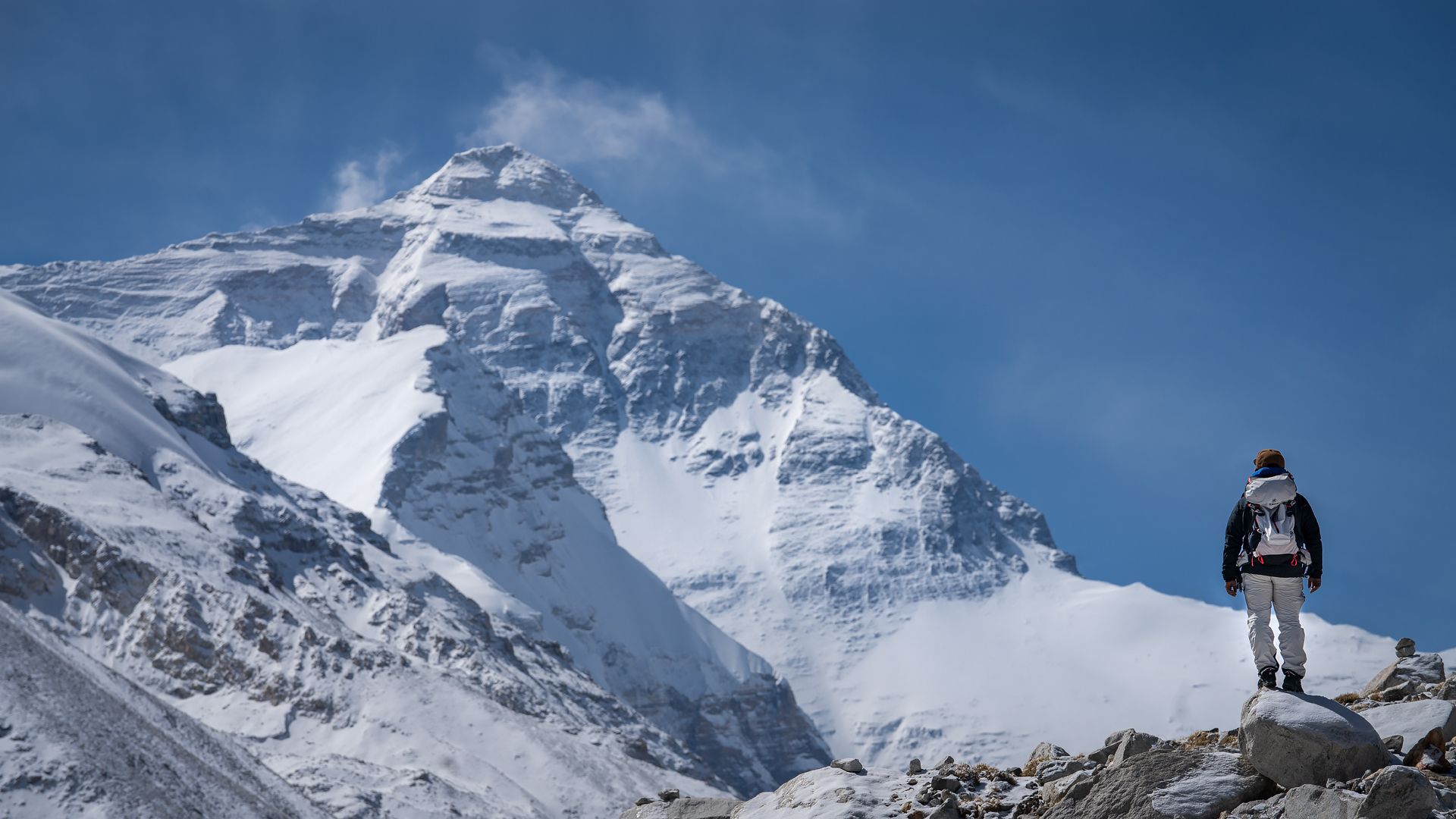
The lime-green boots shine vividly against the dazzling white snow. A man in a knitted fleece smiles as he carefully attaches crampons in preparation for his historic ascent of the world’s tallest mountain. The grainy, 30-year-old video is the last known footage of a climber whose identity has remained a mystery to all but a small circle of mountaineers since he died in a ferocious storm near the top of Mount Everest in 1996. The storm claimed eight lives and inspired Jon Krakauer’s best-selling first-hand account “Into Thin Air.” But the deaths and incredible stories of survival on the Nepal side of Everest have overshadowed one of the enduring mysteries of that day — the fate of three Indian climbers trying to summit the mountain via the more challenging approach from Tibet. For decades, the frozen body of one of those men has lain exposed, curled up as if asleep, at the spot where he died around 300 meters below the summit. For generations of climbers he has been known simply as “Green Boots” — due to those green Koflach shoes that protrude from the ice. But last year, in a covert, high-altitude operation, a small team of Sherpas successfully retrieved DNA samples from his corpse and gave him back his name. “Green Boots” is Dorje Morup, a mountaineer who grew up in northern India, near the border with Tibet, and served in a specialized Indian border police force. He was 47 when he died. Now that India has confirmed who he is, the race is on to bring Morup home. This year India’s government began searching for an elite team of Sherpas to embark on a risky mission: to bring back his body from the mountain’s death zone, where there is so little oxygen that humans cannot breathe unaided for long. “People knew ‘Green Boots’ as a landmark, but they didn’t know the person behind that title,” said Dawa Steven Sherpa, Nepali mountaineer and CEO of expedition company Asian Trekking. Footage obtained exclusively by CNN and testimony from those who were on the mountain paint a more detailed picture than before of Morup, the man who died serving his country and is now the goal of one of mountaineering’s grimmest challenges. It may be mission impossible. Several diplomatic hurdles will need to be surmounted before any recovery effort can take its first steps. And scaling Everest to above 8,000 meters and bringing down a body that has been frozen in ice for three decades will push any team to its limit. The mission also raises another difficult question: do you risk more lives to bring home a dead body? ‘Class-one mountaineers’ Heavy breaths are interspersed by the sound of crunching snow, as shaky, never-before-seen video pans to a team of climbers, several wearing green boots, traversing a white-snow field. Ahead, black dots move in formation like ants as Everest’s imposing upper flanks loom above them. It’s spring 1996 and the climbers are hoping to become the first Indian team to summit Everest from its more challenging northern route. Their day jobs are with the Indo-Tibetan Border Police (ITBP), a specialized force tasked with guarding the peaks and passes of India’s 2,167-mile (3,488-kilometer) long Himalayan border with China. Formed in the aftermath of a disastrous mountain war with China in 1962, the ITBP operates in some of the most inhospitable terrain on Earth. It recruits prominently from communities living in India’s high Himalaya mountains. Alongside Morup were two other Indian climbers who hailed from Ladakh, a remote mountainous territory bordering Tibet: Tsewang Paljor and Tsewang Smanla. The three were “class-one mountaineers” who were close “like family,” according to one of their fellow climbers. The never-before-seen expedition footage captures the camaraderie and humor among the team. Inside a tent, one man serves food from a steaming saucepan. He’s one of the team leaders, and as he hands out the plates the rest of the team joke about the inversion of hierarchy. In another scene, a group of climbers are chatting together next to a cluster of tents. “When I get up there, I’m going to do this,” one man says, making a drinking gesture. But getting up there would prove deadly. The last person to see them alive Hundreds of miles from the snow and ice of the Himalaya, a modest house in the plains of India’s Punjab state holds memories of the last hours of Morup’s life. It’s the home of veteran mountaineer Harbhajan Singh, a leader on the ill-fated expedition, and one of the last people to see Morup, Paljor and Smanla alive. Old furniture fills the rooms, giving the place the domestic, lived-in feel of a family home that has grown with its occupants. However, the medals, photographs and awards hung in the hall tell an extraordinary story of a life spent never far from danger in the mountains. Now 70, the retired ITBP inspector general points out Morup, Paljor and Smanla in video shared with CNN during a visit to his home and smiles as he flips through photo albums. He had climbed before with them in the Indian Himalaya and was amazed by their strength. “I have not seen them tired,” he said. As the team collapsed into their tents at the end of each grueling day on Everest, it was invariably Morup, Paljor and Smanla who still had the energy to brew tea and revive spirits, he remembered. Morup was easygoing and a “silent worker,” said Singh. “Whenever we were given any task, like fixing the ropes, he would always volunteer. He was technically very sound, physically very sound.” The first time the team saw Everest was awe-inspiring, Singh said. “I bowed my head out of respect,” he added. “It was very beautiful.” But the team was not there to admire the scenery. There was a job to be done, and national prestige at stake. A successful Indian ascent of Everest from the north side “was a matter of pride,” he said. Several other teams were on the mountain, including from Japan, Norway, and a British team making a documentary with actor Brian Blessed. “It was wonderful,” Singh said. “Everyone was excited.” The summit push After weeks of arduous climbing, Singh led a six-man team, including Morup, Paljor and Smanla above the final camp located at 8,300 meters (27,000 feet). They were just over 500 meters from the summit. Their task on May 10, Singh said, was to open up a route to the Second Step and test the stability of a ladder fixed to the rock face. The step is an almost vertical 40-meter bottleneck, and the most technically challenging part of the climb. Beyond was the last stretch to the summit, typically about a four-hour climb in normal conditions. If the weather was good, they could make a summit attempt, Singh said. But it was late in the day and despite favorable weather reports, Singh said he could see clouds forming above Everest: An omen that bad weather was on its way. He decided not to proceed. “If you try you will not be able to come back,” Singh had told Morup, Paljor and Smanla. But the three decided to push on and later phoned base camp to say they were making an attempt for the summit. “I was the last one (to see them alive),” Singh said. “They had a cup of tea at the Second Step… As they were going up, I saw them fixing the rope. I thought, ok they will come back,” he added. At such heights with so little oxygen, “you cannot judge whether you will be trapped,” Singh said. “You have only one aim: I have to climb Everest.” Singh and another climber turned back for the high camp. By the time they reached the safety of the tents at 6 p.m., Morup, Paljor and Smanla had radioed base camp. They had summited. “All of us were very happy,” said Singh. “But it was very short-lived.” A deadly storm The storm quickly rolled in, catching many climbers on both sides of the mountain off guard. On the Nepal side, American mountaineers Scott Fischer and Doug Hansen died, as well as New Zealand’s Rob Hall and Andy Harris, and Japan’s Yasuko Namba. Down at Advanced Base Camp on the Tibetan side, the anxious Indian team could see two headlamps light up their descent high on the mountain. “One of the beams spiraling downwards, toward the Second Step. Then darkness, as they went out of our lives,” the expedition’s senior deputy leader PM Das said in a written account. The Second Step would have been “very challenging” to descend in those conditions, said Jon Gangdal, a Norwegian climber leading a separate expedition on the north side of Everest and who was in contact with the Indian team. “What hits the mountain so high are these jet stream winds,” he told CNN. Those winds are full of snow and ice, and bring gusts of 150-200 kilometers per hour, plunging temperatures to minus 60 to 80 degrees Celsius (minus 79 to minus 112 Fahrenheit). “And the higher you are, the stronger the winds are,” Gangdal said. Exposure, coupled with a lack of oxygen, rapidly becomes an “extremely dangerous” situation, he added. Before the summit attempt, Gangdal described a feeling of “competition” between the Indian and Japanese teams to be the first to summit that season. Summit fever – an irrational drive to reach to the top, whatever it takes – may have taken over the climbers, he believes. At base camp, “everybody is only heading for one thing, summit, summit, summit,” said Gangdal, author of “Guilt and Glory: Climbing with Sherpas.” “As soon as you are on the ridge… you get the feeling that (the summit) is within reach.” A few days later a second team from the Indian expedition summited Everest. For Gangdal, who helped try and rouse the team leaders into mounting a rescue, that was the wrong move. “They should have put in effort to get the bodies down first,” he said. Paljor is believed to have fallen off the mountain; his body was never found. Smanla lay above the Second Step before he too disappeared. And Morup, who managed to descend in the storm, lay near the trail below the First Step in a small limestone cave, his Green Boots visible in the snow. American climber David Roeske, who summited Everest in 2013 and 2016, said passing Morup was an “opportunity to pay homage” and “felt like you were honoring him and his memory best by pausing there and taking note.” “It was a beautiful opportunity to remember this man’s experience and life and to move gently and humbly up the mountain yourself… his memory lived on in a very powerful way by being there for so long,” he said. ‘We always knew’ The upper reaches of Everest are home to many of the more than 300 climbers who have perished on the mountain. Rescues this high are risky and expensive, and helicopters cannot safely fly at such altitudes. Among them was US climber Francys Arsentiev, who died in 1998 after becoming the first American woman to summit without supplemental oxygen. Her body remained visible for a decade before it was removed from view, and she became known as “Sleeping Beauty” for the peaceful way she rested on the mountain. Previous attempts to retrieve bodies at such high altitudes have been called off because of the risk of death to the rescuers. The document issued by the ITBP inviting bids to retrieve Morup’s body does not say why it is trying to do so now, 30 years after his death – although some of the members of the 1996 Indian expedition have since attained high rank in the organization. “We felt that any brave ITBP mountaineer should be given a dignified farewell,” an ITBP official told CNN in response to queries on the timing of the proposed expedition. “Someone who made the supreme sacrifice in the line of duty at high altitude should be given that dignity.” The ITBP official said they identified Morup after carrying out “a detailed examination of the available expedition records, took inputs from surviving expedition members and considered the technical inputs.” But those in the industry “have always known” Green Boots was Morup, said Dawa Steven Sherpa, whose mountaineering company Asian Trekking outfitted the 1996 Indian expedition. Proving it was a complex operation. Dawa said his company “without very much fanfare, without making it too public” launched “a very small expedition to send a group of Sherpas up,” to extract DNA samples from the frozen corpse’s hair and nails. The team was relying on bottled oxygen so “we needed to act quickly to get whatever DNA samples we could,” Dawa said. “You do not want to be spending too long doing this, and finishing off your oxygen, or putting yourself in a position where you wasted so much time that you could get the team in trouble.” Under that time pressure, the team had to carefully handle the precious DNA to prevent the risk of contamination on their descent. A lab in India later confirmed the samples belonged to Morup. Bringing Dorje home Though there will be challenges, bringing Morup off the mountain is possible, said Dawa. His body has been frozen solid for 30 years, making him much heavier to move. But a team of about eight Sherpas could do it – using foam padding and a special stretcher that cocoons the body, Dawa said. “You’re able to then bring the body down by dragging it, and it will slide over rocks and ice,” he said. “You need a couple of extra hands just to make sure that the body doesn’t slide off down the mountain.” Complicating the retrieval is the position of Morup’s body, and the risk that it could be damaged or start decomposing on the way down. “If (limbs are) outstretched, there’s no way to push it back in… It’s frozen solid, so it really does make that really, really hard,” he said. “You could break the limb, if it catches on a rock and then gets twisted.” Cultural sensitivities around Sherpas handling a dead body would also need to be respected, said Dawa. “It’s not just any dead body… this is a Ladakhi climber who is very similar in terms of culture and religion in ways that a Sherpa can see himself in that,” he added. The ITBP official said the mission is now expected to happen during the April-May climbing season of 2027 after “taking everything into account — necessary approvals, clearances and everything else.” It is unclear whether any companies will make a bid for next year. Any mission will also need diplomatic buy-in from China, which closed the Tibetan side of Everest to foreign climbers this year. Ties between the two countries remain strained over their long-running Himalayan border dispute, which erupted into a deadly skirmishes in 2020 that saw soldiers from both sides use rocks and iron rods in brutal hand-to-hand combat. CNN has reached out to the Chinese Mountaineering Association and the Sports Bureau of Tibet Autonomous Region for comment on the proposed mission to retrieve Morup’s body. Repeated calls to the China Tibet Mountaineering Association, which manages permits for Everest’s north route, went unanswered. “It should have happened 30 years ago,” Gangdal said. “This is the Indian responsibility to bring this guy down, especially when they learnt that he became like a death marker on the mountain.” Singh and Dawa say it would be an important achievement if Morup is finally brought home to his family. “There is closure for families when you bring a body down, when you give it a proper burial,” said Dawa. “In another way, you are humanizing the person again.”
Gathered from external sources. Rights to this text belong to whoever originally published it.