South Africa vs Australia: Hosts set up epic finale - what do stats and history suggest could happen?
South Africa set up an epic final day of their decisive Test against Australia by batting throughout the fourth day. What does history suggest could happen?
Third Test, Cape Town (day four of five)
South Africa 329 & 387: Mulder 115, Rickelton 101
A gripping series has the finale it deserves.
Having effectively began day four on 40-4, South Africa batted on and on against Australia in Cape Town to move from a position where defeat looked likely to one where a series victory is a real possibility.
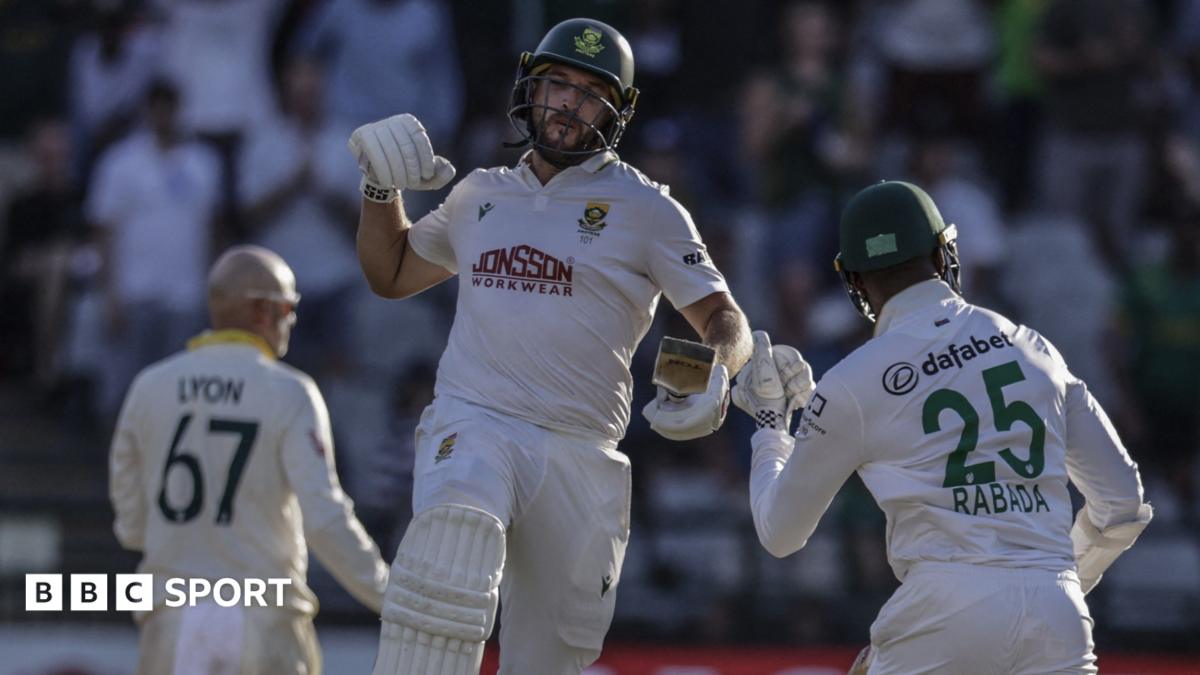
In being bowled out for 387 in the final over - with Ryan Rickelton making 101 and Wiaan Mulder last man out for a brilliant 115 - South Africa set the tourists a target of 288 for victory.
WinViz - the tool analysts CricViz use to predict such results - gives the hosts a 54% chance of victory.
Australia's target is such that should they chase it on day five, it would be the second-highest fourth-innings chase in the 62 previous Tests on this famous ground.
The highest? That's a good omen for Australia.
They chased 331 for a four-wicket win in an epic Test against the Proteas in 2002, when Ricky Ponting hit a brilliant 100 not out.
There have been five other scores above 288 in the fourth innings at Newlands - all of which were made in defeats or when salvaging a draw.
For much of the afternoon and evening sessions, as Australia's bowlers tired, this surface appeared flat enough to score.
When Rickelton and Mulder applied themselves, few opportunities were created. They were able to progress to their third and fourth Test centuries respectively.
It took a run out to end Rickelton's knock, after which Marco Jansen pulled to deep square leg and Gerald Coetzee was also run out - three dismissals down to batter error in a collapse of 4-61, which left South Africa nine down and 251 runs ahead.
That Mulder and number 11 Kagiso Rabada flogged 36 before the close, suggested run-scoring is not impossible.
Pitch turning more but batters more secure
None of those late runs were made under the pressure of a chase, however.
The wicket of Simon Harmer in the final session, bowled shouldering arms by a ball from Nathan Lyon which turned back sharply showed the difficulty ahead.
Harmer dismissed Travis Head, Marnus Labuschagne, Josh Inglis and Alex Carey in Australia's first innings - all recognised batters.
The 37-year-old Essex legend, who once considered playing for England, will be crucial.
As ever in such scenarios, the pitch will play its part.
The PitchViz rating - CricViz's way of assessing the difficulty of a surface - jumped to 6.6 in the final session, comfortably the highest (thus most difficult) rating of the Test.
After settling down in the morning, the ball, as would be expected as a Test progresses, was turning significantly more in the final session than at any point across the previous four days.
Interestingly, however, South Africa's false shot percentage was just 11% across day four, a drop from 18% on day three.
Uneven bounce has not yet been a factor but one ball to Rickelton shortly after tea also shot low.
Intrigue is added by the fact that whoever wins this Test will end the series top of the International Cricket Council's Test rankings.
One man appears to likely to play a huge part in the outcome.
Faced with a target of 205 in the first Ashes Test almost a year ago, Australia opener Head thrashed a sensational 123 from 83 balls to turn a tricky chase into a riotous charge to victory over England.
There was a time, between 2008 and 2019, when Australia had a poor record in situations such as these.
In that period they failed in 14 of their 17 fourth-innings chases when set targets between 200 and 350.
That has changed in recent years, however, with Cummins' men having pulled off pursuits of 282 and 279 since 2023, in addition to the Perth victory last year.
Few sides have been better in key moments in the modern era. Saturday will provide another chance for Australia to deliver under pressure.
Topics in this story
Gathered from external sources. Rights to this text belong to whoever originally published it.