Final Offseason Grades for Every NBA Team Ahead of Training Camp
We've hit late September, which means virtually all of the NBA's offseason business is done.
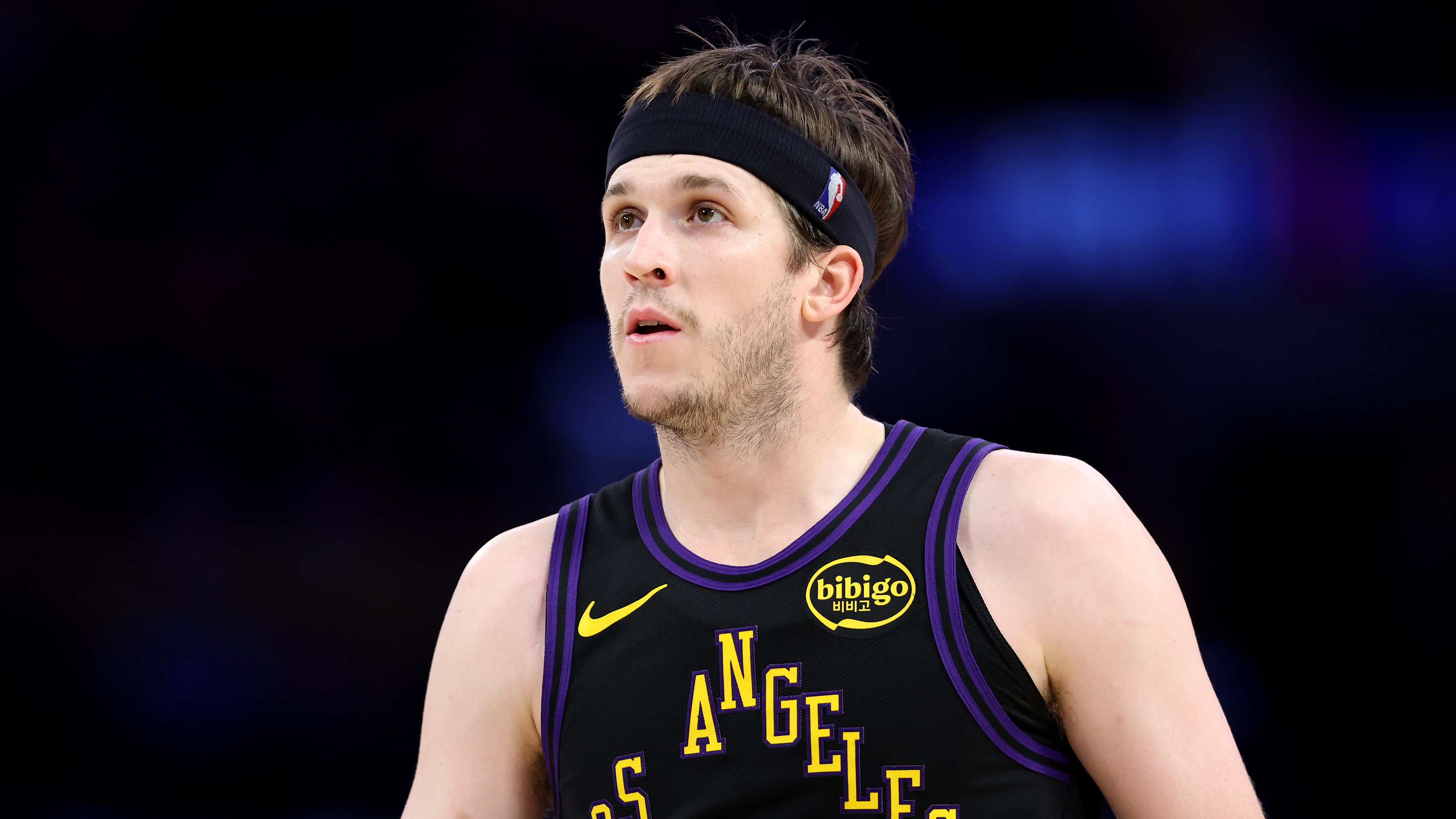
We've hit late September, which means virtually all of the NBA's offseason business is done.
That's right: It's time to do some harsh judging, complete with some very simple letter grades that should appease the analytics and "just watch the games" crowds alike.
Did the Los Angeles Lakers spend wisely in adding Walker Kessler and a host of offense-first free agents? Did the New York Knicks cheap out just after winning their first championship in 53 years?
We'll tackle those high-profile squads and all the rest as we hand out grades for every team's offseason performance. Keep in mind that a "C" is average. We're evaluating teams on what they did relative to their resources and chosen direction.
The Atlanta Hawks didn't take a big swing this offseason, but it doesn't hurt them here for several reasons. The most important of those is the lack of a difference-making target worth the trouble.
So instead of acting recklessly, the Hawks kept their powder dry, made opportunistic additions with Aaron Wiggins and Lu Dort, called it quits with the disappointing Zaccharie Risacher and inked CJ McCollum ($21 million) and Jock Landale ($14 million) to eminently tradable one-year deals.
Atlanta needs a star player to slot above Jalen Johnson in the pecking order. It remains perfectly poised to pounce when the right one becomes available. That status doesn't stem from lazy inaction; it's the result of patience and planning.
The Boston Celtics get an above-average grade mainly because top executive Brad Stevens has earned the benefit of the doubt. This C-plus depends on the belief that Stevens correctly judged the risk-reward trade-off of continuing to roster Jaylen Brown and that sending him to the Philadelphia 76ers was the best available move.
A confluence of factors—unfavorable analytics, a looming extension, Brown's potential dissatisfaction with his role—convinced Stevens and the Celtics that the organization was better off with Paul George and a couple of first-round assets than with the former Finals MVP. At least until this trade proves to be the disaster some say it is, we should defer to Boston's judgment.
Smaller-scale home runs led by new contracts for Jordan Walsh, Ron Harper Jr. and Neemias Queta help push the Celtics' grade above break-even. Mitchell Robinson's three-year, $47 million deal comes with health concerns, but the big man fills a glaring need for size and post defense up front.
The Brown trade comes with real risks. There's a case to be made that it knocks Boston out of the contender class. This grade is a bet on the Celtics having a better sense of their near- and long-term futures than their critics do.
The Brooklyn Nets were one of a small handful of teams with spending power this offseason. That position could have let them pitch restricted free agents or take on bad salary via a trade with picks attached.
Instead, Brooklyn chose to ink several smaller, short-term deals for role players like Keon Ellis (two years, $18 million), Josh Minott (two years, $9 million) and Moritz Wagner (two years, $19 million). The Nets did well to secure team options on all three of those agreements, as well as the two-year, $20 million pact they inked with presumptive starting center Day'Ron Sharpe.
A charitable view of Brooklyn's summer, which also included swapping Nic Claxton for Julius Randle and a five-spot jump from No. 28 to No. 33 in the draft, is that it preserved flexibility. A harsher analyst would say it was unambitious and might be remembered as a missed opportunity.
Brooklyn didn't do any damage to its big-picture fortunes. Mikel Brown Jr. looks like a sensible pick at No. 5, but it's hard to get past the feeling that a little more aggression could have paid off.
The Charlotte Hornets made the bold choice to cut ties with LaMelo Ball, shipping him to the Minnesota Timberwolves for a package headlined by Naz Reid, an unprotected 2033 first-round pick and three first-round swaps.
Though the move was not without its risks, and though Ball had a major part to play in Charlotte's elite offense over the last 60 games of 2025-26, dealing the oft-injured point guard was the right call. By moving on, the Hornets will no longer have to worry about Ball's shaky health, off-court immaturity and his next contract. Put more simply, Charlotte may have just traded him at the peak of his value.
Coby White will be back on a three-year, $74 million deal that declines in value. If he provides 85 percent of what Ball did (which isn't hard to imagine given Ball's availability issues), there's a good chance the team won't lose any short-term ground.
While the Ball trade was polarizing, the deal that sent Miles Bridges and a 2029 first-rounder to the Phoenix Suns for Grayson Allen, Royce O'Neale and an unprotected 2033 first-rounder was an absolute heist.
We're holding off on an "A" only out of respect for the possibility that Ball could prove Charlotte wrong.
It was encouraging to see the Chicago Bulls start their offseason process at the top by replacing lead executive Arturas Karnisovas with Bryson Graham. Though the irony of booting the decision-maker whose "let's try to stick in the league's go-nowhere middle" approach would actually make a lot of sense under the new lottery rules, it was clearly time for a change.
Caleb Wilson flashed superstar upside in Summer League, but the Bulls don't really get much credit for using the No. 4 pick on the last remaining member of the draft's consensus top four.
Tiago Splitter got a raw deal in Portland and seems like the right coach for the early stages of a rebuild. Free agent Norman Powell should be tradeable for positive value on his two-year, $44 million deal (team option for 2027-28) when the time comes.
Chicago probably didn't need to spend $17 million for two years of Zach Collins' services, but that mild overpay doesn't do much damage to what was otherwise a sensible summer.
The Cleveland Cavaliers won 64 games two years ago and reached the Conference Finals last season, so they were justified in boldly pursuing a player who might be the last piece of the puzzle.
Peyton Watson may be overvalued on the basis of six hot weeks last season, but he's still the ideal theoretical fifth starter for the Cavs. If his improved playmaking and knockdown three-point shooting persist, and if he proves capable of defending the toughest opposing perimeter matchup, Cleveland won't miss the 2031 first-rounder it sent away or the $88 million it committed to paying Watson over the next four years.
Donovan Mitchell got a colossal four-year, $273 million extension. The Cavs gave James Harden three more years and $97 million guaranteed. Both agreements come with serious downsides, but as with the Watson deal, they need to be viewed through the Cavs' all-in lens.
When you're as close to the mountaintop as Cleveland seems to be, you spend and trade what it takes to climb those last few feet.
The Dallas Mavericks' focus on adding forwards around Cooper Flagg, while largely ignoring their lack of guard depth, suggests last year's No. 1 pick will continue to be tested as an on-ball weapon.
Kyrie Irving will be back after missing last season with a torn ACL. Rookie Sergio de Larrea sees the floor exceptionally well. Both come with big questions—age and inexperience, respectively—that could thrust Flagg right back into a first-option role.
That may not be the worst thing for his development. The additions of Santi Aldama, rookie Morez Johnson Jr. and second-draft flier Zaccharie Risacher give new head coach Dusty May plenty of options up front.
In letting restricted free agent Peyton Watson walk via sign-and-trade, Denver chose to degrade the roster over money. It really is that simple.
Given the team's win-now posture with an in-prime Nikola Jokić, choosing savings over contention looks awful—especially when the same ownership group quickly went out and bought the Los Angeles Angels for $4 billion .
Even if Denver was committed to avoiding the second apron, there were other ways to do it. Trading Cam Johnson wouldn't have been ideal, but letting him go to retain Watson would have at least given the Nuggets the higher upside. Johnson is a good player and a known commodity, while Watson has an outside chance of becoming a star. That long-shot outcome probably would have appealed more to Jokić, who yet again chose not to sign an extension in Denver.
DeMar DeRozan might prop up some bench units with individual scoring, but he isn't going to raise Denver's ceiling.
The Detroit Pistons acted as if a lack of shooting was their only issue last season. That feels like an oversight.
Sure, plenty of stats show the Pistons were short on spacing in 2025-26, not least of which is the fact that the offense was 10.2 points per 100 possessions better whenever Duncan Robinson was on the floor. But anyone who watched Detroit sneak by the Magic and then fall to the Cavs in the second round understood the need for someone not named Cade Cunningham who could actually make a play.
That's why a summer that netted 40.0-percent snipers in Isaiah Joe, John Collins, Gary Harris and Taurean Prince underwhelms. Detroit appears to think that spacing will cure all ills, but it will only help if someone besides Cunningham can capitalize on that breathing room by breaking down the defense off the dribble and setting up a teammate.
Based on the risky five-year, $155 million extension they gave Ausar Thompson, the Pistons seem to believe he can help in that area. Time will tell on that one.
Daniss Jenkins was a terrific breakthrough player last year, but he's overtasked as the team's only proven creator behind Cunningham.
Lastly, the Pistons get only a little credit for playing hardball with Jalen Duren in restricted free agency. The All-NBA center flopped in the playoffs and had no outside leverage in negotiations.
If it seems dangerous to run it back with an aging, injury-hit roster that won only 37 games last year, that's because it is.
To be fair, the Golden State Warriors chose this path when they brought back head coach Steve Kerr and committed to keeping their championship core together a little longer. When they missed out on LeBron James, the status quo was their only backup plan.
The Dubs seem to understand they're not true contenders and are instead going forward on the strength of sentiment, which is understandable given how much Kerr, Stephen Curry and Draymond Green have meant to the organization and its fans.
Kristaps Porzingis (two years, $40 million), Al Horford (two years, $14 million) and De'Anthony Melton (two years, $11.2 million) are all back. Jimmy Butler and Moses Moody will return from last year's catastrophic injuries at some point. They'll join a roster whose only outside addition was No. 11 pick Yaxel Lendeborg.
If they weren't going to burn the whole thing down, this was the best the Warriors could do.
The Houston Rockets continued their tradition of negotiating effectively, retaining restricted free agent Tari Eason for five years and $81.5 million and then holding onto Amen Thompson for five years and $208 million, about $9 million below his max rate per season.
Thompson is an A-plus athlete and wing defender, but his inability to shoot means this contract comes in toward the high end of reasonable. There's real potential that Houston could regret its decision, especially given how many more teams are using the leverage of restricted free agency.
Marcus Smart (two years, $13 million) is a valuable addition who'll shoot willingly and add even more defensive grit to the team's makeup, while Bogdan Bogdanović might boost the team's playmaking on a low-risk minimum deal.
Bonus points for bringing widely respected shooting guru Chip Engelland into the fold. If Thompson is going to live up to his contract, Engelland salvaging his shot will have something to do with it.
"Quiet" barely does the Indiana Pacers' offseason justice, not that that's a bad thing.
Indy did its heavy work during a gap year, bringing aboard starting center Ivica Zubac in a trade with the LA Clippers and promptly putting him on ice to avoid injury during meaningless games.
Other than inking Kelly Oubre Jr. to a two-year, $17 million deal and waiving backup big man Micah Potter, it's hard to find a move that will factor significantly into the upcoming season.
Oubre is a good value and should slot into the rotation as an athletic wing, but he's mostly a known commodity at this point and probably won't move the needle much.
If we have to consider everything that happened to the LA Clippers this summer, it's impossible to avoid a failing grade. They saw five future first-round picks disappear as a result of the league's conclusion that owner Steve Ballmer presided over serious cap circumvention involving Kawhi Leonard.
Sure, the two unprotected future firsts LA got back with Brandon Ingram and Gradey Dick by trading Leonard to the Raptors will help replenish those lost assets. The Clippers are still in a world of hurt.
Bradley Beal's two-year, $13.2 million contract may or may not warrant its own circumvention investigation , but it's certainly more than most teams would have paid a player who was in major decline before he logged just six games last year due to injury.
Maybe if Keaton Wagler validates his No. 6 draft slot and Max Strus plays well after being acquired for next to nothing, we'll look back on this offseason as something other than a franchise-crippling disaster.
Luka Dončić's desire for a center like Walker Kessler might make this a false choice, but try this thought exercise anyway: Would you rather have Kessler on a four-year, $130 million contract or two unprotected future firsts, two swaps and, let's say, Mitchell Robinson and Robert Williams III?
Maybe the alternatives at center don't move you, but the outlay of cash and the vaporization of so much draft capital make the Kessler move immensely risky. He needs to be a fully healthy, difference-making starter who lifts the Lakers into the top 10 on defense. Otherwise, the trade might go down as a major mistake.
Austin Reaves' four-year, $184.8 million contract is less risky but by no means a sure thing.
Dončić, Reaves and Kessler could be special. It helps that the Lakers hit on some cheap defensive signings in Matisse Thybulle and Ziare Williams. Their mid-tier acquisitions—Sandro Mamukelashvili, Quentin Grimes and Collin Sexton—all have the potential to create positive value, mostly on offense.
In the end, it's not totally certain the Lakers are better now with their new group than they would have been if they'd salvaged the relationship with LeBron James and held onto the likes of Rui Hachimura, Marcus Smart, Luke Kennard and Deandre Ayton.
The Memphis Grizzlies got off Ja Morant's contract without attaching any draft capital, which seemed impossible at several points last season. In addition to bringing back Jerami Grant and Kris Murray, the Grizzlies also get to turn the page on a previous era and move forward with their new core.
Cam Boozer, who has a chance to be the best player in the 2026 draft, was impressive enough to win Summer League MVP honors. That's a good first step toward validating the analytics models that loved him as a prospect.
We'll spare you the breakdown of Memphis' convoluted wheeling and dealing of second-rounders, but ending up with Isaiah Stewart while preserving the giant traded player exception from the Jaren Jackson Jr. deal for Santi Aldama and a top-20-protected 2030 first-rounder made solid sense.
Fixate on the lack of depth, the total depletion of future resources and the reliance on aging vets like Klay Thompson if you want to, but keep the simplest view in mind when assessing the Miami Heat's offseason.
While the two-time MVP is on the wrong side of 30 and comes with plenty of durability questions, his arrival gives Miami a legitimate championship upside. That's not to say the Heat are title favorites, but they're a different class of threat than they were before.
Quietly, the Heat shored up their rotation around Giannis.
Thompson is well past his prime, but he'll team with free-agent signing Tim Hardaway Jr. to provide desperately needed spacing. Andrew Wiggins' opt-in and extend only added $34 million in new money for 2027-28 and 2028-29, a bargain for a starting three-and-D wing with championship experience. Pelle Larsson could join him in closing lineups after inking a four-year, $60 million extension.
The asset cupboard is pretty bare here, but there's a real team taking shape.
The process of trading Giannis Antetokounmpo was a mess, but the result turned out surprisingly well.
In Tyler Herro, Kel'el Ware, Kasparas Jakucionis and Jaime Jaquez Jr., the Milwaukee Bucks netted four quality players (three on rookie-scale deals) to go along with four first-rounders and a swap. Considering the lack of a bidding war, Antetokounmpo's recent health history and the looming specter of his next contract, that's a solid haul.
Further bolstering Milwaukee's rebuilding efforts, No. 10 pick Brayden Burries shone in Summer League and looks like one of the draft's early steals.
New head coach Taylor Jenkins should be a major improvement over the departed Doc Rivers. Even the three-year, $17.3 million deal for Ousmane Dieng has some upside.
If not for the four-year, $64 million contract Gary Trent Jr. signed, which immediately triggered whispers about cap circumvention, this might have been an A-level offseason.
The Minnesota Timberwolves believe so strongly in the best version of LaMelo Ball that they traded away four first-round assets and Naz Reid to acquire him. It's difficult to overstate how risky that belief is.
Ball was key to Charlotte's offensive success last season but couldn't convince his team he was worth keeping. Minnesota wasn't bothered by that in-house assessment and now absorbs all the health, character and defensive shortcomings the Hornets opted out of.
The Wolves brought back Ayo Dosunmu, Bones Hyland and Jaylen Clark to shore up a suddenly deep guard rotation while they wait for Donte DiVincenzo to return from a torn Achilles. Up front, the salary dump of Julius Randle paired with Reid's exit leaves Jaden McDaniels and castoff Jonathan Kuminga as the only real forwards in the rotation.
If Ball stays healthy, he'll relieve the playmaking pressure on Anthony Edwards, potentially unleashing an MVP run for his All-NBA teammate. That upside results in a marginally positive grade.
New head coach Jamahl Mosley built a quality defense with a young roster in Orlando and should help the New Orleans Pelicans do better than last year's No. 23 ranking on that end of the floor. Or, at least that would be the expectation if he weren't saddled with a roster almost totally bereft of quality defenders.
Saddiq Bey is a solid two-way wing who skews toward offense. His three-year, $55.5 million deal grades out fine.
New Orleans' two other biggest personnel moves, to use the word loosely, were signing free-agent gunner Bennedict Mathurin and retaining veteran center DeAndre Jordan. Neither is above-average on D. Mathurin is a particularly strange fit on a roster that has plenty of on-ball options—two of which, Jeremiah Fears and Derik Queen, are critical to the team's future.
A cost-cutting trade that sent Jordan Hawkins, Micah Peavy and second-round draft capital to the Grizzlies only highlighted the Pels' lack of ambition and direction.
On a macro level, it was disappointing to see the defending champions let key figure Mitchell Robinson leave in free agency over cost concerns. New York Knicks owner James Dolan telegraphed the team's unwillingness to spend when, just days after the Finals, he said in a WFAN interview that going into the second apron would be "suicidal."
Here's a thought: If you have a team that just proved it could win the championship, you should spend what it takes to keep that team together.
It's not like Robinson's three-year, $47 million deal with the Celtics was wildly above market value. New York could have matched or beaten that number and figured out the rest later.
Bargain deals for Mo Diawara (four years, $11.3 million), Jose Alvarado (three years, $14.4 million) and Landry Shamet (four years, $24 million) help the overall grade, but it remains a bummer that a title-winner cheaped out.
After much speculation about how they'd avoid the second apron, the Oklahoma City Thunder went the logical route by trading away Lu Dort, Aaron Wiggins and Isaiah Joe for a total of seven second-round picks. Considering Cason Wallace's readiness for more responsibility on the wing and Ajay Mitchell's exciting upside, OKC probably won't miss the trio of cap casualties all that much.
Proving they weren't strictly stripping off assets, the Thunder re-upped with starting center Isaiah Hartenstein on a three-year, $75 million deal that rates as one of the better bargains signed by a big man all summer.
Oklahoma City will remain one of the league's most expensive rosters for the next few seasons, but it has substantial young talent in the pipeline, including No. 12 pick Aday Mara. It's not easy to remain atop the contender class while shedding a starter and two rotation players, but the Thunder pulled it off as effectively as anyone could have hoped.
The road not taken would have been far more transformative, but the Orlando Magic chose correctly by keeping the core together and replacing head coach Jamahl Mosley with Sean Sweeney.
Given the elite production of Paolo Banchero, Franz Wagner, Jalen Suggs, Desmond Bane and Wendell Carter Jr. on the rare occasions that the group shared the floor last year, blowing up the roster would have been too drastic a move. Check back next season if the Magic underwhelm again.
Other than bringing in Sweeney, Orlando did nothing else of consequence. Because it was so clear the Magic needed a new head coach, but don't know if Sweeney will live up to the billing that put him on many teams' radar as an assistant, we're going with a straight "C".
Apologies to any sentimental fans who might want to honor the return of Nikola Vučević with an above-average grade.
We cautiously defended the Celtics' side of the Jaylen Brown trade, but the calculus is different here. The same concerns about Brown's personality, future cost and shaky analytics don't matter as much on a Philadelphia 76ers team that is already all-in on the present, wildly expensive and in need of a two-way wing just like him.
Plus, adding Brown made the Sixers attractive enough to land LeBron James on a minimum. In that sense, Philadelphia dealt Paul George and a couple of firsts for Brown and James. That's a great little piece of business.
Dean Wade (four years, $39 million) and Anfernee Simons (two years, $12.2 million) were among the best mid-tier contracts secured by any team. The result of the Sixers' active offseason is a squad that can now credibly be viewed as a championship threat.
The Phoenix Suns had a good thing going early on, looking smart for re-signing Collin Gillespie (four years, $48 million) and Jordan Goodwin (three years, $19 million).
They gave back those gains with their later moves.
Mark Williams was a gamble on a three-year, $38 million contract, considering Khaman Maluach's potential and Oso Ighodaro's rotation-worthy play at the position. Injury-prone throughout his career, Williams has already had surgery to repair a torn labrum. His contract is one bet the Suns have already lost.
More damage came when Phoenix sent out a 2033 unprotected first-round pick, Royce O'Neale and Grayson Allen for Miles Bridges and a 2029 first. That 2029 selection is the least favorable of Charlotte, Cleveland, Minnesota and Utah's picks, which basically assures it'll be in the 20s.
The cherry on top: The 2029 first-rounder was originally Phoenix's and went to Charlotte for Williams in the summer of 2025.
Ja Morant was going to bring baggage wherever he went. Health concerns, all those suspensions and the specter of athletic decline should concern the Portland Trail Blazers just as much as any other team. The difference in Portland is that adding Morant also made no positional sense.
You could talk yourself into Morant's upside in a lot of places, but the Blazers need to see what they have in Scoot Henderson. That's to say nothing of Damian Lillard's return to health, Jrue Holiday's value to the team and Deni Avdija's clear worthiness for maximum on-ball reps.
On the off chance Morant rediscovers his form, the Blazers will be ecstatic. They gave up nothing but bad money to get him. But his ascent would come at the expense of other players Portland highly values.
Micah Nori is a good hire on an insulting deal from owner Tom Dundon. Robert Williams III's three-year deal comes with enough games-played qualifiers to mitigate the risk.
The most negatively impactful move of the Sacramento Kings' offseason was technically out of their control. Zach LaVine, untradeable for positive value and unable to find an interested suitor in free agency, picked up his $49 million player option.
He'll team up with intriguing rookie Darius Acuff Jr. to form one of the league's most defensively inept backcourts.
Sacramento salary-dumped 2024 lottery pick Devin Carter and waived DeMar DeRozan, but it's still stuck with LaVine's salary and the remaining $24.9 million on De'Andre Hunter's contract. Maybe those two could be combined with picks to acquire a bigger name on a bad deal, but it's hard to be optimistic about that possibility with Domantas Sabonis collecting $94.1 million over the next two years.
The Kings are a serious threat to land in the relegation zone and somehow pay the luxury tax.
One small bright spot: Two years and $11.5 million was a good deal for Precious Achiuwa, who salvaged his career with some strong play last year.
In a perfect world, the San Antonio Spurs would have gotten off De'Aaron Fox's contract via trade, using that massive salary slot to acquire a forward who wouldn't eat into minutes that should be going to Dylan Harper and Stephon Castle.
That was never realistic given the size of Fox's extension and the recent memory of his postseason struggles, so the Spurs instead acted on the margins to improve a roster that nearly went all the way last year.
Julian Champagnie's three-year, $45 million contract is extremely team-friendly, paying a Finals-tested starter like an eighth man. Veteran forward Harrison Barnes is back on a one-year, $8 million deal that seems worth it for his locker room presence alone. If Tobias Harris still has some juice, he'll play ahead of Barnes anyway and is fairly compensated on a two-year, $30.8 million deal.
Kawhi Leonard is probably worth what the Toronto Raptors traded to get him from the LA Clippers, but we can't pretend the 35-year-old arrives without risk.
Maybe all the talk of cap circumvention monopolized our Leonard-related brain space, but let's not forget that for at least the last half-decade, every assessment of the Clippers' prospects hinged on whether the two-time Finals MVP could stay healthy enough for the team to be a real playoff threat.
The Clips won just three postseason series in Leonard's seven years, averaging 55 games per campaign.
The Raptors may not miss Brandon Ingram or Gradey Dick, but they sent out two unprotected first-rounders and a swap to land an aging star who hasn't proved he can carry a team to real success since 2019. The potential payoff means Toronto was right to make the deal, but this is absolutely a gamble.
It can't have been easy to part with restricted free agent Walker Kessler, a player who seemed critical to the Utah Jazz's intentions up front. Jaren Jackson Jr., acquired via trade last year, isn't best utilized at center. Kessler's exit will probably slot him and Lauri Markkanen at the 5 and 4 more often than Utah expected.
That said, the Lakers offer was too good to refuse. In addition to not paying Kessler $130 million over four years, the Jazz hauled in unprotected first-rounders in 2031 and 2033, plus swaps in 2028 and 2030. That's a superstar-level return for a good big man who only played 63 games over the last two seasons.
Jusuf Nurkić (two years, $22 million) and Jaxson Hayes (two years, $12 million) should be fine in the middle.
The five-year, $158 million extension Utah agreed to with Keyonte George could end up being very team-friendly. That's a lot of cash to commit to a player who has exactly one great season on his resumé, but last year felt like a first step toward stardom for the young guard.
Darryn Peterson was the consensus No. 2 pick, but it's hard to get past the feeling that Utah should have grabbed Cam Boozer and figured out the forward rotation after the fact. Summer League can be unreliable, but Boozer appeared to be the better player in Vegas.
If you want to get cynical about it, the Washington Wizards only avoid a failing grade because they have yet to throw even more good money after bad. If they follow up the abominable Trae Young extension with a max-level contract for Anthony Davis, all bets are off.
Despite no other suitors and an acquisition price that amounted to dead salary, the Wizards saw fit to gift Young a four-year, $212 million deal. There was no need for this, however loudly the Wizards want to claim that mystery suitors drove up the price.
The Young deal made even less sense after Washington won the lottery and the right to select AJ Dybantsa* at No. 1. What better opportunity to go to Young's reps, claim circumstances had changed and back out of whatever pre-arranged agreement was in place after the trade?
The bright side: Washington could be a playoff threat with Young and AD. It's no longer profitable to bottom out. That doesn't change the fact that the Wizards needlessly handed out one of the worst contracts in the league.
*The Dybantsa pick was a straight "C". He's got a great shot to be a star, but every other team in Washington's position would have taken him.
Stats courtesy of NBA.com , Basketball Reference and Cleaning the Glass . Salary info via Spotrac .
Grant Hughes covers the NBA for Bleacher Report. Follow him on Bluesky and subscribe to the Hardwood Knocks podcast, where he appears with Bleacher Report's Dan Favale .
Topics in this story
Gathered from external sources. Rights to this text belong to whoever originally published it.