Atlanta Dream hosting WNBA Finals at smaller home arena is an inexcusable, avoidable outcome for league's marquee event
Holding games at Gateway is a disgrace, for both the Dream and the league, and overall a bad idea.
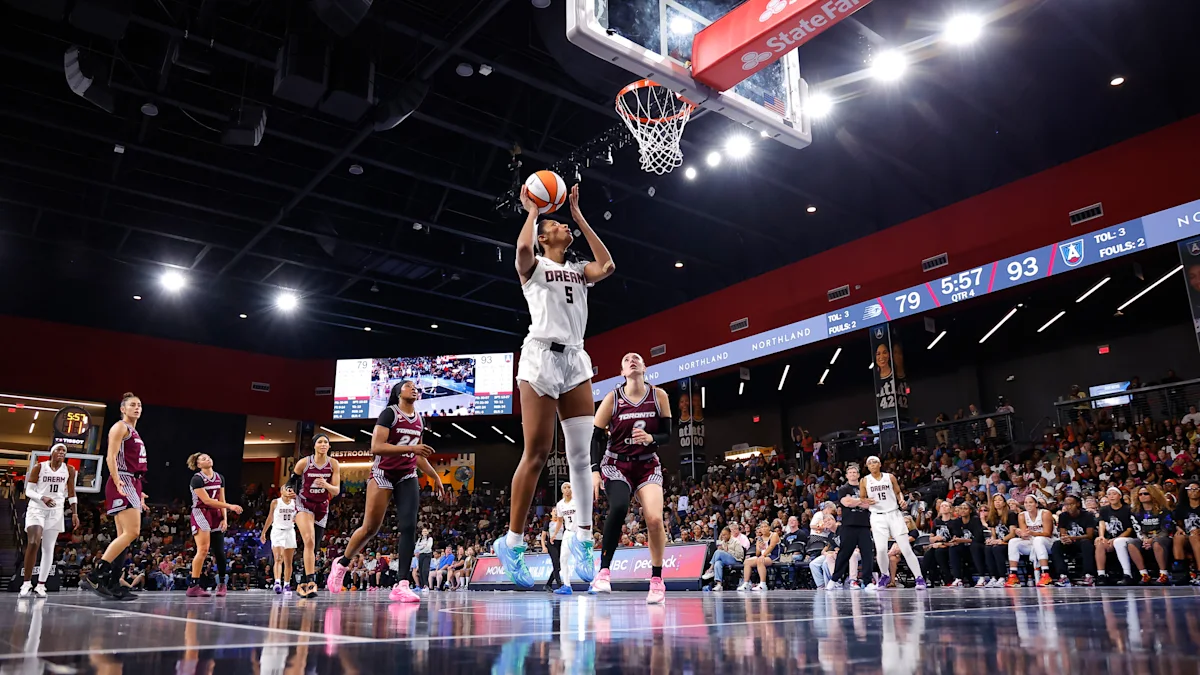
Atlanta Dream games at Gateway Center Arena are often described in a similar way, one that president and chief operating officer Morgan Shaw Parker used again last week.
"I can't really describe it," she said. "It's like passing a plate of food with your family and your friends in the backyard. There's also an amazing concert going on, and holy cow, the basketball is insane."
The Dream have proudly touted sellouts of said party for three consecutive seasons. But it's a misnomer, a positive public-relations twist few probe too deeply. Because not all sellouts are built the same, and that fact is about to smack everyone in the face at the worst possible time.
It is looking more and more likely the Dream will hold WNBA Finals games at their 3,500-seat arena in College Park , rather than move them into a larger location. Meanwhile, the rest of the series will take place at Chase Center, where the Golden State Valkyries have sold out every game of their existence with a league-best average attendance of 18,064.
It's intimate versus intimidating. The Atlanta swing of the Finals is about to be mostly friends and family only. No plus-ones allowed. Maybe that works at a Traitors-style dinner party. It doesn't in the WNBA Finals amid an era defined by massive attendance numbers and viewership marks jumping off the bench for a growing league.
Holding games at Gateway is a disgrace, for both the Dream and the league, and overall a bad idea.
Surely, the Dream head honchos aren't all that happy about it, either. They need to grow and support a fan base ahead of moving into State Farm Arena full-time beginning in 2027. Though Shaw Parker said all games, including playoffs, will be held there in the multi-year agreement, the Dream's official press release specified only the 25 regular-season games.
They will miss out on massive championship-level ticket revenue, suite sales and merchandise money from having more people in the arena. Even the tickets they can sell won't equal 3,500. Players will receive comp tickets, and the large media contingent — including broadcast TV partners — covering the Finals will need a place to go. The arena is one level, with limited bar-style seating up top. One basket is courtside seating only.
Shaw Parker said last week every game at State Farm Arena, where they hosted the first round and semifinals, will be a learning opportunity "for what this market will bear" in terms of ticket price points.
But that experiment never received its best test. Nor will a Finals berth help fill out a base that will continue to come to games in downtown Atlanta next year. They always used to say, come to one game and you'll see how exciting it is. You'll want to come back.
Atlanta is missing that chance, despite employing one of the most well-known young talents in the game and building a roster they knew could be in this position.
It's in some ways a kerfuffle of their own making. The Dream used to play in State Farm Arena when it was named Philips Arena, from its inception as an expansion team in 2008 through 2016. The latter 2010s were a tough time for the WNBA, and many teams downsized. The Washington Mystics play at CareFirst Arena, which seats about 4,200. The Aces are a middle child, playing in the 12,000-capacity Michelob Ultra Arena. Most others are in NBA arenas as partners of the local NBA team.
Here's where the Dream find themselves in the bind that's going to cost them. They can't come to a simple agreement to fix this since, as one of the few independent WNBA franchises, Atlanta has no partnership or overlap with State Farm Arena or the main tenant, the NBA's Atlanta Hawks. They individually leased the arena for games they believed could make it worth the deal and did not conflict with other events.
Five games this year were sellouts of 17,044; two against Caitlin Clark's Indiana Fever, two against the reigning champion Las Vegas Aces and another against the Chicago Sky, Reese's former team. The sixth, against the Toronto Tempo in June, listed a total attendance of 9,685.
The Dream were able to move the first-round and semifinal dates to State Farm Arena without overlapping the Hawks. The Dream only sold tickets in the lower bowl and listed attendance at around 9,600 in each of the three games, which were labeled as sellouts.
A Sombr concert is scheduled for Oct. 22, the day of Game 3. The Hawks host Houston on Oct. 24, the day of Game 4, in their regular-season home opener, and host Cleveland on Oct. 29, the day of Game 6, in the third game of the home schedule. The Hawks averaged 16,355 fans per game in 2025-26, and started strong with a sold-out 17,811 at their home opener.
It does not behoove either party to upend their own highly intricate logistics to bend around the Dream when they aren't partners in either ownership or arena tenants. This isn't a charity wherein people are loud enough on social media to disrupt those with better planning and awareness. The Valkyries could boot Doja Cat to a contingency date because they are under the NBA's Warriors' ownership group, and they own Chase Arena.
The WNBA Finals schedule went out to teams in December, and the Dream set themselves up to make it to the end. They traded for Reese as their missing piece in April, as soon as they could following the delayed collective bargaining agreement (CBA), and signed DeWanna Bonner on Aug. 27 after the veteran agreed to a buyout with the Phoenix Mercury.
It is unclear how long the Dream have been in discussions with State Farm on the use of their arena, or with other locations around the city. The only correct answer is since January. Anything else is a dereliction of duty for a franchise attempting to become one of the best in the league and solidify itself in a crowded Atlanta space.
It's understandable they want to keep things the same for the players instead of moving elsewhere, as they seek the first WNBA championship in franchise history. They were swept in all three Finals they reached in 2010, 2011 and 2013.
To win is not only meaningful for the players individually, but the franchise collectively as it continues down its five- and 10-year plan. Arguably, it's ahead of schedule. Yet again, it could fall back behind by keeping potential fans away from seeing its home team clinch a historic championship.
The Dream touted all week how they built it. It's looking more and more like they won't be able to see if the people will come.
Topics in this story
Gathered from external sources. Rights to this text belong to whoever originally published it.